







Last week, Sunny Mehta and the New Jersey Devils made a fairly big free agency splash. Desperate for a top six winger, the team signed Anthony Mantha to a two-year, $4.75M AAV contract. Coming off a career year with 33 goals and 64 points, the hope is that Mantha can be the top scoring winger that Jack Hughes hasn’t had since Tyler Toffoli was traded during the 2023-24 season.
I really like the move. It’s low-risk given the term and the cap hit, and it’s high-reward considering what Mantha is capable
of. He’s always been a player who, while far from bad, has never been able to put all his tantalizing tools together to form a true difference-maker of a player. He’s massive, he can skate very well, and he’s got great hands. That sounds like it should add up to being an impact player to me, but until last season with the Pittsburgh Penguins, that was never really the case. But credit to Mantha, he kept plugging along until finally producing that big year that everyone knew he was capable of. And now that he’s in New Jersey, Mehta, head coach Sheldon Keefe, and the rest of the organization must figure out how to help Mantha maintain that level of play for the next two years.
Since Mantha played in Pittsburgh last season, he skated in a ton of games against the Metropolitan Division. And now that he has joined the Devils, he’ll do that again this year. So with that being the case, I thought it would be helpful to take a look at how Mantha fared against his division rivals a season ago (with the obvious exceptions of Pittsburgh and New Jersey). This is especially important considering how much New Jersey struggled against in-division foes in 2025-26, with a 7-17-2 record against the Metro. It’s true that the Metro looks different, with teams like the New York Rangers and Washington Capitals improving by quite a bit on paper, so it’s not like this is a perfect data set to project how Mantha will do this upcoming season. That being said, these teams are largely the same, and if the Devils want to return to the playoffs, one of their top priorities has to be figuring out how to avoid getting run over by Metropolitan squads for a second straight year.
What was Mantha’s production like against the Metro? What about his underlying numbers? Who was he mostly matched up against? Are there any patterns we can find that might tell us how Mantha can keep up the pace he set last year? We’ll try and answer all of that today as we take a closer look at the newest Devil. Note: All advanced numbers below come from Natural Stat Trick, and reflect 5-on-5 play.
Let’s begin:
Carolina Hurricanes
Music to the Devils’ ears: They’ve found a player that can produce against Carolina. Mantha scored an impressive three goals in four contests against Carolina last season, to go along with one assist for four points in four games. The fact that he did so while averaging only 14:29 per game is even more impressive. Given how much trouble New Jersey has had with the defending champs in recent years, they really need Mantha to keep it up.
Perhaps even more impressively against a team like Carolina, Mantha largely controlled the run of play when he was on the ice. He had one great game, one good game, one breakeven game, and one bad game. The encouraging thing to me is that he did it against a wide variety of competition. He wasn’t always matched up against depth, there were games where he drew one of the Hurricanes’ top six lines or top defense pair. His one clunker came against the Stankoven line, but he got his revenge against them in the next game.
Columbus Blue Jackets
Not as much goal-scoring against Columbus, but Mantha still did post a goal and three points in four contests. Solid production in 15:17 of ice time on average.
Mantha got better against Columbus with each passing game. He saw a LOT of Ivan Provorov and Cole Sillinger. And I’m encouraged that his best game came against Columbus’ best players, especially reigning Norris Trophy winner Zach Werenski.
New York Islanders
Mantha only played three games against the Islanders last year, but he made them count. He popped in three goals and added two helpers for a very strong five points in three contests.
Mantha didn’t just put up empty-calorie points either. He absolutely steamrolled the Islanders whenever he hopped over the boards. Granted, he didn’t always do it against the stiffest of competition, although he did perform very well against rookie phenom Matthew Schaefer. But regardless of competition, Mantha was an unstoppable force against the Isles in both traditional production and advanced numbers.
New York Rangers
Mantha isn’t slowing down. Against the Rangers last season, he averaged a point per game, scoring three goals and adding one assist in four contests. It’s also against the Rangers that we see Mantha average by far his most ice time yet.
As far as his underlying numbers go, it was a weird season series against New York for Mantha. He alternated incredible games and despicable games. He saw a boatload of Vlad Gavrikov. And he also saw top six competition for the first two matchups and bottom six competition for the last two. Very bizarre.
Philadelphia Flyers
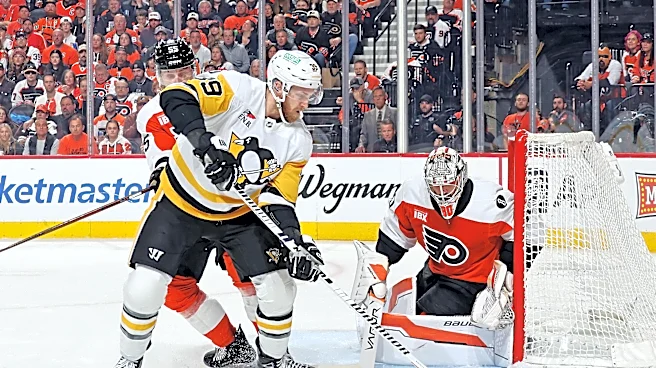
Here we finally see Mantha kept out of the goal column. In four games against the Flyers, Mantha did not find the back of the net once, although he did manage to contribute with three assists in those four contests. Mantha also matched up with Philadelphia in the first round of the playoffs, where he was held to one measly assist in six games. So in all, Mantha posted zero goals and four assists in 10 games against the Flyers last season. Not great.
The good news about Mantha’s performance against the Flyers is that, while his raw production wasn’t great, his play-driving numbers were. Mantha controlled puck possession in every game he played against Philadelphia in the regular season. Not only that, he also did it largely against tough competition. Travis Konecny was a very common opponent. So were Sean Couturier and Jamie Drysdale. Those aren’t truly elite players, but they’re quality competition, so the fact that Mantha controlled the game against all of them is promising.
Washington Capitals
Mantha only played two games against Washington this past season. But he made them count, scoring in each game despite very limited ice time.
Not much sticks out here, just a couple of middle of the road games as far as advanced numbers go.
Evaluating The Past To Project The Future
In all, Mantha played 25 games against the Metropolitan Division last year, registering 12 goals and 22 points. If you can believe it, the Devils were actually the team that slowed him down the most a season ago, holding him to just a single assist in four games. So if you take out his numbers against New Jersey, then Mantha was exactly a point per game player against Metro teams last season, with 21 points in 21 contests. That’s excellent production, which New Jersey desperately needs on their roster.
His play-driving metrics looked pretty solid on a game-to-game basis as well. There were some clunkers mixed in to be sure, but by and large he held his own against whatever came his way.
So are there any conclusions that we can draw and perhaps take into 2026-27 for Mantha? I believe there are a few:
- Mantha did not consistently match up against elite competition night in and night out. This might be a bit worrisome considering he is likely to begin the year on Jack Hughes’ line, who is sometimes a target of opposing teams’ top units. That said, Mantha did mostly hold his own against the elite competition he did face a season ago. Plus, Nico Hischier usually takes the elite competition himself whenever Sheldon Keefe can manage it. This leaves the Hughes line to do battle with secondary competition a lot, which might suit Mantha quite well.
- I was surprised at the relative lack of ice time Mantha got in Pittsburgh last season. It’s not like he got fourth line minutes, but I was expecting him to settle around the 17-18 minute mark in terms of average time on ice. Instead, Mantha was generally in the 14-15 minute range per game. So if the idea is to put him on the Hughes line, Mantha is going to need to get used to playing more minutes.
- But then again, will he? Of the 12 goals he scored against Metropolitan teams a season ago, only two of them were on the power play. In fact, Mantha only averaged 1:58 of power play ice time in those contests, which seems like PP2 levels of ice time to me. This tells me two things. First, he doesn’t need abundant power play time to be a prolific goal-scorer. And second, there is potential for growth here if Mantha can find his way onto the first power play unit.
- Mantha seems to have versatility in that he can produce against elite competition, but can also thrive in a depth role. In Pittsburgh last season, his most common linemates were Justin Brazeau, Tommy Novak, and Evgeni Malkin. In other words, Mantha made it work with middle six teammates. So while I do think that it would probably be a bad sign if we see Mantha on the third line for an extended period next season, based on the numbers from 2025-26, it’s also possible he could perform quite well in such a role. It seems like Plan A should be thriving on the Hughes line, but don’t discount a solid Plan B being slotting into the third line with Cody Glass and bulldozing lesser competition.
There might be a few more, but these are the most important takeaways to me. I am encouraged that Mantha contributed in both the traditional stats and advanced metrics. He doesn’t seem like a player who can drive a top line all on his own, but with elite play-drivers such as Jack Hughes and Jesper Bratt, he could very well be that complimentary piece that puts New Jersey’s top six in a great spot.
Your Take
What do you think of Anthony Mantha’s performance against the Metropolitan Division from a season ago? Are you encouraged by the numbers he put up? Is there anything that concerns you? What would you like to see more of from Mantha in 2026-27? As always, thanks for reading!