



Bob “Sarge” Kuzava was a left-handed pitcher who found success with the New York Yankees during a career in the majors that lasted a decade and saw him suit up for eight different teams. Kuzava, pronounced koo-ZAH-vuh, was born and raised in Wyandotte, Michigan, a town about 15 miles outside Detroit that now features a baseball field named in his honor.
Kuzava’s biggest claim to fame was being a valued swingman for Hall of Fame manager Casey Stengel during the Yankees’ early-1950s dynasty. In fact,
the southpaw became the first pitcher to earn a save in back-to-back World Series clinching games, turning the trick to close out Subway Series showdowns with the New York Giants and Brooklyn Dodgers in 1951 and 1952, respectively.
Robert Leroy Kuzava
Born: May 28, 1923 (Wyandotte, MI)
Died: May 15, 2017 (Wyandotte, MI)
Yankees Tenure: 1951-54
Signed by Cleveland before the 1941 season out of St. Patrick High School in Wyandotte, Kuzava reported to Class-D Mansfield in Ohio. He performed modestly enough at age-18 to get the bump in 1942 to Class-C Charleston, where he posted a terrific campaign. Impressing both his organization and the fans in West Virginia’s capital, Kuzava went 21-6 with a 1.72 ERA and 1.145 WHIP in 235 innings.
However, Kuzava’s baseball career would not fully begin until after military service. Able men throughout the sport joined the fight in World War II, and Kuzava entered the U.S. Army in 1943. He served through 1945, focusing on military policy and spending two years overseas in Burma (now Myanmar), India, and China. When speaking about his time in the service, Kuzava said he was fortunate to see little, and no heavy, action but was nonetheless simply happy to survive and make it home.
After returning from the service, the left-hander had a solid season in Class-A for the Wilkes-Barre Barons, one of the predecessors of the Yankees’ current Triple-A club. Playing alongside future big leaguers like Ray Boone (Aaron’s grandfather), Kuzava went 14-6 with a 2.36 ERA in 217 innings, earning his first taste of the big leagues in a couple innings as a September call-up for Cleveland in 1946. While Kuzava did not make the club out of spring training the following year, he again got a few more cups of coffee in 1947, appearing in four games. Instead, most of his time was spent in Baltimore, as the O’s were a Triple-A affiliate for Cleveland in their final years as a minor-league club before the St. Louis Browns came to town and became the modern Orioles.
Cleveland eventually dealt Kuzava to the White Sox following the 1948 season as part of a trade including Ernest Groth for Frank Papish. This provided Kuzava with his first full season in the majors. In 1949, Kuzava appeared in 29 games for the Pale Hose, posting a 10-6 record with a 4.02 ERA while making 18 starts, good enough to earn him a single AL Rookie of the Year vote (the Browns’ Roy Sievers took home the honors with 10).
Kuzava started the 1950 campaign with Chicago but was traded in May when the White Sox packaged him alongside Cass Michaels and Johnny Ostrowski in a trade to Washington for Eddie Robinson, Ray Scarborough, and Al Kozar. The parts of two seasons that Kuzava spent with the Senators got interrupted by a torn Achilles. The injury occurred when Kuzava attempted to cover first on double play and got stepped on by former White Sox teammate Nellie Fox.
The extent of the injury was not known to the Yankees and general manager George Weiss, who acquired Kuzava at the then-Trade Deadline on June 15, 1951.

In exchange for Tom Ferrick, Bob Porterfield, Fred Sanford, and some cash, the Yankees got a still-on-crutches Kuzava. However, the Yankees needed a lefty reliever and once recovered, Kuzava quickly became an important arm for Stengel’s club as a bullpen arm and spot starter. With New York in 1951, Kuzava went 8-4 with a 2.40 ERA appearing in 23 games and making 8 starts.
Kuzava’s earn-your-pinstripes moment arrived during the 1951 World Series against the crosstown rival Giants. With a chance to clinch the Yankees’ third consecutive championship in Game 6 at Yankee Stadium, Kuzava made his playoff debut in a helluva spot: the ninth inning with the bases loaded after three-straight singles off Johnny Sain, none out, and the Yanks holding a 4-1 lead. Stengel opted for the lefty despite a pair of right-handed batters due up next in future Hall of Famer Monte Irvin and recent “Shot Heard ’Round the World” playoff hero Bobby Thomson due up. The move was called “perhaps as deep and mystifying a piece of managerial strategy as any world series has seen,” by the New York Times. He hadn’t pitched in a week and a half.
Per SABR, Stengel told an admittedly nervous Kuzava to get the ball over and make the Giants hit it in the air. That is exactly what Kuzava would do. Irvin flew out to left, as did Thomson. Two runs scored to trim the lead to 4-3, but both Kuzava and his skipper were happy to trade them for outs. Then Kuzava preserved the Yankees championship by recording the final out against another righty, pinch-hitter Sal Yvars, who almost found the outfield grass until Hank Bauer who made a game-saving, diving catch.
That moment gave Kuzava the save and secured the Yankees’ three-peat, a feat only matched by the 1936-39 Yankees, the the 1972-74 Oakland A’s, and of course the more recent 1998-2000 Yanks. This particular dynasty wasn’t done yet, however, as they had their sights set on breaking the record held by those Lou Gehrig/Joe DiMaggio-led late-’30s teams.
The left-hander continued serving as an important bullpen arm and occasional starter over the next few seasons. In 1952, Kuzava won eight games and posted a 3.45 ERA across 28 appearances and 12 starts. The Yankees won another championship that season this time taking down the Dodgers in seven games.
For the second year in a row, Kuzava didn’t pitch in the Fall Classic until the very end. And wouldn’t you know it? The bases were loaded again. He was last on the mound on September 27th during a meaningless game against the Philadelphia A’s. Stengel had stuck with his top starters in Game 7, deploying each of Eddie Lopat, Allie Reynolds, and Vic Raschi before having to to turn to someone else when it was evident that Raschi didn’t have it.
So in came Kuzava with a 4-2 lead in the seventh, nowhere to put Hall of Famer Duke Snider, and the fans at Ebbets Field imploring “the Duke of Flatbush” and their Dodgers to finally drop the hammer on the hated Yankees. Remarkably, Kuzava stayed cool and induced a pair of popups from Snider and no less a luminary than Jackie Robinson himself. He needed a last-second bailout by Billy Martin to actually snare the second pop fly, but the inning was over with the Yankees still up by two.
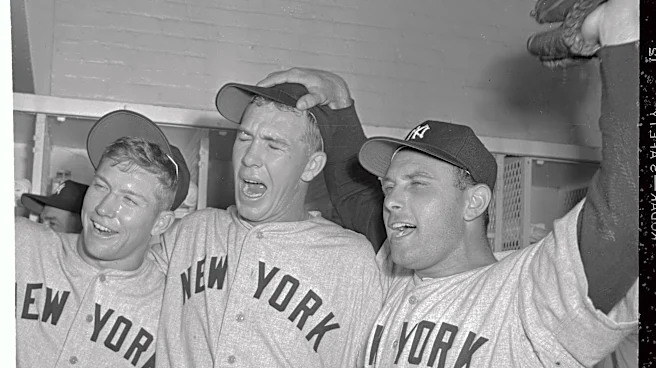
A high throw by Gil McDougald on an error with one out in the eighth gave Brooklyn two more cracks at tying the game off Kuzava. The unflappable southpaw instead struck out pinch-hitter Andy Pafko and got a fly ball from Carl Furillo to Gene Woodling just shy of the warning track in left. The final inning was the least dramatic, Kuzava retiring the side in order and ending it on a fly ball from Pee Wee Reese to Woodling in left. A euphoric Yogi Berra hopped aboard hit batterymate’s back in the celebration.
That Game 7 cemented Kuzava’s place in history. Although the save statistic was not yet established, he became the first person in baseball history to earn a save in back-to-back World Series clinching games. Oakland’s Rollie Fingers almost accomplished the feat, but Darold Knowles got the save for the A’s in 1973, sandwiched between Fingers’ saves in 1972 and 1974. Will McEnaney of the Cincinnati Reds become the second pitcher to accomplish this after closing the doors in 1975 and 1976.
There has only been one pitcher to top Kuzava and McEnaney and, of course, it was another Yankees legend: Mariano Rivera. Mo earned the save in the clinching games of the 1998, 1999, and 2000 World Series, extending the Yankees’ dynasty nearly 50 years after Kuzava inked his name in the record books.
Kuzava stayed with the Yankees for the 1953 season, another solid year in the Bronx resulted in a 6-5 record with a 3.31 ERA. The team continued rolling as well winning the World Series in six games over the Dodgers; Kuzava again pitched just once, but this time it was just a third of an inning in the Game 5 victory. Reynolds relieved Kuzava for the save in that game, and then collected the win in relief of Whitey Ford for the clincher in Game 6. Martin’s walk-off single secured the club’s fifth consecutive title, a streak that remains unmatched to this day.

In 1954, Kuzava’s role in New York began shrinking as age and mileage started catching up to him. Fresh off the franchise move from St. Louis, the Orioles claimed him off waivers in August of that season, ending his Yankees tenure after four seasons and three World Series championships in the Bronx. In parts of four seasons with the Yankees, Kuzava went 23-20 with a 3.39 ERA and 13 saves.
Kuzava’s career then turned into the familiar late-career baseball shuffle many veteran pitchers experienced during that era. He spent time with the O’s, Phillies, A’s, Pirates, and Cardinals organizations while continuing to bounce between the majors and high minors. His best seasons were behind him, but Kuzava’s ability to provide innings and mentorship kept him around until 1960 when he finished up his career as a player-manager for the Charleston White Sox in the South Atlantic League.
As a manager, and after, Kuzava spoke out about the difficulties black athletes were experiencing at the time. Recalling the experience, Kuzava said, “I’d get phone calls from people threatening that if those guys played, they were going to do this or that. It was terrible. I’m talking 1960! We had Cubans whose skin was darker than the Blacks and they could live with us in the hotels. The Blacks couldn’t and those were the guys who went to war for us along with me and the other guys.”
Across 10 MLB seasons, Kuzava compiled a 49-47 record with a 4.05 ERA and 13 saves across 213 appearances. Often shifting between starting and relieving, Kuzava regularly did whatever managers needed him to do.
Following his time as a big leaguer and manager Kuzava spent another decade travelling the country scouting ballplayers. As his family grew and the strain of travel picked up, he decided to return to Wyandotte and started a career in the beer industry. In 2003, Kuzava was elected to the Polish-American Sports Hall of Fame. The three-time champion only passed away a few years ago, at age-93 in May 2017, one of the last living links to the heart of that particular Yankees dynasty.
Happy birthday, Sarge!
See more of the “Yankees Birthday of the Day” series here.