

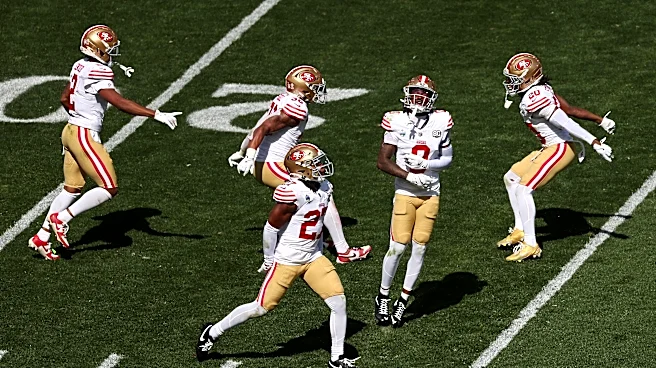
The San Francisco 49ers “upset” the Los Angeles Rams in Week 1. If you’ve watched sports long enough, you know that when the talk is so one-sided about one team, the other team usually prevails.
That was true in Australia in Week 1, but the Niners find themselves on the other side of the talking points in Week 1. After all, the Miami Dolphins couldn’t muster much of anything offensively against a Las Vegas Raiders defense that nobody would confuse with the top teams in the league.
The 49ers enter Sunday
as nearly two-touchdown favorites. Double-digit spreads are abnormal in the NFL. And while this one might feel like it’s warranted after the 49ers’ convincing 20-point win over the Rams, history suggests the Niners’ home opener will be a lot closer than the line suggests.
Here’s an uncomfortable stat that applies to the Dolphins: Week 2 road underdogs off a double-digit loss have gone 24-5 against the spread. Perhaps that means the 49ers only win by 10. Maybe it’s a surprising nail-biter decided by one possession.
Let’s let the data lead us to the right answer.
49ers’ pass offense vs. the Dolphins’ pass defense
49ers passing offense
Using a one-week sample size when said week was historically high-scoring can get you in trouble.
The only quarterback with a higher passer rating through 50 career games than Brock Purdy, provided they’ve thrown at least 100 passes, is Patrick Mahomes.
Purdy had 34 attempts against the Rams, with 12 of those coming behind the line of scrimmage and another 16 taking place within 10 yards. Kyle Shanahan was not going to let Myles Garrett beat him. The game plan seemed to anticipate Aaron Donald playing.
What fascinates me is how different the passing attack looks in Week 2, especially if Miami is without their top pass rusher, Chop Robinson.
A short passing attack shouldn’t be viewed as an indictment on the quarterback. There’s absolutely zero shame in being efficient and staying out of longer down-and-distances, which is precisely what the offense accomplished:
The Dolphins just faced a quarterback who had no interest in pushing the ball down the field. Kirk Cousins was 21-for-30, but only 1-for-7 on passes 10+ yards downfield, including two interceptions.
The Raiders are running into a different beast Sunday. Purdy’s Week 1 passer rating (105.6) was on par with his career number (104.0), as we mentioned above. As noted, Purdy’s yards per attempt was on the lower side, but he still managed to finish 12th in EPA per dropback and fourth in passing success rate.
Those short-yardage third downs allowed Purdy to lean on Mike Evans on obvious passing downs. All six of Evans’ receptions resulted in a first down or a touchdown. But if Week 1 is any indication, this will be a Christian McCaffrey, Deebo Samuel, and Kaelon Black game.
Dolphins passing defense
Why will the 49ers be more aggressive through the air this week? The Dolphins had the most total snaps played by rookies in Week 1, logging 439—158 more than any other team. Cornerback Chris Johnson, free safety Michael Taaffe, and linebacker Jacob Rodriguez were all rookie starters for the Dolphins.
Rodriguez is a fun player with instincts that have some pundits comparing him to a certain 49ers linebacker. While Rodriguez racked up 10 tops, he allowed both of his targets to be completed, including one for a touchdown. He’s better in zone when Rodriguez can get his eyes on the quarterback. He’s a great athlete, but McCaffrey on a choice route with a two-way go is an advantage for CMC against anybody, especially a rookie.
Eye candy. Much like in Week 1, messing with the defender’s keys will put the 49ers in advantageous situations. The touchdown Rodriguez allowed was on a play-action, and Jeanty leaked out of the backfield and past Rodriguez for a touchdown.
Johnson was targeted 9 times and held up well. Johnson limited the damage to five receptions for 48 yards. A couple of those came underneath against Michael Mayer. Don’t be surprised if we see George Kittle isolated underneath against one of the rookies, too.
What those stats don’t tell you are the touchdowns Johnson allowed. One came on a simple red-zone slant route from the slot. Hello, Mike Evans. The other was when the Raiders had two running backs in the backfield, a pony set the 49ers used last week with both Kaelon Black and Deebo Samuel, and Jeanty crossed his face on an angle route for a score.
Miami finished 12th in Week 1 in EPA per pass allowed. On average, Cousins had 2.9 seconds to throw. Cousins was pressured 32.3% of the time, about five percentage points below last year’s league average.
The quality of quarterback is drastically different, making it difficult to dig into the numbers. Cousins has a passing success rate of 46.3. Purdy has the sixth-best passing success rate and was second in catchable target rate. The Dolphins should be stressed on the back end far more than they were in Week 1.
Jeff Hafley blitzed Cousins 29% of the time but generated pressure only 29% of the time. Purdy should be comfortable and have time to throw. Purdy will probably see a little more man coverage than he did a week ago.
Player to watch: LB Jordyn Brooks
The former Seahawks linebacker has blossomed into one of the league’s best. He allowed all four of his targets to be completed, but only for an average of 4.8 yards. He reads the field well and has instincts to step in front of a Purdy throw — especially in that hook/curl zone. Steer clear of Brooks and any potential mishaps, and the 49ers should stay on schedule in the same manner they did a week ago.
Advantage: 49ers +1
49ers rush offense vs. Dolphins run defense
The uptick in dash motion led Kittle to coin a new nickname for the 49ers. The run game looked like 2023, which might be the biggest compliment you can give. No team had a higher success rate or more yards before contact than the Niners in Week 1.
The personnel didn’t change. The 49ers used a fullback on 42.2% of the time. For whatever reason, the league still refuses to steal that part of Shanahan’s playbook, as that figure was 36$ above league average.Going from 0.93 yards before contact to 2.79 on running back carries had to bring a smile to the coaching staff’s face. Motioning at the snap on nearly two-thirds of the snaps led to hesitation, and the Rams were all but blocking themselves.
That was against an experienced team with ample playoff experience.
The 49ers had five 10+ yard carries. The Raiders had four. The 49ers only had 6.7% of their runs stuffed — a gain of zero or negative. Nearly a quarter of the Raiders’ runs were stuffed. That’s how Las Vegas ended up with a success rate of only 40%.
The Dolphins missed 20 tackles against the Raiders. McCaffrey and Black forced five missed tackles. Deebo ran through a tackle on his lone carry. More importantly, the trio combined for 97 yards after contact.
The Dolphins matched up with the Raiders’ heavy personnel, which plays into the 49ers’ hands. Miami used base personnel on over 68% of their snaps, which was almost 39% above league average.
It’s easy to see why this game is being treated as a potential blowout when you look at how each team performed on this side of the ball a week ago.
Player to watch: DT Zach Sieler
Even on plays where the Raiders gained positive yards, Sieler can be seen doing his job and handling his man. He’s somebody the Niners need to be aware of. He lives on the other side of the line of scrimmage.
Dolphins pass offense vs. 49ers pass defense
Malik Willis’s reward as a starter is getting to throw to three rookies and a 5’9″ wide receiver. When your other options are playing their first NFL game, it’s no surprise that Willis targeted Malik Washington on a team-high eight times. Here’s how much turnover the Dolphins had: Washington ran a career-high 35 routes.
Last week, we saw Matthew Stafford have ten attempts over 10 yards. Washington had six receptions of 10+ air yards. The usage of each wide receiver hints at the 49ers’ secondary being tested more than it was a week ago.
My draft crush Chris Bell and 6’4″ rookie Caleb Douglas have a long way to go from a precision standpoint, but also showed promise. They can run and present different body types than the Rams’ wideouts.
Douglas had three first downs, with an average depth of target of 15 yards downfield. Ironically, Miami’s wideouts are going to test the 49ers more than the Rams, simply by where they attack the field.
Now, whether Willis will throw them the ball on time is a different discussion. Willis had a -0.35 EPA per play. He either didn’t trust his receivers, didn’t process what the defense was doing, or all of the above. Willis didn’t have a chance on a couple of the five sacks he took, but he bears the brunt on a couple of the other ones. All of the sacks happened when the Dolphins were in 11 personnel. Willis was only 2-for-7 for 18 yards when Miami was in 21 personnel.
Willis was at his best between 10 and 20 yards. It was a mess, for the most part, everywhere else. It looked like Willis was holding the ball, almost waiting to scramble. He scrambled on 13.5% of his dropbacks — the same percentage of dropbacks he was sacked on. For reference, Purdy scrambled on only5.5% of his dropbacks.
Willis can run, and we know that’s been the Achilles heel of the 49ers defense this decade. Willis ran for 39 yards, but had 28 after contact. He’s a threat, and arguably the biggest one in this game on this side of the ball.
This is a game where the 49ers’ pass rush should come alive. Raheem Morris only blitzed four times last week. Despite a low blitz rate, the 49ers generated 10 pressures while sending four or fewer rushers. That was the ninth-best mark in Week 1. That’s good news, as 75% of the pressure Willis faced last week came when the Raiders rushed four or fewer pass rushers.
Much of the pressure the Niners generated a week ago came from different slants, games, and movements up front. Another rookie starter for Miami is left guard Kaydn Proctor.
Proctor allowed three pressures. The Raiders got the best of Proctor on stunts, when he made obvious rookie gaffes. It’s something Morris should take advantage of, with players like Nick Bosa and Osa Odighizuwa commanding attention, allowing Keion White and Romello Height to stunt right past Proctor.
Player to watch: Malik Willis running
There are more paths to the Dolphins moving the ball through the air than 49ers fans want to admit. Most of them involve Willis extending the play and using his legs.
Advantage: 49ers +3
Dolphins rush offense vs. the 49ers rush defense
The Rams bailed the 49ers out continuously in Week 1 by throwing the ball. A 27-7 score looks great, but the Niners allowed the sixth-worst EPA per rush of the week and allowed the Rams to have a 44.8% success rate.
As they tend to do, Nick Bosa and Fred Warner saved a couple of drives with their impact plays. Had it not been for their heroics, the game would’ve been much closer.
Going from the Rams to this iteration of the Dolphins rushing attack is like going from the 64th floor to the 8th floor in a building. Miami, with a running quarterback, had the third-lowest rushing success rate and sixth-lowest yards before contact in Week 1. Their total of 16 yards before contact for the game matches two of the 49ers’ runs from a week ago.
Nearly 31% of the Dolphins’ carries resulted in no gain or a loss. That’s an ungodly amount, especially when you reference the Niners sitting at 7.1% in the same category.
Miami ran outsize zone on more than 75% of their carries. It’s a Bobby Slowik offense. There will be no surprises as to what’s going to happen here.
This week feels like the definition of “What goes up must come down” for both teams. The law of averages tells you that neither team will be as good or as bad as they were a week ago.
The question is, where does that show up? Process of elimination points us to one of the fastest players in the NFL: De’Von Achane. He couldn’t shake free from the Raiders a week ago, despite forcing three missed tackles. Don’t be surprised if Achane plays a bigger role in the passing game.
Earlier in the week, Slowik said, “We don’t want to leave a game with De’Von Achane only having 14 touches.” I’d venture to guess Dre Greenlaw, Jaden Dugger, and the 49ers safeties will be in some type of conflict involving Achane all game, with more designed runs involving Willis off that action.
The result of the game helped mask some deficiencies upfront for the 49ers. Save Bosa and a few plays of Gracen Halton, they were pushed around. It may not be as extreme this week, but it’s hard to get those images out of my brain, which leads me to think Miami can find some success on the ground.
Player to watch: Achane in space, and how the 49ers defense reacts to his speed.
Advantage: Dolphins. Making it +3 for the 49ers