
The mid 2000s were a pretty brutal period in Yankees’ history when it comes to one specific facet of the team: pitching. Andy Pettitte left the team in free agency after 2003, having not felt wanted enough
by the Yankees, and almost every notable pitching move the team made until his return in 2007 didn’t seem to go well. From Kevin Brown, to Carl Pavano, to literally Randy Johnson, no big-name fixes worked, and every year the Yankees seemingly exited the postseason not having enough good starters. Sure, there was the likes of Chien-Ming Wang and Mike Mussina, but that wasn’t enough.
During that period, the Yankees had several attempts to band aid up the rotation that worked to vary degrees of success. (Shoutout to Aaron Small.) Some of their names have a greater degree of name recognition than your normal, back-end/emergency rotation depth. One of those you may remember is Darrell Rasner.
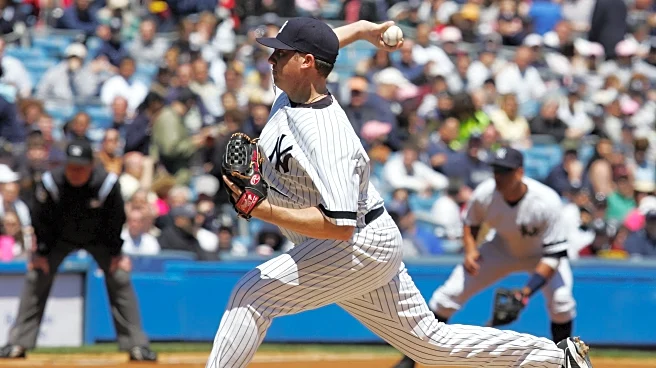
Darrell Wayne Rasner
Born: January 13, 1981 (Carson City, NV)
Yankees Tenure: 2006-08
Born in Nevada, Rasner attended the University of Nevada, Reno, where he played on the baseball team. His success — he was inducted into the college’s sports hall of fame in 2015 — there led him to be selected in the second round of the 2002 MLB Draft by the Montreal Expos.
Rasner worked his way through the minors over the next couple seasons, although he never quite made it to Montreal. That’s mainly because when he debuted in 2005, the Expos had moved to Washington DC and were in their first season as the Nationals. He was a September call-up that year and was solid in his 7.1 innings at the end of the season. However, he apparently wasn’t solid enough for Washington to want to keep him around, as they placed him on waivers the following February, from which the Yankees picked him up.
While he got a brief call up and one appearance in June 2006, Rasner was again mostly used as a September call-up that year. He put up a 4.43 ERA (104 ERA+) in 20.1 innings, and recorded his first career MLB win on September 3rd, holding the Twins to one run in six innings.

His solid run, good 2007 spring training, and the aforementioned mess that was the Yankees’ rotation led to Rasner getting the fifth spot in the rotation to start the 2007 season. The Orioles hit him pretty hard in his season debut, but Rasner was pretty solid after that. Over his next four starts, Rasner allowed just four earned runs in 20.1 innings. His next start was then opposite future Hall of Famer Tom Glavine at Shea Stadium on May 19th against the Mets. However, an Endy Chávez comebacker in just the Mets’ second at-bat of the game hit Rasner on the hand and fractured his right index finger. The injury forced him to undergo surgery and limited him to minor league appearances for the rest of the season.
After initially being released after 2007, the Yankees brought back Rasner on a minor league deal for 2008. He was recalled in May to replace an injured Phil Hughes in the rotation and once again put in a very solid stretch. In his first six starts of 2008, Rasner posted a 2.58 ERA and a 3.42 FIP in 38.1 innings. That was capped off by a career long eight-inning outing on June 6th, where he held the Royals to just two runs.
Five days later, though, Rasner was roughed up by the A’s and knocked out after just 3.2 innings. While he remained in the Yankees’ rotation through September, that day began a stretch where his ERA was 6.97 in 71 innings over 15 starts. With the Yankees going nowhere, they eventually replaced him with Alfredo Aceves and demoted Rasner to the bullpen.
After the season, Rasner ended up going to Japan, as he was picked up by the Tohoku Rakuten Golden Eagles. Following a rough 2009 season, he ended up carving out a decent career for himself in NPB. It culminated in 2013, where he helped the Golden Eagles win the Japan Series championship as a pitching staff-mate of future Yankees ace Masahiro Tanaka. Rasner retired after that and took a job with the Golden Eagles as an international scout. At least according to a LinkedIn page for “Darrell Rasner Jr.,” it’s a job he appears to still hold today.
I do not mean this as a slight in any sense, because Rasner was a perfectly serviceable pitcher for the Yankees at a time when they needed some, but if he showed up at an Old-Timers’ Day at Yankee Stadium, Rasner probably wouldn’t get anything more than a polite hand. That’s more than you could say for some other pitchers of that era, though.
See more of the “Yankees Birthday of the Day” series here.