





The Colorado Rockies are a team in the midst of a rebuild. With this in mind, the staff at Purple Row thought it would be useful to revisit the “State of the Position” series that we ran in March to see where things stand. We’ve asked authors of the spring articles to re-evaluate their earlier remarks with an eye toward the August 3 trade deadline.
The state of the Rockies’ starting rotation is, well, less than ideal as we reach the midpoint of the 2026 season.
To put it in perspective, Colorado’s
starters rank 30th in ERA, 30th in WHIP, 29th in K/9, 30th in H/9, and 16th in BB/9. Some of that is to be expected. Pitching at Coors Field is an inherently difficult challenge, thanks to the combination of altitude and the vast outfield dimensions.
Even with those caveats, however, the rotation has fallen well short of expectations. Too often, it has struggled to keep the Rockies in games, putting the club at an early disadvantage.
It wasn’t supposed to go this way.
The offseason plan, the first under Paul DePodesta’s front office, was built on a specific bet: durability. Tomoyuki Sugano, José Quintana, and Michael Lorenzen were signed to one-year deals precisely because they take the ball — the trio averaged 26 ⅓ starts a season over the previous two years. Paired with Kyle Freeland, they were supposed to guarantee that the Rockies never had to start someone who couldn’t hold a major league job. Instead, availability — the one thing this group was supposed to provide — is exactly what has fallen apart.
The injuries came for everyone
Quintana hasn’t pitched since late May, when a left elbow sprain sent him to the 60-day injured list. Sugano was scratched from his scheduled July 4 start and placed on the 15-day IL with back spams. Chase Dollander, one of the two real upside plays this rotation has, underwent an internal brace procedure on his right elbow on June 22 and won’t pitch again until 2027.
The backup depth got hit, too. Tanner Gordon (hip impingement) and Ryan Feltner (right ulnar nerve inflammation) both spent time on the IL, while McCade Brown has been sidelined by shoulder inflammation since late March without throwing a pitch this season.
The veterans who stayed healthy haven’t held up their end
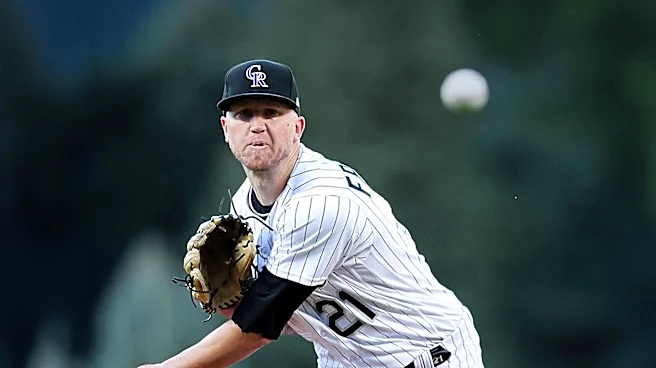
Freeland’s season has been the most difficult to watch. The franchise leader in career innings pitched carries an ERA above seven through 17 starts, and he hasn’t resembled himself since returning from a shoulder issue of his own. The 170 innings he needs to vest his 2027 option is, at this pace, out of reach. The lone bright spot came in June, when he became the second pitcher to reach 1,000 strikeouts in a Rockies uniform.
Lorenzen’s first half was, for stretches, the roughest of any starter in baseball. He leads the majors in hits allowed, and his home/road splits have undercut the theory that his eight-pitch mix would translate to altitude. There is a real trend worth nothing though: Over his last seven starts, he’s posted a 3.22 ERA. It’s not dominance, but it’s the first sustained stretch that looks like the pitcher Colorado thought it signed.
Then there’s Sugano, who has been the staff’s most reliable arm — and has done it backwards. The 36-year-old is 8-4 with a 4.80 ERA, built on a 4.14 ERA in seven starts at Coors Field, with most of the damage coming on the road. In a season where the organization is starving for any pitching lesson that travels, its most interesting data point is a command-and-mix veteran thriving at altitude. His back injury is reportedly minor, but every start he misses goes to someone who probably shouldn’t be making it.
Feltner has been the plan that actually worked
Feltner won a rotation spot out of camp, validating the offseason strength work that was supposed to put his lost 2025 behind him. Right ulnar nerve inflammation cost him five weeks in the middle of the first half — poorly timed for a pitcher re-establishing himself.
But he’s made the layoff look like a footnote. Since returning in late May, he has been arguably the Rockies’ most dependable starter, posting a 3.74 ERA across eight starts. He is also the only member of the Opening Day rotation under club control beyond this season — which makes him less a nice story than the lone bridge.
Dollander, the other camp arm with long-term upside, saw his season end before he could truly make his own case — leaving Feltner as the last man standing from what was supposed to be the rotation’s future-facing competition. Gordon has filled his familiar swingman role when healthy, while Antonio Senzatela and Jimmy Herget — the two spring wildcards — both settled into the bullpen, the outcome that always seems likeliest.

The future arrived early, ready or not
The injuries dragged the prospect timeline forward by months. Sean Sullivan (No. 8 PuRP) got the first call and struggled, surrendering 22 earned runs across 22.1 innings before being optioned back to Albuquerque — a reminder that the gap between the Pacific Coast League and Coors Field is wider than a plane ride.
Gabriel Hughes (No. 12 PuRP) is the more encouraging test case. Selected on July 1, the former first-round pick made the first start of his career Wednesday at Dodger Stadium — opposite Roki Sasaki — and turned in the kind of outing the final score undersells in a 4-3 loss. He velocity is up from a year ago, the strikeouts followed in Albuquerque, and he now has a three-month audition to prove he belongs in the 2027 rotation.
What the second half is really about
Here is the uncomfortable math underneath all of it: Freeland, Sugano, Lorenzen, and Quintana are all headed to free agency this winter. Felnter is the only starter who projects to open 2027 in the rotation. The most expensive free-agent pitching class since Jorge De La Rosa was never a foundation — it was scaffolding, and it comes down in October, no matter what happens between now and then.
That makes the trade deadline, not the standings, the story of the second half. Any healthy veteran becomes the front office’s clearest chance to turn this season into something with a longer shelf life. And the auditions — Hughes, Sullivan, maybe eventually Brown — become the competition that actually matters: the one for jobs that won’t exist until next spring.
The question in March was whether this rotation was better. The midseason answer is: barely, briefly, and not where it counts. The better question now is whether anything from the first half — Sugano’s Coors formula, Feltner’s return, Hughes’ arrival — is something the Rockies can keep.
Join the conversation!
Sign up for a user account and get:
- Fewer ads
- Create community posts
- Comment on articles, community posts
- Rec comments, community posts
- New, improved notifications system!
Please keep in mind our Purple Row Community Guidelines when you’re commenting. Thanks!