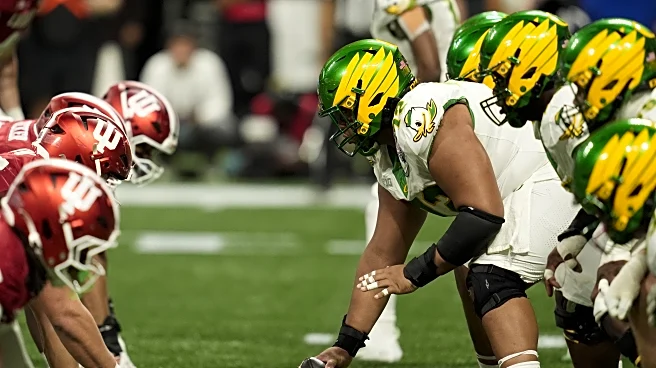

After the Hoosiers’ first possession of the second half the Ducks were facing a 42-7 deficit with only 8:52 left in the 3rd quarter. Realistically, even with perfect drive outcomes (touchdowns scored and
no points allowed) from that point on Oregon didn’t have time to come back and tie the game before time expired. However, neither team substituted starters at this point and the play calling remained approximately the same as it had. Having a larger sample size outweighs the score for the purposes of this one game until the score became 49-15, but for the full season numbers a number of possessions will be trimmed off.
This leaves Indiana with 9 meaningful offensive drives for each team, even with Oregon’s final possession of the first half being excluded due to the lack of time on the clock. From the least granular view, Oregon lost this game in the first half by committing 3 turnovers that directly led to 21 Indiana points. According to hythloday’s film study Oregon’s most likely path to victory was to stay within 7 points of Indiana in the 4th quarter when the Hoosiers’ lack of defensive depth could allow the Ducks to pull away late. That path became extremely unlikely after the opening pick-six, and was soon completely closed.
Upon examining the film completely, the primary deficiency for the Ducks in this game was in execution. The turnovers are the most obvious manifestation of this, but other key mental and physical errors gave the Hoosiers opportunities the Ducks simply couldn’t make up for. Indiana’s own execution was superb, and they also benefited from some fortunate bounces of the ball. There were four fumbles in this game (two by each team), and the Hoosiers recovered all four. I do have some criticisms of both of the offensive and defensive game plans, which I will get into below. Individually, I think each of these factors (execution, turnovers, and game planning) would have been enough to cost Oregon a close game. Combined, we have the second year in a row when the Ducks were blown out in a playoff game.
Offense
The team’s offensive performance was almost perfectly average, with the exception of an extremely poor explosive rushing numbers. Given explosive rushing was an issue all season, combined with the depth situation at running back, that is unfortunate but hardly surprising. It should also be noted a single 40+ yard run tilts the Yards Per Rush play, without that one carry the per play average is well below FBS median. With the benefit of hindsight it would have been better for Oregon’s offensive staff to aim for more of a 60/40 pass/run split, as throwing the ball was just as efficient but far more productive on a per-play basis.
The offensive line had cumulative error rates of 25% in the run game and 18.82% in pass blocking. This is a slight improvement over their performance against Texas Tech, similar in pass blocking to the first match up with the Hoosiers (which was 19.05%), but a big dip in run blocking from that week 7 game (which was 20%). This lackluster performance led to a striking decision at halftime with the team trailing by 28 points: starters LT #76 World and RG #74 Iuli were replaced by OT #59 Fox Crader and IOL #73 Kawika Rogers, respectively. Though the sample size for the reserves is somewhat small, their error rates are noticeably lower on my tally sheet. Based on his performance in the first half, it is my suspicion that had OT #78 Gernorris Wilson been healthy enough to play that RT #71 Harkey would have been benched as well.
A late game injury to RB #0 Jordon Davison in the Orange Bowl and RB #27 Jayden Limar entering the portal meant Oregon was extremely short-handed at running back for the first time all season. Further issues arose when RB #6 Noah Whittington was injured before the Peach Bowl and listed as “Questionable.” He did see the field, but only in obvious passing downs as an extra blocker, he had no carries or receptions. The most frequent ball carrier was deep backup RB #22 Jay Harris, who stayed with the team through this game despite also having entered the transfer portal (and apparently committed to Kansas State, a school on the semester system). Harris’ numbers (42.86% efficiency on 14 carries as a mere 2.43 yards per attempt) were not good, and the overall rushing numbers were buoyed by the 5 carries from RB #23 Hill and a single carry (on a read, as I had previously suggested) by QB #5 Dante Moore.
Despite the statistics I thought Harris did about as well as could be expected given the circumstances. His toughness shined through and I have several plays on my tally sheet where he turned a failure into a small success by churning his legs through contact. I would have liked to have seen a more even split in carries between him and Hill. If the plan had been to give the bulk of early carries to Harris to absorb hits before Indiana’s defense wore down late when Hill’s speed would be unleashed, the score quickly made that plan obsolete. I was also surprised none of the sweeps to WR #1 Dak. Moore that were seen early this season were brought out of mothball to spread the ball around a bit.
With a backup running back doing most of the work behind an under performing offensive line against a decent rush defense, it was never reasonable to expect Oregon to win this game on the ground. We saw some perimeter runs, but without the threat of explosive rushing between the tackles to manipulate the safeties this was ineffective against a playoff caliber defense.
(Film editors note: The director of this production, even more than last week’s, liked to push the envelope in how long he could wait until cutting to the regular view just before the snap. As such, I have been forced to include some clips that I otherwise would have discarded which leads to a few jarring transitions.)
Here is a representative sample of successful rushing plays:
(Reminder – you can use the button in the lower right corner to control playback speed)
- :00 – This is RB #22 Harris’ first carry of the game, and it showcases both his strength and his inexperience. Even with RT #71 Harkey unable to keep his hat play side of the defender, Harris still has a chance to get skinny through the C-gap between Harkey and TE #9 Ja. Johnson. Instead he takes a risk by bouncing outside, but his stiff arm keeps the corner at bay.
- :26 – Speedy TE #18 Sadiq motions into the backfield and could take the ball to the edge. When the DE follows Sadiq outside, Moore keeps on the read and follows RG #74 Iuli and Harkey on a QB counter. It’s not the most elegant looking run, but good for over 6 yards on 1st on and 10.
- :39 – Another version of counter, but without the read. Instead, Harris tries to lure the defense out of position with a partial motion into the boundary before the snap. The first puller is LG #75 Pregnon who turns the DE inside, but LT #76 World completely misses the MIKE. Harkey delays getting up to the WILL even when the DT attacks the A-gap and risks a holding call. Harris has to muscle forward for 4 yards.
- :53 – Same blocking, different formation. The WILL has coverage responsibilities and Moore is reading the DE, so he has to slow play this which buys time for C #72 Iuli to get to him. If Harkey can kick out the MIKE the speed of RB #23 Hill could make this a big play. The linebacker wrong-arms Harkey on the pull and gets his hands on Hill so the MIKE can hold this to a modest gain.
And examples of unsuccessful rushing plays:
- :00 – As drawn up on the board, Sadiq is meant to kick out the SAM while World and Pregnon double team the DE before one releases to seal off the WILL. This should give Harris a choice of gap to attack depending on the leverage Ja. Johnson gets on the SAM. Once the double team is split there is no choice to be made, the defender just has to hang on before the safeties arrive.
- :14 – This is 13-pers, with Sadiq in motion and TE #83 Saleapaga on the offense’s left while Ja. Johnson is lined up on the right. Indiana has countered with a fifth defensive lineman, in a two point stance on the offense’s right. Harkey and Ja. Johnson initially do well to seal this defender outside, but Iuli doesn’t release from his chip-and-up in time to get to the linebacker, who blows up the play by forcing Harris outside.
- :29 – Oregon only needs less than 2 yards on third down, and as long as he can build up momentum a big back like Harris should be able to fall forward forward even if a linebacker is left clean. Notice the nose tackle lined up directly across Laloulu, and the confusion it causes just as it did in the previous game. Iuli and Harkey need to combo the defensive end before one gets leverage and advances to the linebacker. Iuli does make contact once he makes sure the 0-tech isn’t attacking his gap, but Harkey completely ignores the defender who gets a tackle for loss.
- :55 – It’s the second half and the substitutes are now in the game. Immediate penetration allowed by Saleapaga interferes with the pull of RG #73 Rogers, which in turn interferes with Sadiq and their two assigned defenders combine for the tackle.
My biggest criticism of the coaching staff in this entire game was the lack of stretch and/or levels concepts run to the wide side of the field in the passing game. Film analysis has consistently shown this to be one best ways to attack Indiana’s secondary, and despite getting a second chance (now former) OC Stein and the offensive staff didn’t take advantage. There were still attempts to try to force quick throws toward the short side of the field than in the first. Unfortunately the opening play pick-six was one such example, the boundary corner had no safety help over the top but was confident it would be a short throw so he risked squatting on the out and was rewarded by both the quarterback and the play call. Rather than try to manipulate Indiana’s pass rush against balanced backfields (as hyth had noted), there seemed to be a plan to give QB #5 Dante Moore single read calls so he could get the ball out quickly. This played right into the hands of Indiana’s defensive strengths.
There were only 3 screen passes called, 2 of which were successful. The greatest contributor to failed passing plays continued to be pressure allowed by the line. While Moore was far from blameless in his accuracy and decision making, typically if his first read wasn’t open he never had the chance to find a second.
Below are examples of successful passing plays:
- :00 – The Hoosier’s are running a simulated pressure but showing an overload to the offense’s left, so Moore had to get the ball out quick. He gets the dump off away to WR #4 Benson before the dropping defensive end is out of his back pedal and the run after catch is enough for a first down.
- :25 – This play demonstrates the simplified reads to encourage a quick release from Moore. He fakes the hand off then bootlegs to his right where his options are WR #11 McClellan deep or Sadiq in the flat. With front side pressure coming from the defensive tackle the short throw is the QB’s only option (and McClellan was covered anyway), but fortunately Sadiq sheds man coverage and gets enough separation to for the first down.
- :47 – Even with only a four man rush the pocket is rapidly collapsing as the tackles are pushed back and the interior struggles with a twist. When the linebacker trails after Ja. Johnson Moore has no time to look to Sadiq streaking down the field. There is a gap created so that after he gets the ball to Harris to avoid a sack the running back can earn a first down with a run after the catch.
- 1:05 – This overload to the field side is a great call against Indiana’s defense, especially against the blitz. Obviously I’m not the biggest fan of perimeter screens, and the blitzing linebacker forces Moore to throw the ball behind #1 WR Dak. Moore so the timing is thrown off. If he’s going forward at the catch he might be able to duck under the linemen releasing downfield. As is, he has to improvise but his natural athleticism gets him a big gain.
And here is a sample of unsuccessful passing plays
- :00 – The protection holds and this is a good throw against the zone coverage, it’s just dropped. It was the only drop on my tally sheet, but could have killed a critical drive.
- :23 – It’s only a three man rush so there is plenty of time, but the slant to Dak. Moore is undercut by the linebacker and Sadiq hasn’t gotten separation. Finally the QB has to try to force the ball to Hill on a scramble drill, but it’s a narrow window and he air mails a wobbler.
- :45 – Oregon is trying to bait Indiana into thinking run out a 6OL formation (notice OL #56 Trent Ferguson on the right). Instead it’s a pass and the first look is to Ja. Johnson who is covered. Moore then looks deep where he has a shot to Benson. By then there is pressure in his face as World has knocked a defender down but not made sure he stayed there, then runs into his own team mate while Iuli has lost control of his man. The quarterback has to eat a sack or risk being hit during his throwing motion.
- 1:06 – Indiana shows pressure, then backs off but inserts the boundary corner. With the QB’s first read being to the field the line has to account for all rusher coming from the offense’s right. Moore is hit from his blind side just as he has looked off the linebacker to open window to Ja. Johnson and the hit affects the throw.
Defense
The rushing numbers are actually a notable improvement from the team’s first meeting, but there is no sugar coating the performance of the pass defense. Even before reading hythloday’s preview, my biggest anxiety going into this game was how the Oregonsecondary would handle needing to cover the three viable threats they faced in Indiana’s trio of wide receivers. The simple answer was: not very well. Indiana probably would have thrown more often if they hadn’t had such a big lead early in the game. Given just how efficient they were through the air, they could afford to burn clock by running the ball for modest gains by their strong backs before airing it out to move down the field.
The vast majority of Indiana’s ground attack was built on standard inside and outside zone blocking with no QB run threat. We saw none of the called runs for Indiana QB #15 Mendoza that extended drives in the first meeting, and I have only one QB run-read and RPO each on my tally sheet. Even the RPO was different than earlier this season; there was no mesh with the RB but Mendoza made a pre-snap read to throw quick rather than hand off in the low red zone. There were a couple of counter blocking plays run as well just to keep the offense on its toes. With a big lead in the first half, the Hoosiers seem to have made a reasonable choice to concentrate on chewing clock and not losing yardage when they ran the ball, so they stuck to their staple zone concepts.
Here is a sample of successfully defended rushing plays:
- :00 – This is a standard stretch play that the Hoosiers are running out of the pistol. At DE #10 Uiagalelei holds his ground while LB #54 Mixon and DT #52 Washington shed their blockers to try and catch the running back in a pincer. The back almost finds a narrow hole to squeeze through but DB #31 Thieneman has diagnosed the play and filled it. Field corner CB #7 Obidegwu helps clean up.
- :17 – Notice Thieneman signaling CB #5 Th. Johnson that as the receiver cuts back across the formation he has outside contain. The safety then uses his leverage to beat the receiver to the outside and cut off the back on the toss, while pursuit from Uiagalelei and CB #4 Finney ensures there is no chance to cut back.
- :32 – This was the only time all game I saw Mendoza keep on a live read, something the Hoosier’s hadn’t shown recently. Consequently it makes sense that Uiagalelei is crashing on the running back. Boettcher has kept backside contain as Thieneman has the play side responsibility. He makes a textbook open field tackle on the quarterback.
- :55 – Lacking depth at tight end, Indiana has brought on 6OL, their largest WR, and stacked two tailbacks in the I-formation for short yardage. Washington jumps outside and turns the runner back in despite some Big Ten blocking and DT #50 Gray pursues down the line to sandwich the runner with Uiagalelei (whose blocker is enthralled by his white jersey…).
And examples of unsuccessfully defended rushing plays:
- :00 – In 2nd and long Oregon has taken OLB #9 Purchase off the line of scrimmage and has him playing from a middle linebacker position, giving them another defender in coverage with Mixon widening to the field. Mixon has to honor a possible RPO, and this creates a natural gap to attack when the TE slices across the formation. By the time Thieneman can come down from his safety spot it’s already a 4 yard gain, and as had been frequently demonstrated on film the strong RB muscles forward for some extra yards.
- :23 – The defensive front has clogged all the inside running lanes. Again, Mixon and Thieneman combine to keep contain but the back pushes forward for a successful play.
- :38 – We see the heavy formation in action again here. Mixon is pushed backwards immediately by the TE and OLB #44 Tuioti can’t hold against the double team. This leaves a blocker free to take on Boettcher, but he escapes to grab the runner legs and combine with DB #21 Flowers to save a touchdown.
- :57 – On this outside zone play Gray (lined up as 0-tech true nose) fails to get his helmet play side. This opens up a cut back lane for the running back, who then nimbly redirects after Jackson reacts to his initial move. This might still be a modest gain but Purchase gets pushed around completely and loses his outside contain so he and Thieneman are now both in the same gap.
Since the first game between these two teams in Week 7 Indiana WR #80 Becker had emerged as perhaps the Hoosier’s best receiver. He has been especially good in the new passing offense they had evolved into in the last part of the regular season with less emphasis on RPOs. His physical abilities are such that hyth even recommended that CB #4 Finney shadow him wherever he lined up. The Ducks didn’t opt to do this (just as had been foreseen), but he also unfortunately left the game with a (hopefully minor) injury part way through and only recorded two catches (though both for over 10 yards). While Indiana WR #3 Cooper was held to very modest production, Indiana WR #13 Sarratt went off against Oregon’s secondary. Most frustrating for Duck fans (and staff no doubt) was that he was not running the same RPO routes he burned Oregon with earlier this year, but had his best game of the season so far in the new look offense.
Oregon brought more blitzes against Indiana than they did against Texas Tech, and this all aligned with what hythloday’s film study recommended. To summarize, the key to slowing Indiana’s passing attack is to bring extra rushers to pressure the quarterback, but also to call a coverage that will take away the hot read the Hoosier’s use to negate pressure. With a couple of exceptions, the execution of this tactic generally failed. The coverage called behind the blitz’s normally didn’t effectively predict where the hot route would be and left it open to be exploited so the extra rusher(s) were wasted. Now former DC Tosh Lupoi and his staff have to take the blame for this part of the failure. The bigger issue was that against the passing threats Indiana presented Oregon simply didn’t have the players in the secondary needed to hold up in Cover-1 man. Rather than sitting back in zone and giving Mendoza time to pick them apart, the staff took a risk in hoping their back end could hold up, but they simply couldn’t.
Below are examples of successfully defended passing plays:
- :00 – Oregon brings Boettcher as a 5th rusher from the offense’s left, which is also where the hot read is in the flat toward the boundary. The coverage has left this open with the defender back pedaling at the snap. Since the pressure has overloaded the side where the throw is going Boettcher is able to knock the ball down. Even a completion would only have been for a short gain. Notice the number 2 receiver open at the 30 yard line on the skycam angle. Under pressure the QB never had a chance to find him.
- :11 – In 3rd and long OLB #32 Wyatt uses pure speed to get around the edge and cause a fumble. The ball bounces right back into the left tackles grasp, who promptly loses control before it bounces again into Mendoza’s hands, depriving the Ducks a turnover opportunity. All the chaos still results in a major loss of yardage on the sack.
- :32 – Indiana is in the 6OL formation again, but this time as a set up for a pass. Immediate pressure from DT #99 Green and Purchase forces a check down. Rapid reaction from Boettcher holds the running back to no gain.
- :38 – Pressure is once again in Mendoza’s face as Gray comes right up the middle. He has no time to go through his progressions so he tries to force a throw into double coverage and ends up simply sailing the ball over everyone.
And unsuccessfully defended passing plays:
- :00 – In his preview hythloday noted that, even when healthy, he had yet to see Indiana WR #13 Sarratt show the ability to make a contested catch. So, naturally, having healed from playing hurt much of the latter half of the year he bails out his QB against a blitz by securing the ball with his hands away from his body where Obidegwu had no chance to break up the catch despite having his hands in position to do so. This was one of two contested catches for Sarratt on my tally sheet.
- :32 – The Ducks bring a fifth rusher by having Obidegwu blitz from the boundary. This means Flowers has to rotate over to cover Sarratt and he has surrendered outside leverage. Mendoza’s first read is to his left and once he sees the corner rushing he knows the defense cannot defend the out route.
- 1:02 – Finney didn’t shadow Indiana WR #80 Becker all over the field, but was matched up with him several times as the field side corner. Because of the blitz from Mixon the safety cannot help him inside. He does well in a one-on-one situation with the Hoosier’s best receiver, but the throw is so accurate it is just out of his reach.
- 1:18 – For all the issues that blitzing Mendoza created, this play shows that simply dropping back and playing coverage wasn’t a viable option either. Oregon only rushes 3 plays zone coverage. Mendoza has so long in the pocket he can wait until his tight end settles into a hole in the zone, turning second and very long to third and medium.