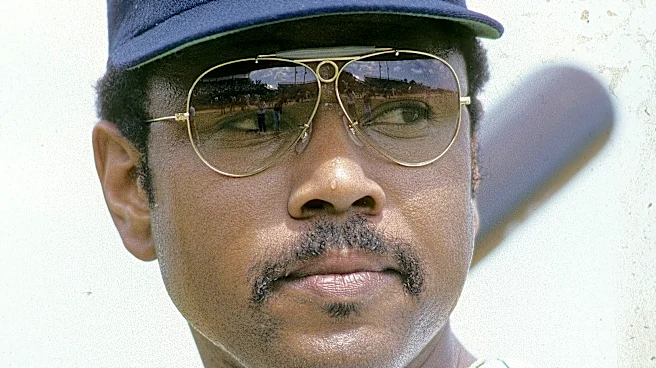

The baseball lifer may well be the most romantic of all baseball archetypes. While the superstar or what-could-have-been flameout grab more attention in the moment, in the final accounting, someone who quietly stays around the game long after the spotlight has faded is the one whose passion for the game draws the most admiration from the die-hard fan. 1996 Yankees World Series champion general manager Bob Watson accomplished a great deal in his baseball life. But perhaps his greatest accomplishment
was his staying power.
Robert Jose Watson
Born: April 10, 1946 (Los Angeles, CA)
Died: May 14, 2020 (Houston, TX)
Yankees Tenure: 1980-82 (also GM from December 1995-February 1998)
Bob Watson grew up in Los Angeles, CA, where he was a standout catcher at Fremont High School. Dodgers scout Tommy Lasorda came to watch him play in the 1964 city championships and poured cold water on the senior’s dream of playing for his hometown team. ”He told me I didn’t fit the Dodger mold,” Watson said years later. ”I told him that every chance I got in the major leagues, he would pay.”
The youngster instead signed with the Astros, moving off catcher to outfield and first base while rising through their minor-league system. The man they called “Bull” made his big-league debut at the age of 20 in 1966, spending the next few years shuttling between Houston and the minors before nailing down an everyday role in 1970. In all, he’d spend parts of 14 seasons with the Astros, establishing himself as a dependable all-around hitter. While his power numbers never wowed while playing in the pitcher-friendly Astrodome, Watson hit .295 and posted a sturdy 130 OPS+ during his time with Houston, making two All-Star games and receiving MVP votes in three seasons.
In 1979, the 33-year-old finally broke free of the moribund Astros, who traded him to a Red Sox team in the midst of a pennant race. He played some of the best baseball of his career, slashing .337/.401/.548 in 84 games. That performance drew the attention of the rival Yankees, who signed him to a two-year free agent deal the following offseason to replace Chris Chambliss as the team’s first baseman.
The remarkably consistent Watson had a typical first year in the Bronx, hitting .307 with an .825 OPS. That October, the veteran got his first taste of the playoffs and made the most of it, going 6-for-12 with four extra-base hits, though the Yankees were swept by Kansas City. Watson suffered a groin tear on Opening Day the following season, leading to a wilderness year in which he hit .212, his first sub-.288 mark in a decade, while appearing in just 59 games as he fell into a platoon role. With the Yankees once again reaching the postseason, though, he turned back the clock, hitting .340 and appearing in all 14 games during their playoff run. In Game 1 of the World Series, Watson hit a three-run homer in his first at-bat, a moment that resonated deeply.
”I played almost my whole career at Houston when they were bad,” he said after the game. ”When I went to Boston in 1979 they were in first place when I got there and ended up in third. Then I came here last year and we won 103 games and then got swept by the Royals. I longed to play in a World Series. I always dreamed of playing in the big fall classic. This is it, and to do a good job makes you feel happiness, satisfaction, all those good things. This game, without a doubt, is the biggest I played in my entire career and I played a long time looking forward to this moment.”
It didn’t hurt that the long ball came against a Dodgers team now managed by Tommy Lasorda, the scout who’d blown him off 17 years earlier. The Yankees would lose that series in six games and trade Watson to the Braves the next April. He’d hang on with Atlanta through 1984, including three years working under young skipper Joe Torre, finishing his 19-year career with 1,826 hits.
Immediately after hanging up his cleats, Watson transitioned to coaching, serving as the Athletics’ hitting coach for four years. The Astros then brought their longtime franchise mainstay back into the fold, first as assistant general manager and then, in 1993, as GM. Watson became the first Black man to hold the title of GM in the history of the American and National Leagues, a distinction he both acknowledged and contextualized. “It’s something the minority population can point to now and say, yes, there is a Black man, or a minority person, in a decision-making role for a major league club,” he said of his groundbreaking promotion. “But I don’t want to be categorized as a pioneer. I want to be categorized as a guy who was the right man for the job.”
After two years heading up the Astros’ front office, Yankees owner George Steinbrenner hired Watson away to replace Gene Michael as his GM when the visionary “Stick” finally got too fed-up with Steinbrenner to stay in the role. “[Watson] did an outstanding job in Houston and he’s a man that has always exuded class: as a player, as a baseball executive and as a human being,” Steinbrenner said in a statement. “He’s one of the most intelligent players we’ve had in my 22 years with the Yankees.”
Like many relationships Steinbrenner had with those working under him, the partnership with Watson would be both fruitful and rocky.
One of the first decisions Watson would be a part of making in a revamped Yankees’ front office would be among his most impactful, advocating for the outside-the-box hiring of Torre as manager. “Bottom line: Joe and I go way back,” Watson said years later of the managerial hire. “Joe was one of my idols as a right-handed hitter. I coached for him as an unofficial hitting coach when I played for him. He let me manage his last game, which was my last game before I retired. I wanted him as my first choice to manage the Yankees and the rest is history.”

In retrospect, the 49-year-old’s confidence that he would have the same “type of control” he had with Houston while working under the Boss was fatefully misguided. Watson and Steinbrenner quickly began a proxy war in the press that was as confusing as it was contentious. After reports the owner planned to fire the GM, Watson said he and Torre deserved to be shown the door if they missed the playoffs, adding of Steinbrenner, “he’s a very volatile man. But I hope he would be enough of a man about it to come and tell me.”
“He’ll know. If that happens, I will be enough of a man to tell him,” a befuddled Steinbrenner retorted back. Amidst the animus, the Yankees went out and won their first World Series since 1978, with the Boss threatening to fire Watson again during the ALCS.
The relationship between the two continued to deteriorate the following year, and the offseason after the Yankees were eliminated in the ALDS, Watson resigned. “I just couldn’t take the stress every day that I was going to get fired — the yelling and screaming,” he said later. The stoic GM was likely never going to be a long-term fit with the mercurial owner, and his premature departure stunted the credit he deserved alongside Michael as one of the architects of the Yankees’ most recent dynasty. Brian Cashman replaced him in early February 1998 and the rest is history.
Watson’s baseball odyssey continued as he became MLB’s VP of On-Field Operations, a position he’d hold for nearly 15 years, continuing to shape the game to which he’d devoted his professional life. He retired in 2010, continuing to stay involved with the game through the Baseball Assistance Team, which raises money for retired members of the baseball community. He passed away from kidney disease in 2020 at the age of 74.
In a lifetime spent in and around the game of baseball, Watson wore many hats. He was never any less than the dignified, proud kid who bristled at Tommy Lasorda’s oversight and would later voluntarily step off the hamster wheel of George Steinbrenner’s front office. On what would be his 80th birthday, join us in celebrating the singular legacy of Bob Watson.
See more of the “Yankees Birthday of the Day” series here.