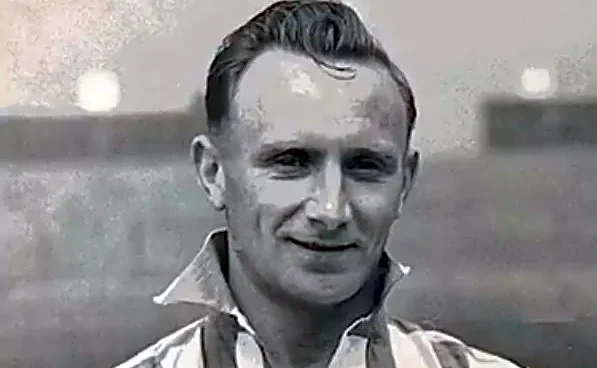






Arthur Wright was an ‘adopted son’ of Castletown. He was actually born in Burradon, Northumberland, on 23 September 1919.
In 1929 his family moved to Castletown and so began a Sunderland connection that would last fifty-six years.
Arthur’s early days saw him playing for Castletown Schools and Sunderland Schools. He also played for the famed Hylton Colliery Juniors, who spawned such talents as Jimmy Hindson, Harry Bell, George Hunter, Augie Scott, Bill Robinson, Ernie Taylor, Tony Cummings, Micky Lydon
and Harry Hooper.
Arthur was a prodigious schoolboy player and was the first County Durham lad to earn three England Schoolboy caps in one season at the age of fourteen, which really caught the eye of Johnny Cochrane and his backroom team at Roker Park, who signed him onto the ground staff in 1934.
What a time to be starting your career at Sunderland. Cochrane had built a fine team who ran the all-conquering Arsenal all the way to the last two games of the season in 1934/35 to finish runners-up. However, in 1935/36 they won the league trophy with the legendary forward line of Davis, Carter, Gurney, Gallacher and Connor.
Johnny Mapson would take over in goal from Jimmy Thorpe (who tragically died from injuries received on the field of play) in February of this season and would go on to play many games alongside Arthur Wright.
Bert Johnston and Charlie Thomson formed a powerful half-back line alongside Alex Hastings. Johnston and Thomson would be Wright’s half-back partners when he first broke into the team. The legendary Alex Hastings played in Arthur’s preferred position and, apart from being a Scottish international, he was an inspirational team captain who led Sunderland to the league championship. Arthur had a great player to learn from and aspire to in his early days at Sunderland AFC.

He made his debut for the reserve team at sixteen-years-old in 1936 and, as Sunderland followed up their league championship win in 1935/36 with their very first FA Cup win in 1936/37, Arthur was catching the eye with some classy performances for the reserve team.
Arthur Wright made his debut for Sunderland at Roker Park on 16/04/1938 aged eighteen-years-old. Injuries to Charlie Thomson and Alex Hastings saw him play left-half in a half-back line that included Bert Johnston and local lad Alex Lockie. In a hard-fought draw, Arthur was reported to have found the pace of the game quite tough, but had displayed solid positional play and got the ball under control very quickly.
From that one game in 1937/38, Wright appeared twelve times at left-half the following season. There was plenty of experienced competition in the half-back line as Hastings, Johnston, Thomson and Lockie vied for the three berths, with Hastings being the preferred left-half when available.
This season also saw the departure of manager Johnny Cochrane, with secretary George Crow taking over in a caretaker capacity, before ex-player Bill Murray returned as manager in March 1939. Murray would go on to manage Sunderland for all of Wright’s playing career.
The onset of WWII saw the league programme suspended in September 1939. Arthur enlisted in the Royal Engineers and, in between Dunkirk and D-Day, he served in Northern Ireland where he guested for Linfield and won an Irish Cup Winners’ medal, as well as playing in a representative match for the Irish League against the League of Ireland.
Arthur did make six appearances in the war years for Sunderland in a regional league programme between 1941 and 1944, designed to raise morale and keep some semblance of the game running. He actually scored six goals (including a hat-trick at York City), though he did turn out at inside-left in a couple of these games.

It was 1946/47 before the league programme resumed in full and Arthur made twenty-four appearances, scoring three goals. By the end of the season he had just about made the left-half position his own and was earning great reviews as a half-back who was solid in defence, with a real attacking instinct and a great ability to change the point of attack with sharp and accurate passing.
There also emerged a recurring theme regarding Arthur’s shooting, of which it is reported many Sunderland fans believed to be the hardest shot in the Football League.
Playing in front of Arthur on the left-hand side was Willie Watson and, at first, Eddie Burbanks and then Tommy Reynolds. Half-way through this season Len Shackleton joined the club and Arthur would play many games with Shack and Reynolds on the left flank over the next five seasons.
John McSeveny took the left-wing position from Reynolds in 1951 and Billy Elliott arrived in 1953 and became first-choice left-wing, alongside Shack at inside-left, with Wright often the source of sharp, accurate passes out of defence to his two left-sided attackers.
In 1946/47 Arthur became Bill Murray’s left-half of choice until the end of the 1953/54 season.
Arthur played only two games in the 1954/55 season, with his final game being on 14 March 1955 at Bramall Lane in a 1 – 0 defeat to Sheffield United.
By the time Arthur’s playing career had drawn to a close he was already involved with the coaching and training team.
Arthur made 283 appearances, scoring 14 goals between 1938 and 1955. His career was interrupted by the war years and, upon its resumption after the war, he spent much time as first-choice left-half in the expensively assembled Bank of England team.
His half-back partners included legendary figures as well as expensive names such as Alex Hastings, Bert Johnston, Fred Hall, George Aitken, Charlie Thomson, Ray ‘Bebe’ Daniel and Willie Watson.
International honours almost came Arthur Wright’s way after he had represented the Football League in two games in the 1948/49 season. There was much clamour for him to be given an opportunity at international level and, in 1951, he was called into Walter Winterbottom’s touring England side.
Unfortunately, his two young daughters were so ill he made the decision to stay at home and look after his family. He never got another opportunity to represent his country, but did become a bit of a celebrity as his decision to stay at home and look after his family endeared him to many people around the country (if not Walter Winterbottom), who flooded him with fan mail for putting his family first.
In an interview with the Shields Gazette in 1984, Arthur said of this incident:
“I decided to stay at home and help my wife look after the children and not getting an England cap is something I don’t regret under the circumstances.”
Arthur appears to have eased seamlessly into the coaching team at Roker Park upon hanging up his playing boots, where he is listed as “Trainer” in many of the team photos from 1955 to 1969.
He worked in this role in the latter days of Bill Murray’s tenure as manager and through the Bank of England scandal and Sunderland’s first-ever relegation – some might say cursed to live through interesting times!
During Alan Brown’s first spell as manager he was part of the backroom team that eventually saw the club promoted in 1963/64 and then remained in post through Iain McColl’s tenure as manager in the top tier, with Jim Baxter and all that came with him, including relegation battles. It must have been a challenging period to be part of the backroom team.
By the time Alan Brown returned in 1968, long-time trainers and club servants Jack Jones, Bill Scott and Arthur Wright were part of the fabric of a club that had often seemed in upheaval. They offered some stability and continuity behind the scenes, not just for first-team players but the much-vaunted youth team players as a succession of fine youngsters graduated to the first team.
By May 1969, following another relegation-threatened season, Alan Brown caused a minor sensation when he transfer-listed Bruce Stuckey and Cec Irwin, gave free transfers to George Mulhall and Ralph Brand, as well as club captain Charlie Hurley. He also gave a month’s notice to Arthur Wright, Bill Scott and Jack Jones.
Whilst Brown may have had the best interests of the club as his motivation for this, the way that it was done left room for criticism.
Brown had lined up his former coach at Sheffield Wednesday, Ian MacFarlane, and recently retired player George Herd as coaches and had little budget to keep the ageing Wright, Jones and Scott on the payroll.
Wright was just fifty-years-old and the sacking appears to have come out of the blue for all three men. It brought to an end almost thirty-five years of service to Sunderland AFC as a player and coach. Arthur Wright is believed to be Sunderland’s longest-serving employee.
Jones and Wright took the club to an unfair dismissal tribunal but did not win their case, although the tribunal did make mention of the manner in which the dismissals were carried out and that they believed Jones and Wright when they said that no explanation had been given for their sacking.
It was a bitter end to a long association with the Black Cats.
By the time the tribunal hearing took place Arthur Wright was publican at The Travelling Man pub in West Boldon, where he remained a very popular mine host for fifteen years before retiring in 1984.
On 27 May 1985, Arthur William Tempest Wright passed away aged sixty-six-years-old.
He played 283 games for the club, scoring 14 goals. His playing career spanned the Bank of England era, where he played with and against the most expensive and exciting players of his day. He was a much-respected member of the coaching team and held in high esteem by many connected with Sunderland AFC.
Such was his standing within the club, he was invited by Sunderland to be a special guest at Wembley for the 1973 FA Cup Final.