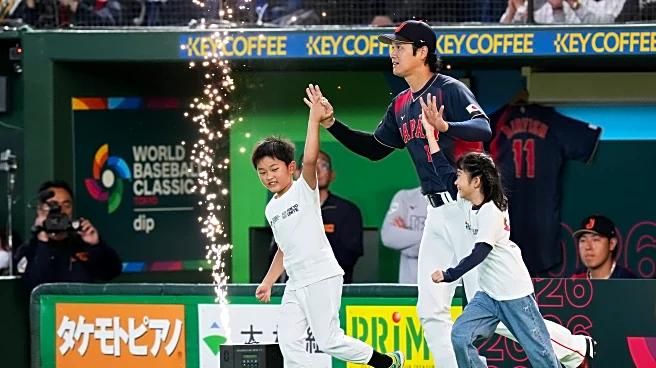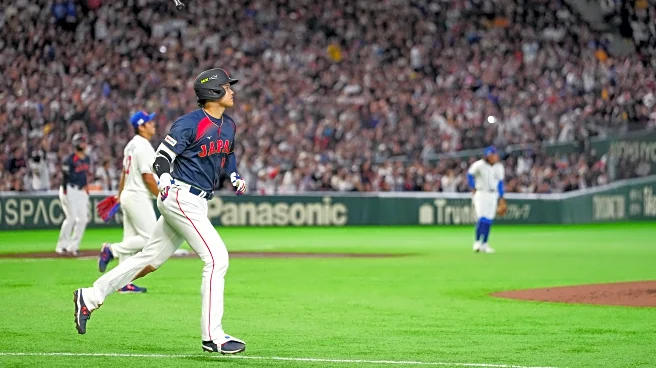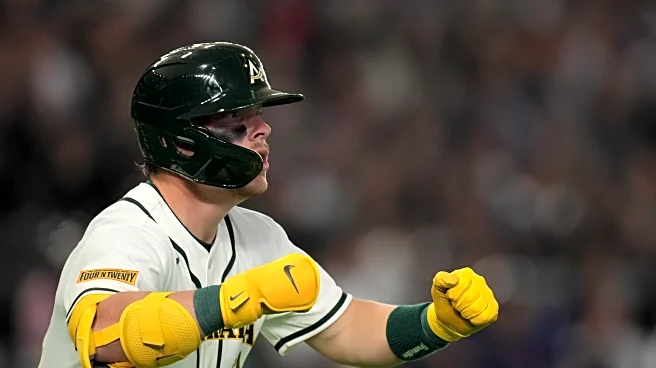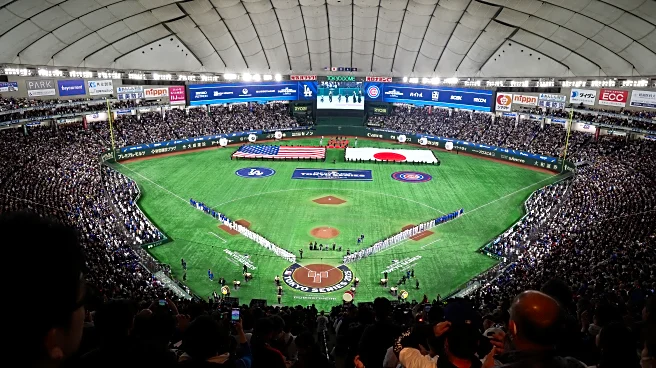

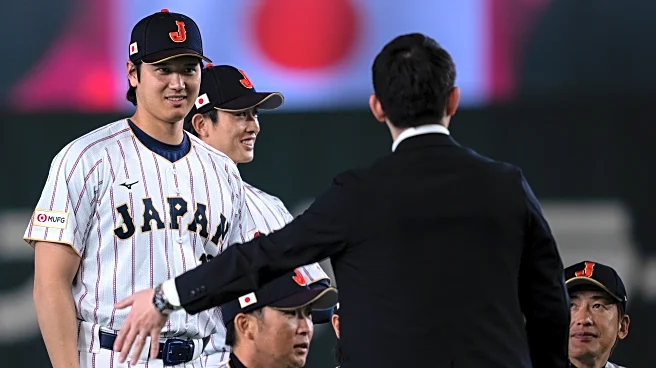
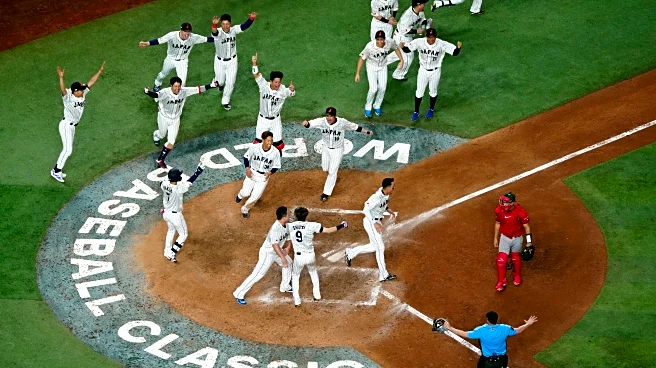
If it is not obvious, the Dodgers and the United States are merely borrowing Shohei Ohtani, as most recently evidenced by Ohtani’s recent batting practice session at the Tokyo Dome in preparation for the upcoming World Baseball Classic.
With that in mind, in November 2025, MLB announced a documentary film about the 2025 Tokyo Series, titled Homecoming: The Tokyo Series. The documentary is billed as an examination of baseball in Japan with intersecting stories involving the five Japanese players who
participated in the 2025 opening series: Ohtani, Yoshinobu Yamamoto, Roki Sasaki, Shota Imanaga, and Seiya Suzuki.
Baseball might be America’s pastime, but it is also an omnipresent part of everyday life in Japan.
Never was that more clear than during Major League Baseball’s Tokyo Series between the Cubs and Dodgers that opened the 2025 regular season this past March. That two-game series — headlined by Japanese superstars Shohei Ohtani, Yoshinobu Yamamoto, Roki Sasaki, Shota Imanaga and Seiya Suzuki — and the impact of baseball all around the country is the focus of a new documentary that will be coming to movie theaters soon.
“Homecoming: The Tokyo Series” celebrates the intersection of culture and global sport, illuminating how baseball unites beyond borders. Produced by Supper Club and in coordination with MLB Studios and BD4, Banijay Americas’ premium documentary label, the documentary will be shown in theaters on Feb. 23 and 24, distributed by Fathom Entertainment.
The documentary had a two-day limited theatrical run in theaters in late February 2026. For those who missed the documentary in theaters, CNN announced that the network would exclusively bring the documentary to its new streaming offering on March 27.
As we have covered, the 2025 Tokyo Series was both a massive cultural event in Japan and a runaway financial hit, leaving the sport wondering when Tokyo Series 2: Electric Boogaloo will happen with the Cubs and Dodgers.
There has been only one review of the film by Shikhar Verma of High on Films, who rated the film 3.5 out of 5. True Blue LA was provided with a screener of Homecoming: The Tokyo Series, and I watched the 90-minute documentary twice for this review.
Review of Homecoming: The Tokyo Series
The film barely scratches the surface of what it was like to experience the 2025 Tokyo Series. If I had to describe the film in a single sentence, it would be “atmospheric but light in substance.”
This criticism is not to say that the documentary is bad or not worth watching. The documentary suffers greatly from not deciding on a focal point, of which there are many. If you want a coherent story or narrative from this documentary, you will be disappointed. Here is how the film was described in its theatrical release:
Homecoming: The Tokyo Series explores Japan’s deep bond with baseball, culminating in the 2025 MLB Opening Day games in Tokyo as hometown heroes Shohei Ohtani, Yoshinobu Yamamoto, Roki Sasaki, Shota Imanaga, and Seiya Suzuki return to where their baseball dreams began. Through the lives of those shaped by the game, the film reveals how baseball bridges generations, connects nations, and reflects the balance between tradition and modern life. More than a chronicle of a sporting event, it is a portrait of a nation’s enduring love for baseball and the pride of watching its stars come home.
I would have loved to have watched that film, because the film I watched does not match this synopsis.
What happens when you do not pick a lane
The best way to describe Homecoming: The Tokyo Series is a mish-mash of two films with little overlap. If Director Sterman could pick a lane, I think the documentary would be infinitely more coherent.
On the one hand, you have a series of slice-of-life vignettes between a mother and adult son, Yasuko and Toru Tanahara, running a youth baseball team in Osaka, a player on the team and his father in Osaka, respectively Kanato and Shogo, superfan and salon owner, Hironobou Kanno, in Oshu (Ohtani’s hometown), owner of a glove restoration business, Re-Birth, Tomohiro Yonezawaya, in Ota (a ward inside Tokyo), master craftsman of bats for Mizuno, Tamio Nawa, in Yoro, discussing their individual stories and love affairs with baseball in Japan.
None of these threads end up at the Tokyo Dome to watch the Tokyo Series, or even overlap, which is a shame given the passion involved and appropriateness of the conclusion, considering the gravity of the homecoming happening in the literal background. The closest we get to an overlap of our cast and Tokyo Series is when Mr. Kanno is shown watching Game 2 of the Tokyo Series at home. Given how little the Tokyo Series is discussed or covered in this portion of the movie, you can excise it entirely and still have a lovely, atmospheric documentary on Japanese baseball, both in its place in Japanese culture and history.
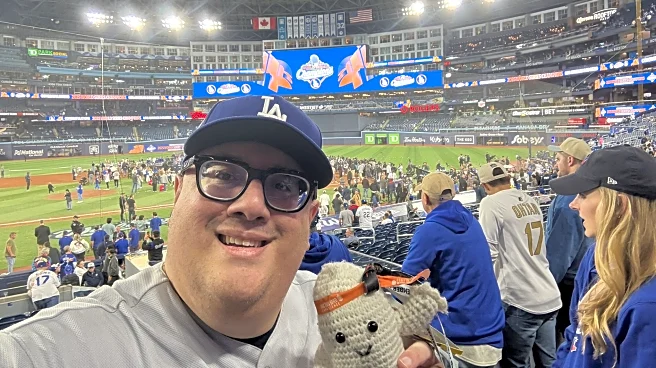
To play Devil’s Advocate for a moment, tickets to the Tokyo Series were notoriously hard to get, even with all the efforts made to make the tickets available for Japanese locals. The face value for my Game 1 ticket was 32000 yen (about $212.84). Even with an anti-scalping law on the books, I paid exponentially more; therefore, gathering tickets for as many subjects as the film had was likely not feasible.
In the film’s other part, you have American expatriates like Jason Coskrey of The Japan Times, Jim Allen, a longtime freelance columnist, and Meghan Montemurro, Cubs domestic beat writer for the Chicago Tribune, discussing the nuances and characteristics of Japanese baseball with the backdrop of the Tokyo Series. In what had to be a logistics-driven decision, this portion of the film is largely Cubs-centric, with Montemurro going to the Cubs’ team dinner before the series and an off-site visit to a Japanese elementary school with former Cubs Derrek Lee and Kosuke Fukudome on March 19.
However, the inarguable main story of the Tokyo Series is Ohtani’s return to Japan, but the documentary is either unwilling or unable to give the topic the attention it deserves. Ohtani in Japan is a cross between The Beatles, Michael Jordan, and Babe Ruth: a blend of cultural zeitgeist and omnipresent history. One cannot overstate the imprint Ohtani has made and continues to make in Japan. One can see this impact in the sheer volume of advertisements in which Ohtani appears, which is not surprising given that he made $100 million from advertisements last year, leading all athletes worldwide in 2025.
Put another way, in the days leading up to the Tokyo Series, thousands of fans filled the Tokyo Dome just to watch the Dodgers and Ohtani practice. Not play, practice.
Per Bill Plunkett of The Orange County Register on March 14, 2025:
MLB put tickets on sale for Friday’s workouts at the 55,000-seat facility known as “The Big Egg” and capped the crowd at approximately 10,000. Tickets priced at 2,000 yen (about $13) were gone within an hour and 10,507 showed up to watch their favorite team – say it in your best Allen Iverson voice – practice.
The Dodgers’ Tokyo Series opponents, the Chicago Cubs, worked out earlier in the day Friday in front of a much smaller crowd. For the Dodgers’ workout, the fans showed up, indeed painting the lower level of the seating area in Dodger blue.
A group of Japanese fans seated behind the Dodgers’ dugout were so ardent in their support they called out the names of players as they jogged out of the dugout onto the field, regardless of their stature – from All-Star outfielder Teoscar Hernandez to relief pitcher Anthony Banda…
When the star of the show, Ohtani, emerged from the dugout to do some running drills – he rarely takes batting practice on the field and didn’t Friday – his appearance drew a gasp from the crowd and then loud applause. His every move on the field during his brief appearance was shown on the large video board in center field.
“I really feel the excitement of the country with the games being played here,” Yamamoto said.
One would be oblivious to these facts if relying solely on Homecoming: The Tokyo Series. With no disrespect to Yamamoto, Sasaki, Suzuki, or Imanaga, if any or all of these players were not present, the Tokyo Series would have still gone on with nary a blip. Not so for Ohtani, as he’s that central to the overall narrative.
While Tokyo was gripped by Tokyo Series fervor, folks recognized my Dodgers cap and surmised I was there, even though I was as far away as Kumamoto. The U.S. equivalent is someone being able to figure out what you are doing in the country based on your appearance in Portland, Oregon, or Salt Lake City, Utah, for a contemporaneous event at Dodger Stadium.
In the documentary, Ohtani’s hometown is briefly featured, and a snippet of the media day press conferences is included. Accordingly, Ohtani’s absence is omnipresent in the documentary, except when the actual Tokyo Series is shown. In the vignettes about Japanese baseball, his absence, except as a figure of admiration or motivation, makes sense, since famous athletes are generally not daily fixtures in our everyday lives.
But for the portion of the film focusing on the lead-up to the Tokyo Series, it is an utterly inexcusable decision.
To further illustrate this point, imagine a hypothetical documentary about the 2025 World Series, but set from the Toronto Blue Jays’ point of view. Further imagine that the focal point was not Vladimir Guerrero Jr. or Ernie Clement (who both had a stellar series), or even Jeff Hoffman (the tragedy of the closer who blew it), but rather Kevin Gausman (the pitcher who got beat twice) or Brendon Little (he was there largely as an observer except for one solitary moment).
This hypothetical documentary would be a confusing watch because of an inherent flaw in its construction stemming from the wrong focus; instead, say MVP Yoshinobu Yamamoto. Anecdotally, I saw far more Dodgers gear and fans than Cubs fans, and if pressed to estimate, I would put the split at around 85/15 in favor of the Dodgers during the weeks I was in Japan.
Homecoming: The Tokyo Series has the same faulty construction of viewpoint; whether to make the Cubs the focal point of the Tokyo Series coverage was a choice between logistics and directorial discretion, and it remains open.
Playing fast and loose with the truth
Ultimately, the documentary’s odd lack of focus is not its only flaw. In many ways, the regular-season games between the Dodgers and the Cubs are arguably an afterthought. The fact that Ohtani et al. returned to Japan to play games is more important than the actual results, which saw the Dodgers sweep.
The real story is that the Tokyo Series happened at all and, in general, was a celebration of and for Japan. Accordingly, Japanese players are becoming more common in MLB. To its credit, Homecoming: The Tokyo Series gets these facts correct during this portion of its runtime.
However, Coskrey, Allen, and Montemurro discuss the unique characteristics and energy of Nippon Professional Baseball (NPB), which is generally a loud, musical, and energetic affair. Japanese baseball can almost be thought of as a martial art, with an emphasis on small-ball fundamentals over the three-true outcome currently embraced in MLB.
This rowdy energy from the crowd was certainly present during the exhibition games between the Dodgers, Cubs, Tokyo Giants, and Hanshin Tigers.
It is worth noting that the Tigers won both of their exhibition games against the Cubs and Dodgers by shutout. And one would expect that energy to be present during the actual Tokyo Series, except it was not.
In a decision to fudge with the facts to support the narrative that NPB is loud and rowdy, Homecoming: The Tokyo Series decides to play fast and loose with the facts, pumping in crowd noise during the game sections and weirdly festishing the pregame activities by playing around with the chronological order of things.
First, while the exhibition games did live up to NPB’s reputation, the Tokyo Series had more in common with COVID-era baseball or The Masters through the aggressive, omnipresent silence from the crowd for most of the series, especially Game 1. This observation is not criticism, as the crowds were respectful and excited when any of the Japanese players played.
The first at-bat of the season was Shohei Ohtani. One would expect this crowd to be rowdy in rapturous joy. Instead, the atmosphere was generally quiet, rapt awe, as demonstrated below, which persisted for large portions of both games. Generally, fans did loosen up as the games went on, but it was a far cry from what I had come to expect from an NPB stadium.
As an aside, fans watching Ohtani practice and play at the Tokyo Dome now have loosened up considerably, even though restrictions on amateur or non-official videography and photography have emerged.
Here is what I said about the Tokyo Dome’s atmosphere at the time:
I was expecting a rowdy, NPB-like atmosphere with bands, chanting, singing, and general tomfoolery over two days. Instead, I got two nights at The Masters.
The observation is not a criticism but a realization that I had an imperfect understanding of Japanese baseball fans. If you wanted to experience what NPB is known for in the Tokyo Series, your best bet would have been to watch the exhibition games against the Hanshin Tigers or Yomiuri Giants.
In my observation, the local fans were far more invested in the returning players, most notably Shohei Ohtani. They would react when any of the five returning Japanese stars were in the game or in a pinch. The rest of the time? Not so much.
During the highlights of Game 1, Homecoming: The Tokyo Series makes the bizarre decision to show the pregame festivities of Game 2, featuring taiko drums and traditional Japanese garb, as if they were part of Game 1, which is factually incorrect.
Game 1’s actual festivities? A celebration of baseball and Pokémon, complete with five-foot-tall Pikachu wearing road grey Los Angeles jerseys and home white Chicago jerseys. Each starting player was introduced with both his name and an associated, unique Mega Pokémon. For example, Ohtani had Mega Garchomp, Pete Crow-Armstrong had Mega Lucario, and Max Muncy had Mega Gengar.
Eventually, Homecoming: The Tokyo Series uses footage from Game 1, where you can see the Pikachus in the background, so there was no reason to fudge the timeline of events.
Final Score
For what it’s worth, Homecoming: The Tokyo Series never rises to meet the sum of its parts, which is a disappointment. Those unaware of the film’s faults will likely leave cinemas wondering what they just watched.
The film promised a story worth telling that I would greatly like to see on the screen someday. For its scope, the film has only generalities and slice-of-life vignettes rather than a cohesive narrative, much to its detriment.
For those who wish to re-experience what it was like in Tokyo during those days, I would recommend visiting my previously submitted essays, the Talk Dodgers to Me podcast’s Tokyo episode on the adventures of hosts Melissa Myer, Jaclyn Ruiz, and Aly Parker, and journalist Molly Knight’s Substack essays on the topic.