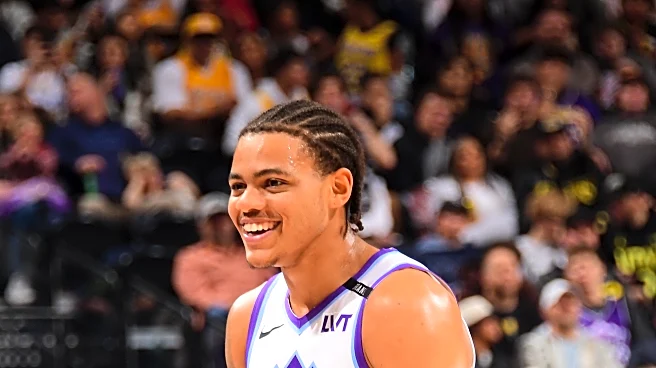

The Utah Jazz fall to Luka Doncic and the Los Angeles Lakers with the final score being 135-143 LAL. LeBron James turned back the clock and was only 7 rebounds short of a triple-double, while Luka did
Luka things and ended up with a 45-point triple-double — these are the types of guys you get when you tank for a top 5 draft pick. Keyonte George and the Jazz made it as close as they could in this high-scoring outing, but the lack of defensive effort and awareness cost Utah the game. Keyonte George was Utah’s highest scorer in this match, where he tallied another 30+ point game (34 pts) along with 8 assists, and 4 rebounds on 45/45/91 shooting splits.
In the first half of the game, the Utah Jazz youth came to life as they dropped a whopping 78 points before the halftime buzzer sounded, led by who other than Keyonte George (also shoutout Brice Sensabaugh who had 15 points tonight) — Key had 18 points and 5 assists at the end of the second. I just want to take a second and talk about Keyonte George’s incredible offensive breakout this year, and this may end up being more of a Keyonte George appreciation post than a post-game recap, but I’ll be sure to include UTA vs LAL analysis a bit before I dive into the Keyonte George all-star propaganda.
I felt like the youth were clicking on offense. Ace Bailey had another game with 13 shot attempts and ended up with 19 points in the game. I think that Will Hardy has been taking his development at the perfect pace. Ace Bailey was someone who was going to need to run a lot of offensive sets away from the basketball, especially with a developing handle.
Filipowski has been showing signs of life as of late due to increased minutes and usage on offense. Flip had one of, if not the biggest, rebounding games of this season and his career with 13 rebounds! Ever since the Summer League and even last season, I felt like Filipowski was struggling to adapt to the brutal physicality of the NBA, especially on the defensive glass, so it’s really great to see him hold his own against the Lakers’ frontcourt in LeBron James, Jaxson Hayes, and Rui Hachimura — all of whom have length and mass.
Nurkic continues to show his connective ability and versatility on offense in the sense that he can be utilized in a myriad of ways. He likes operating at the top of the key to find cutters or run DHOs (dribble handoffs), especially with the guards — Keyonte George is very efficient/effective coming out of handoff playtypes, and we’ll touch more on that later. One thing that Nurkic has been very bad at is his touch around the basket. Among centers that have taken more than 50 2PT attempts, Nurkic is ranked 5th WORST in the league. Nurk has also been the 3rd worst PLAYER in the league when it comes to scoring in the restricted area. His rim scoring has taken a massive hit and has been terrible in the pick-and-roll. Definitely not someone you want on your roster long term and is a perfect piece to build around… if you want to lose as many games as possible.
Isaiah Collier had his best game of the season with an 18-point, 13-assist, double-double. This was undoubtedly the best game he has had all year. Offensively, he has a huge question mark above his head in terms of his future with the Jazz. This is his time to show that he can be a rotation player on our team going forward, which includes some major strides on the defensive end because ball watching, over-committing as a help defender, fouling at a high rate, and just straight up losing your defender, will NOT earn him a spot on this team going forward. His playmaking is fantastic, but his reluctance to shoot the ball is a major concern going forward. There’s a lot of development that needs to happen with Collier, and I believe he can become a legitimate NBA player with a role where he can find some consistent playing time, but he has to figure things out. I am very intrigued to see what Collier becomes as he gets an increased number of repetitions as the season goes on.
Cody Williams did not play after his best game… ever? Hmm.
KEYONTE GEORGE’S GREATNESS:

Keyonte has taken an unbelievable stride in his efficiency at the rim, jumping from 61.4% last year to 68.1% this season. Not only has he jumped in rim%, but he has made a leap in mid-range efficiency. The thing that stands out the most to me is the change in his 3PT shot diet, cutting his 3PT rate/frequency down by nearly 15%! B

By attacking within the perimeter instead of chucking 3PT attempts, it has allowed him to increase his FT rate dramatically — Keyonte has embraced contact and increased his FTr by 13.2% and was ranked 10th in the league in FT attempts before tonight’s game.

Keyonte George was one of the most effective guards in the league operating out of dribble handoffs last season, finishing ranked No. 1 in handoff efficiency. He showed a clear comfort level coming off DHOs — usually initiated by a big — where his ability to make quick, decisive reads stood out. Whether it was flowing directly into a pull-up jumper, turning the corner when defenders trailed, or hitting the short roll when help stepped up, Keyonte consistently punished defensive mistakes, turning a structure-heavy action into real offensive value rather than simply benefiting from it.

Another area where Keyonte has grown more efficient is his isolation scoring. This dude was already a scary guy to guard 1 on 1 with because he has the ball on a string and can get to any spot he could on the floor. However, the problem he’s had so far in the NBA is that the ball was not falling… but it’s falling now. Below, I will show you his collegiate play types, primarily focusing on the off-the-dribble scoring. I’ll also show his shot diet at Baylor as well.


Most of Keyonte’s shooting numbers off the dribble were actually pretty average for a college guard from an efficiency standpoint. However, his diet was considered questionable as he settled for a significant amount of mid-range shot attempts. His diet has carried over for the most part, but he has grown much more efficient as his body has developed and as he has learned how to read NBA defenses, resulting in more confident shots.

Keyonte has always been an average spot-up shooter dating back to college, and it’s carried over to being about league average, but guess what, HE’S JUMPED IN THAT AREA AS WELL! From having a spot-up TS% average of around 54.6% the previous 2 years, he is already on a tear, jumping 20% in spot-up efficiency, and is in the 89th percentile (ranked 30th in the league).
This is no doubt an all-star jump from an offensive standpoint. This is just the scoring part of his game, as well; we haven’t even gotten to the playmaking yet.

Don’t let these numbers scare you, all you have to do is look at the colors and see them slowly start to improve as the years go on, because that just seems to be the trend with Key. Key has been cutting down his bad playmaking turnovers, which is a catalyst in his slight improvement in his advanced passing numbers — most of his turnovers actually come from scoring the basketball, which makes sense as a young point guard who is your primary ball handler.
Another thing that could be a factor in his improved passing is his change in shot diet — by him bending defenses with his offensive gravity as he attacks downhill, it could present an increase in potential playmaking opportunities, and Key is capitalizing on opponents’ defensive lapses by making the correct reads.
Keyonte George should be in serious contention for not only an All-Star appearance but for winning the Most Improved Player award. NO QUESTION.
Now, are there some serious concerns about the defense? 1000% yes. In almost every defensive all-in-one metric, Keyonte George is likely to be found in the bottom 5-10 of the list. There is a visual increase in effort, but the production is still lackluster. For guards who have guarded over 100 opponent FGA, Keyonte George is ranked 5th in Defensive FGA. As poor a defender as he is, this is not Will Hardy intentionally making Keyonte the primary guard defender on the roster like Dyson Daniels and Ryan Rollins, who have more DFGA than Key, this is because he is being targeted by the opposing team.

Not only is he being targeted, but his opponents are scoring at a 52.1% clip — out of 155 players with over 100 defended FGA, Keyonte ranks 139th in FG% allowed among guards. So, Key is being targeted, and he is allowing a lot of points. Can he put up more points on offense than he allows on defense? Maybe, but what happens on a bad scoring night? I’ll leave that up for you to decide for yourself.


Again, his defensive numbers are very poor and have been something that has not improved; in fact, they have gotten worse. The Utah Jazz are actually even better on defense when he is off the floor by 12.5 points! THAT IS TERRIBLE!!! Even with his offensive jump, the Jazz are only 2.6 points better when he is on, leaving him with a total net rating of -9.8, meaning he is a negative impact player overall. Does this mean he can’t win you games? Not at all, we have seen it this season time and time again as he continues to try to ruin the Jazz’s tanking endeavors. I believe he is a sensational and insanely fun regular-season player who can absolutely stuff the stat sheet. I am rooting for him fully, and I hope that when the Jazz eventually return to the playoffs, he will be an offensive monster and lead us to the promised land. Will it take some creative roster building? No doubt. It’s going to take a lot to be able to make up for his lack of defensive production.
Keyonte George is extension-eligible at the end of this offseason, and the Jazz could choose not to offer him an extension as they did with Walker Kessler, but how much is he worth from an impact on basketball POV?
That being said, Keyonte George has exceeded my expectations tenfold and could continue to do so. I am super happy for this kid and am excited to watch him night in and night out, throughout his career, no matter what team he’s on.