
Commanders links
Articles
Bullock’s Film Room (subscription)
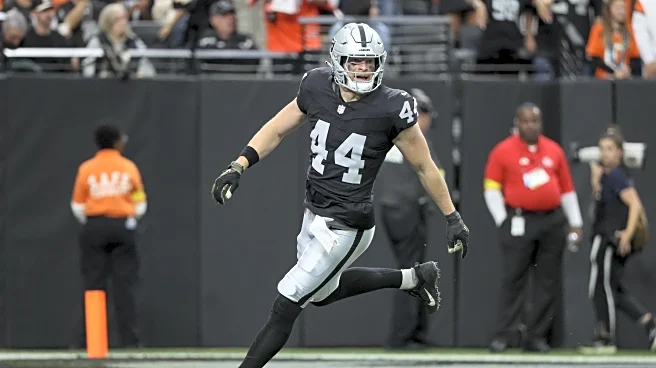
What DL Charles Omenihu brings to the Washington Commanders
Omenihu is listed at 6-foot-5, 280 pounds. He has spent most of his career as a 4-3 defensive end, but we’re anticipating the Commanders to switch from a 4-3 base defense to a 3-4 base defense. When you look at the other edge defenders that the Commanders have signed, Odafe Oweh and K’Lavon Chaisson, those two are listed at about 250 pounds, which is significantly lighter than Omenihu. That makes sense because Oweh and Chaisson would be outside linebackers in a 3-4,
which requires them to be a bit lighter and more agile so that they can occasionally drop into coverage.
But while Omenihu has spent most of his career on the edge, it appears as though he will be potentially joining Deatrich Wise as slightly undersized 3-4 defensive ends. Both Omenihu and Wise are listed at 280 pounds, which is much closer to a 3-4 defensive end size than a 3-4 outside linebacker size. If you scroll through the Commanders social media pages and find the posts where they announce player signings, you’ll see that both Oweh and Chaisson were listed as outside linebackers (OLB) while Wise and Omenihu were listed as defensive ends (DE). That gives us a hint that this is going to be a 3-4 defense.
First thing of note is the term “under front”. Under fronts aren’t exclusive to either 3-4 or 4-3 defense, but they largely refer to the same thing. In an under front, the defense has their three-technique defensive tackle line up away from the offensive strength. Typically, that means they will have a defensive tackle line up on the outside shoulder of the guard away from the side of the tight end. Here’s a visual example of that from the Vikings defense which new defensive coordinator Daronte Jones coached last year.
This is what a 3-4 under front looks like. You can see the Cowboys have two tight ends to the left side of their formation, which makes that the strength of the formation. The Vikings have three interior lineman on the field here, two 3-4 defensive ends and a nose tackle. They have one defensive end line up head up on the left tackle, which is known as a four-technique, while the nose tackle is tilted or shaded slightly to one side of the center. They then have a three-technique lined up over the outside shoulder of the right guard, away from the tight ends on the left side of the formation.
The Commanders actually used a few under fronts last year too. It’s a front that can be used with both 3-4 and 4-3 personnel pretty interchangeably. Daronte Jones, like every new defensive coordinator, talks about wanting his defense to be multiple and not giving it a label of 3-4 or 4-3. This next picture will show you why he avoids those labels and how versatile a front can be.
This is an example of a Commanders under front from last season. The Raiders have their tight end aligned to the left of the formation, so the Commanders shift their front away from him. Instead of a four-technique straight up on the left tackle, they shift him slightly inside into what’s known as a 4i. The nose tackle lines up head up on the center rather than tilted or shaded either side, and the three-technique lines up on the outside shoulder of the right guard (you could argue he’s also a 4i but he’s tilted inside towards the guard so I’m calling him a three-technique for now). It’s not quite the same front, but it’s similar.
The interesting thing with the Commanders version of this under front is that they get to it from a 4-2 nickel package rather than a 3-4 base package like we saw in the Vikings version. While the Vikings have a bigger interior defensive lineman playing the four-technique, the Commanders have defensive end Dorance Armstrong shift inside to play the 4i in their front. With Armstrong shifting inside, linebacker Frankie Luvu walks down to replace him on the edge. This is how 4-3 defenses can get into 3-4 looks. They shift unto an under front and walk down their Sam (strong side) linebacker onto the edge. The famous Seattle Seahawks defense that Dan Quinn coached was typically in a 4-3 under front most of the time.
I think the Commanders will use the Vikings version of a 3-4 under front more often, but when you have versatile linebackers like Luvu and new signing Leo Chenal, that offers the flexibility to play in a 4-3 defense and have one of Luvu or Chenal walk down to the edge and make it into a 4-3 under front just as easily. That is probably why Jones doesn’t want to put a label on it, because he can get to a similar front in a variety of ways due to having versatile personnel.
While all of this is very interesting in regards to the wider picture of what the Commanders defense will look like next year, what does it mean for Charles Omenihu, exactly? Well, at 280 pounds, Omenihu has more size than say a Dorance Armstrong, who is listed at 255 pounds. When you shift the front like this and a 4-3 defensive end shifts inside, they can often be overmatched by the bigger bodies on the interior. If they line up as a four-technique over the tackle, a 4i on the inside shoulder of the tackle, or even a three-technique on the outside shoulder of the guard, having a bigger frame should help them withstand the different types of blockers they would be getting inside compared to on the edge.
That extra bulk should help Omenihu, and indeed Wise, hold up better against the run in those particular situations. You might wonder why not just use a bigger defensive lineman used to playing on the interior. Well, the Commanders certainly can do that. They have plenty of bigger interior defensive lineman that could do those roles, like Daron Payne, Javon Kinlaw, Johnny Newton and even new signing Tim Settle. But the advantage of having guys like Wise and Omenihu at a slightly lighter weight comes in the form of pass rush.
Commanders Rountable
Three Day Two Receiver Prospects Washington Commanders Should Circle
Zachariah Branch, WR — Georgia
If David Blough’s offense is going to weaponize Jayden Daniels in the short-to-intermediate game the way Detroit did with Jared Goff, then Washington needs a receiver who can turn a five-yard catch into a 20-yard gain. That is Zachariah Branch .
Branch came in as the top-rated receiver in the 2023 class and never quite lived up to the billing at USC. Two years, flashes of brilliance, not much else. Then he transferred to Georgia and put up 81 catches for 811 yards and six touchdowns — a single-season program record. The production doesn’t stop at the catch point: Branch ranked fourth among all FBS receivers with 634 yards after the catch last season, averaging a staggering 8.0 yards after the catch per reception. In a Blough-driven offense featuring quick-hit throws, screens, and RPOs designed to put athletes in space, that number is lethal.
At 5-foot-10, 180 pounds, Branch is undersized — scouts will note the limitations on contested balls and boundary routes. But his NFL role is clearly defined. He is a slot specialist and returner, the kind of player who stretches nickel defenders horizontally and wins with change-of-direction quickness that doesn’t show up on a 40-yard dash time. He also ran a 4.35 at the combine. That combination of elite YAC ability, special teams value, and proven SEC production against top competition makes him a legitimate Day 2 value at 71.
Riggo’s Rag
Daron Payne trade idea makes no sense for the Commanders anymore
Payne is apparently on board, but things change quickly in the NFL. This topic was further discussed by Wynston Wilcox of FanSided, who suggested the Carolina Panthers could make an offer as they look to build on their NFC South championship triumph last season.
Payne may have dropped below expectations, but the supporting cast around him wasn’t exactly stellar in 2025. And with options dwindling on the free agent market, he’d be incredibly hard to replace at this stage of the offseason.
Obviously, everyone has a price. Trades are becoming more frequent than ever before. The Panthers have moved into win-now mode, as evidenced by their blockbuster acquisitions of edge rusher Jaelan Phillips and second-team All-Pro linebacker Devin Lloyd in free agency. They have the draft capital to make an intriguing offer, but their salary-cap situation would need to be tweaked significantly to absorb Payne’s contract in this scenario.
This makes absolutely no sense from Washington’s perspective right now. That wasn’t necessarily the case earlier in the offseason, but Peters has already shown his hand. He wants Payne around, and if the performances warrant another financial commitment, the Commanders will seriously consider it in 2027.
Defensive coordinator Daronte Jones’ unit has been revamped, with more arrivals imminent. Even so, having Payne’s experience provides a sense of stability. The former Alabama star should also be highly motivated in a contract year, so removing him from the equation is not an option.
Payne will be on the books in 2026. What comes after that is less clear.
Riggo’s Rag
8 Commanders quietly on the roster bubble after Adam Peters’ big spending spree
Nick Bellore – Commanders LB
The Commanders added to their linebacker room with Leo Chenal in free agency. He’s been a fantastic asset to the Kansas City Chiefs throughout his career, both as a rotational defensive player and a special-teams contributor. Now, Washington is giving him a chance to increase his influence by adding extra responsibilities to his shoulders.
Frankie Luvu is moving back to an off-ball role after being forced onto the edge last season, where he was not particularly comfortable. Jordan Magee has promise as a rotational force, but all bets are off regarding the rest. Though Nick Bellore has a contract, he is aging enough to be on the chopping block this summer.
Bellore is a special-teams weapon. But with the Commanders moving towards a youth movement, others may be preferred unless he leaves no doubt when on-field preparations for the new campaign get underway.
Javontae Jean-Baptiste – Commanders DE/OLB
Strengthening the defensive edge was among the Commanders’ biggest priorities this offseason. And unlike previous years, Adam Peters gave it the correct attention during a frenzied start to free agency.
Odafe Oweh was the big prize, signing a four-year, $100 million deal with $80 million guaranteed. The Commanders acquired K’Lavon Chaisson after his breakout campaign with the New England Patriots, and Charles Omenihu should bolster the depth as a versatile piece for Daronte Jones’ front seven.
With Dorance Armstrong Jr. making encouraging progress from a serious knee injury, this could be a productive foursome for the Commanders if everyone gets a clear run of luck on the health front. What that means for the rest remains to be seen, but Javontae Jean-Baptiste’s role in 2026 is far from clear-cut.
The 2024 seventh-round pick out of Notre Dame has flashed promise, but he’s also dealt with nagging injury problems. A massive effort is needed this summer to stick around.
Podcasts & videos
NFC East links
Blogging the Boys
The Cowboys are making a mistake with this move
We’ve already seen changes take place with the Cowboys trading away Osa Odighizuwa to the San Francisco 49ers. Odighizuwa, a penetrating defensive tackle, seemingly doesn’t fit in with Parker’s vision for the new defensive front and thus was traded away. That’s a major and telling example of pieces having to fit, which is very understandable. The change in defensive philosophy demands different tasks and roles out of your personnel, particularly in the front seven.
With the new change, Dallas will need to find players to fit the system. Edge rushers now need to be dynamic enough to rush the passer but also effective enough to play in space when asked to. Defensive tackles need to hold up at the point of attack and occupy blockers. All of that makes sense. However, what doesn’t is how the Cowboys are handling Marist Liufau.
When Liufau was drafted in the third round in 2024, there was a lot to like about his game. He was big, he could play sideline to sideline, and he had the tenacity to take on blockers. Yet, in his first two seasons in the NFL, Liufau never separated himself from the other linebackers on the roster.
The Cowboys are now asking Liufau to change positions and play outside linebacker. On one end, it seems like the Cowboys are looking for a place to make Liufau most successful. On the other hand, it appears that the team doesn’t know what to do with him. Asking Liufau to have such a dynamic role, which would also include rushing the passer, seems like a lot to expect.
Dallas changing course so dramatically on a player who they still have under contract through 2027 is puzzling. Who knows? They may reconsider after the draft, and once free agency dries up, Dallas does what seems more rational. A position change comes off less like the start of a new beginning and more like the beginning of the end for Liufau in Dallas.
Blogging the Boys
Why are the Cowboys slow-playing free agency?
After some moderate activity in the first few days of free agency, the Cowboys have been pretty quiet. And it’s not like the Cowboys have filled all their roster holes, far from it.
Bob Sturm recently opined that the reason the Cowboys are so bad at free agency is that they set valuations on players, which is a smart thing to do in principle, but those valuations result in their first bid being consistently too low (“comic lowballers”). The Cowboys enter these negotiations looking for a bargain, which we see all the time with lowball opening offers for their own free agents (Aubrey, Prescott, Lamb, Parsons, Pickens … the list goes on and on.) But that’s not going to work in free agency, where the winner is always the one who overspends the most.
In the second and third week of free agency, prices for players tend to come down, as the auction premium from the free agency frenzy of the first 48 hours rapidly declines. This is the time when agents and players start getting nervous as they see more and more open slots being filled up across the league, and prices drop significantly from where they were at the start of free agency.
So why are the Cowboys sitting on their hands when there already are bargains to be had?
One possibility, though admittedly a long shot, is that they are keeping an eye out for potential compensatory draft picks in 2027.
[T]he Cowboys haven’t yet lost any of their own compensatory free agents [but that] could change.
Big Blue View
NY Giants 2026 NFL Draft scouting report: Davison Igbinosun, CB, Ohio State
Davison Igbinosun projects as an important depth piece at cornerback with the upside to start in the right scheme.
Igbinosun won’t be for every team and defense, and his highest ceiling is likely in a “Seattle Style” Cover 3 defense. He’s a smart player, though he can be a bit over-aggressive at times, and that should allow him to play Pattern Matching rules in a Fangio-Adjacent defense, however his length, downhill trigger, and willingness to be physical are an excellent fit for the Seattle mold.
Igbinosun’s draft stock will likely vary based on the team evaluating him. However, he should hear his name called before the end of the second night of the draft.
Final Word: A Day 2 value
Pro Football Talk
Proposed Tisch transfers of shares would value the Giants at $10.8 billion
It’s now a given that franchises have an 11-figure value. As evidenced by the latest valuation of a team at nearly $11 billion.
Per Mike Ozanian of CNBC, via Sports Business Journal, the proposed transfer of the equity held by Steve Tisch, Jonathan Tisch, and Laurie Tisch to their children values the franchise at $10.8 billion.
The proposed transfer involves 23.1 percent of the team. Under that valuation, the specific number applied to the Tisch shares being shifted to their children is $2.5 billion.
Stephen Ross recently sold one percent of the Dolphins to Lin Bin, at a record valuation of $12.5 billion.
NFL league links
Articles
ESPN
Jets eating $48M in cap after moving on from Rodgers, Fields
The Jets are paying Geno Smith $3.3 million to be their starter and Justin Fields $8 million to be the Kansas City Chiefs’ backup.
It’s not ideal. Neither is the fact that Fields and Aaron Rodgers, their last two opening-day starters, are eating up $48 million in cap space (about 16%) because of “dead” charges.
While the accounting doesn’t look pretty on paper, it’s important to take a wide-angle view of the situation. It hasn’t stopped the Jets from being moderately aggressive this offseason — they’re 11th in team spending, per Spotrac. They’re also operating with the knowledge that clear skies are ahead.
This is all part of a carefully crafted plan by general manager Darren Mougey, who inherited the Rodgers contract and a few other unwieldy contracts (Allen Lazard, anyone?). This explains, in part, the massive dead-money hit this year — $104 million, the third-highest in the league, according to Spotrac.
aBit o’Twitter