

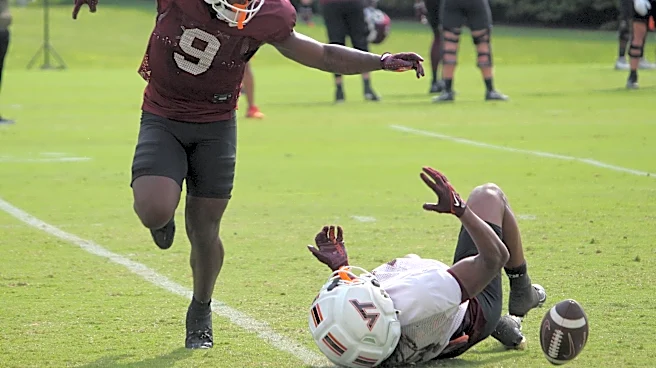
We checked out the very thin quarterback situation (purposeful or not, thin is thin), but the next offensive player in the coaching toolbox might be even more important for 2026. Grunk isn’t a runner, so the #1 and #2 running backs are going to be critical to this offense.
It’s a Small Room for Two Positions
There are eight running backs listed on the 2026 roster for the Hokies. We have two transfers, one last year (Marcellous Hawkins – Central Missouri), and one this year (Bill Davis – Louisiana). That really seems like a big room
but there have been larger groups in prior years. What it really means is that there are at most two backs per 4-year cycle, and because of the Transfer Portal and low target/success rate in high school recruiting the Hokies just have a single true Freshman on the roster. Over a presumed five-year cycle, what seems big begins to thin out a bit under the obvious stress potential for the position. The team is going to have to routinely step up portal recruiting over the next few seasons.
We visited some reality bullet points for Quarterbacks, now it’s time to really dig in and look at some of the same sorts of realities for the guys toting the rock, who are not the QB:
The first and absolutely stunning reality about running backs is that they do not last long. If you want a dose of reality, ask Copilot what the average length of a professional running back’s career is:
From Copilot: The average NFL running back has a career lasting approximately 2.57 years.
Running backs are widely recognized as the least durable position in the NFL, with their careers significantly shorter than most other positions due to the physical demands of frequent collisions and high workloads apsportseditors.org+1. While the overall average NFL career is about 3.3 years, running backs often face early regression in performance, typically around age 28, as accumulated hits and wear on the body take a toll
There is little doubt that over a five year (4 + a redshirt year) that the wear and tear on a running back is going to quickly accelerate as their duties increase. Note the other positions are not much longer, but running backs drop back nearly a full season in the pros. We know that in college the actual productive time on the field is a wild hodgepodge of lengths of time because of the wild transfer rate, and the brutal injury rate. If you look back over the years it wouldn’t be surprising to see that over a four-year potentially productive college career that most RBs are injured and out for a significant period during that time on the team. Of course, the portal will warp those numbers, since the numbers of players transferring is always distressingly high.
- Running backs unfortunately get injured quite often. It’s often unlikely that assumed starters at the beginning of the season will even be on the active roster at the end. (Been a feature of Hokie RB health for a while, now.)
- Running back run totals are often overly optimistic since the statistics always include busted defense breakaway runs. (Some sports-oriented AI probably could get that information, given some time.)
- The Running Game vs. Passing Game conundrum will always cloud judgement in both game design and play calling. Running offenses are brutally inefficient unless the defense it’s facing is completely confounded by a complex running play design. (The Paul Johnson Triple Option run by Army is an example.)
- If an offense deploys run heavy offense, it must have a defense that can dominate the opposing team by limiting their passing attack. (A run heavy drive that scores a touchdown in 8-10 minutes will get beaten by a mixed, heavy passing offense that can score 2 or 3 times in the balance of the time.)
This Season’s Roster is Surprising
The surprise for the 2026 season is the actual number of returning players, 6, and the single transfer for the season. There might be some solid reasons for the choice to only salt one transfer player (from a G6 team) into the mix, but Franklin’s coaching staff seems to have successfully kept two of the potentially best Backs in the ACC.
There are very few players on this list who won’t appear in something this season. It’s really going to depend on how much snap time the coaches want to give the lower three backs in the pecking order. Of course, there will always be Special Teams work for them, as well. Without having to guess too much, we are going to do our best to sort out who is
The Presumed Starting 2 and Backup 2
We’ll be starting this off with a definition since Depth Chart positions for Running Backs are odd. There are one or two backs depending on the formation, and there can be one or two backs on the field at any one time. In addition, to reduce the physical damage that can be done on one “Feature Back” the coaching staff will often sub in the “#2” back often enough that he gets nearly as much time as the #1. So, to make it a bit more accurate we’ll use the terms Primary and Secondary for the 2 positions.
Tech’s Primary Pair Look to Be Well Identified
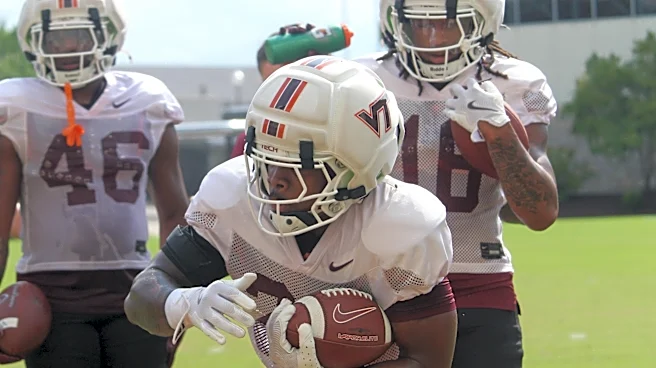
The two Primary Backs for the Hokies are probably going to be Marcellous Hawkins and (I’ll go out on a limb, here.) Jeffrey Overton. Both backs were featured and played in significant snaps in 2025. Hawkins operates more as a power back, and Overton, being about 20 lbs. lighter seems to be destined for the speed and receiving out of the backfield role. This also possibly puts them on the field together in some situations, instead of one or the other and an H-Back. We might see more of this sort of formation because the presumed starting Quarterback, Ethan Grunkemeyer, is not a dual threat QB.
Marcellous Hawkins – 2026 Football Roster – Virginia Tech Athletics

Marcellous Hawkins played a significant offensive role in 2025 with 11 games under his belt and 9 starts. He put up some excellent numbers with 118 carries, 749 yards, 2 100-yard plus games, a rushing touchdown, and a receiving touchdown. Hawkins is good out of the backfield with 12 receptions for 74 yards. Look to see Hawkins repeating his “starting role” but also look to him ending up splitting more time on the field as the Hokies have two potential starters for this season.
Jeffrey Overton Jr. – 2026 Football Roster – Virginia Tech Athletics

Jeffrey Overton’s 2o25 numbers are deceptive. He sat out eight games with an injury and only got the chance to make the field in the final 4 contests. Out of those four games, he made a start. At the end of that he was averaging 5.8 yards a carry and had scored a touchdown in an offense that struggled greatly in the redzone. We’ll have to see if he’s improved with receptions, because in those 4 appearances, he only caught a single pass.
The Primary Pair are Going to Need Backups
We talked about the increased injury risks for running backs, and as we can see from Overton’s record in his freshman season (thus netting him a redshirt and an extra year) he missed 3/4 of the season due to an injury in practice. This means that out of the remaining six players the coaching staff is going to have to identify at least two players who they can sub in or put in a ready backup position.
Bill Davis – 2026 Football Roster – Virginia Tech Athletics

Bill Davis is this season’s transfer. He played two seasons at Sunbelt Conference Louisiana. Davis piled up an impressive record at Louisiana with nearly 800 yards on the ground for his 2024 season and just over 760 for last season. He also is a good receiver out of the backfield with 10 and 11 receptions respectively and ended up named to the Third Team All-Sun Belt Conference list last season. Davis has the tools to actually challenge Jeffrey Overton for a Primary Spot. We are likely to see him regularly since players really don’t transfer to ride the pine at their destination program.
Tyler Mason – 2026 Football Roster – Virginia Tech Athletics

Tyler Mason is really the only other Hokie on the list with any real game experience. We might see him in limited roles on the field in the first two games to see how he is performing in preparation for increased competition levels.
Darius Taylor, John Buetow, and Gray Peterson round out the list of upperclassmen. In most cases we’ll see them on the field for Special Teams assignments. No significant statistics have been listed for their prior seasons. Messiah Mickens is a Freshman from Pennsylvania with an impressive high school record. We’ll see if he gets some good experience this season, but he’s likely to be redshirted if the coaching staff can swing it.