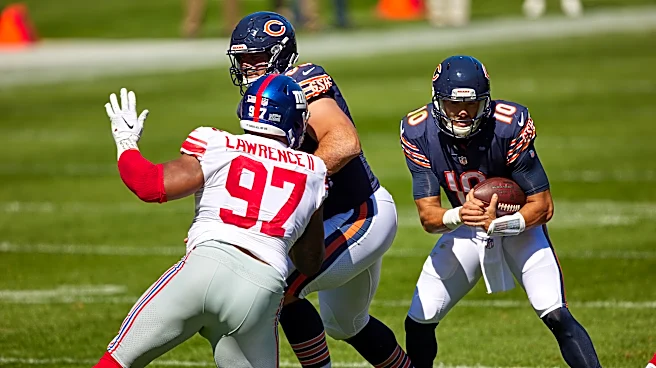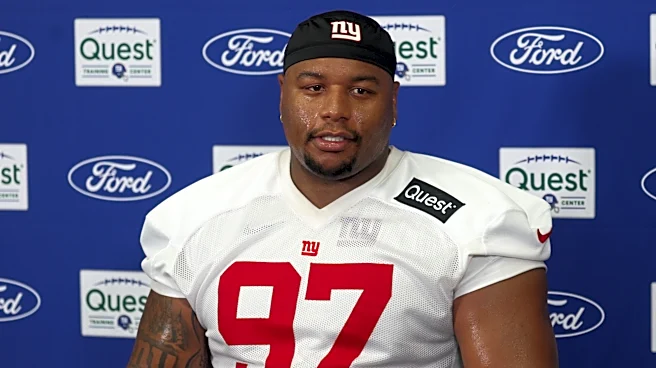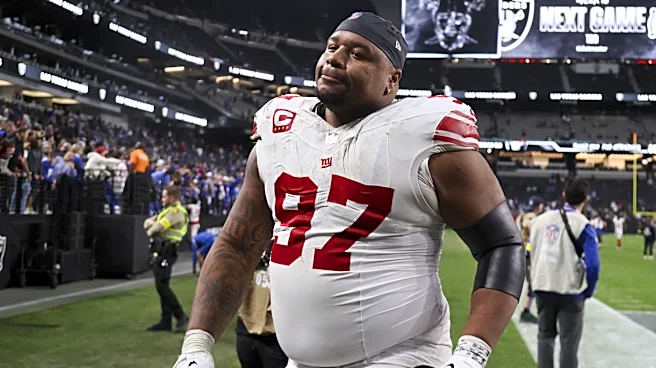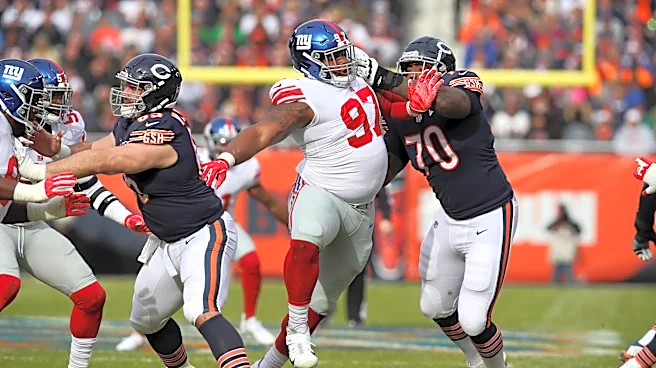




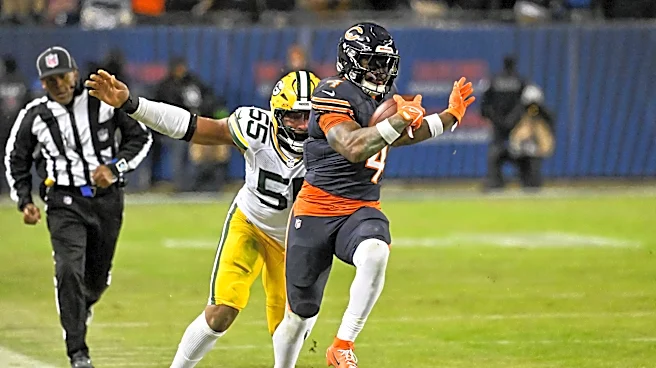
New York Giants All-Pro defensive tackle Dexter Lawrence has requested a trade, and there are fan bases around the league that wonder if their team should make a move and try to acquire the dominating veteran. Out of due diligence alone, the Chicago Bears’ front office should make the call and inquire about the price. If it’s at or below a second-round pick, then it could be a reasonable move.
However, that should be the limit.
Why?
Not counting last year, in the era of the modern CBA, teams have sent
more than the value of a 2nd-round pick for a defensive player twelve times. In eight of those times, the head coach or the general manager was later fired before the team’s next playoff win. The other four times involved the Baltimore Ravens trading for Roquan Smith, the Kansas City Chiefs trading for Frank Clark, and the Los Angeles Rams twice (trading for Jalen Ramsey and then Von Miller). In the case of the Ravens, the head coach was still fired, but only after making it one step closer to the Super Bowl than in the pre-trade run.
Even if the Roquan Smith trade is considered a success, which at least one Harbaugh brother might question, then such moves are still twice as likely to fail as to succeed. The reasons are fairly self-explanatory, but they also merit an asterisk.
First, there are the price-controlled players the team no longer has a chance to draft and to develop. If the value traded away is a first- or second-round pick, then the team is giving away its best chance to draft a starter or impact player. The average defensive player drafted in this position will play in more than 26 games in his first two seasons, recording 20 disruptive plays (sacks, defended passes, or tackles for a loss). If simply talking about an interior defensive lineman drafted in the second half of the first round, such a player would average 48 disruptive plays (including more than 15 sacks) over his first five years in the league. That does not match the level of production a player like Lawrence has attained, but it’s close. His rate has been 12.2 disruptions per year instead of 9.6 and 4.4 sacks per year instead of 3. So, Lawrence would likely be a better player than the rookie potentially drafted at #25, but not by a huge margin. In fact, almost the entire margin goes away if the outlier 6th year of Lawrence’s career is set aside, and the typical player drafted in this range is actually more productive per season across their first two years than Lawrence was in 2025.
Second, there is also a loss of financial opportunity. Using the Bears as an example, the 25th selection in the draft will require a salary commitment of around $4.5m AAV, whereas Lawrence is currently on a deal worth $22.5m AAV. So, assuming that trading for Lawrence did not necessitate paying him more than a 10% increase over this salary (let’s pretend for now), then trading for Lawrence is not simply giving away the 25th selection. It is also the equivalent of giving away the 25th pick in the draft and also giving up the cap space to sign Boye Mafe ($20m AAV) or John Franklin-Myers ($21m AAV). Yes, structures can be played with–but that’s of both a trade or a free agent, so the net loss of flexibility is the same.
Is Lawrence likely to be a good player? Hopefully. Adding his contract to the Bears in place of adding the 25th selection is at a minimum the same as adding one of the ten most-expensive free agents signed in 2026, though, as well. In order for this sort of trade to work out, Lawrence needs to be better for the entire duration of his contract than a late first-round player and one of the top ten free agents signed in the year put together. Otherwise, the move is actually a net loss for Chicago.
This summary leaves out the cold reality that having two players instead of one also insulates the team against a single catastrophic injury taking out the entire investment for a season, as the Packers learned with Micah Parsons.
That, of course, brings up the three teams that made all-in moves last year in order to improve their fortunes. The Packers went from an 11-win team that lost in the wildcard round to a 9-win team that lost in the wildcard round. The Colts went from an 8-win team to an 8-win team. And the Cowboys, who might or might not truly count given that they were on the dealing end of the Parsons trade as well, went from 7 wins to 7 wins. In exchange, of course, all three teams gave up future assets. Maybe coaches and GMs will not be fired over these moves, but so far the best that can be said is that they certainly haven’t worked out yet.
Back to that asterisk. Yes, teams that give up more than a second-round pick for a defensive player, even a very good player, are not likely to see success from this outcome. This is not necessarily because of the lost value inherent in such moves, though. Instead, it is just as likely that it is because the teams that make such moves are often desperate, poorly run, and short-sighted in the first place. The Bears should not rejoin their ranks.