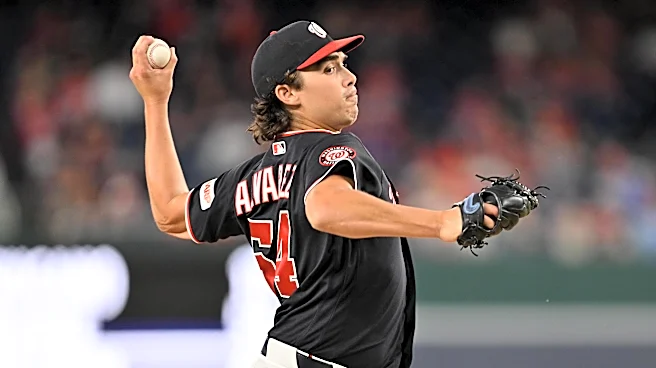



Entering the 2026 season, who would you have expected to be the Nationals second best starter at the end of the year? I am sure it would have taken you a while to get to Andrew Alvarez, but here we are. The Nats pitching staff did not have a great season as a whole, but Andrew Alvarez’s emergence was one of a few good stories.
While Alvarez being this good was unexpected, it did not come out of nowhere. Alvarez actually made five starts at the end of last season, and was surprisingly good. He posted
a 2.31 ERA with 20 strikeouts in 23.1 innings. However, Alvarez was a 26 year old rookie who had middling numbers in AAA. Without much velocity or prospect pedigree, this just felt like a flash in the pan.
However, Alvarez proved that he was no fluke in 2026. On the season, the southpaw posted a 3.43 ERA with 114 strikeouts in 112.2 innings. He dominated down the stretch, with a 2.15 ERA between his recall after the deadline and his unfortunate last start of the season. While he is not a perfect pitcher, Alvarez’s success was no accident.
Andrew Alvarez has a well defined approach to pitching, and it makes him difficult to hit. He avoids throwing pitches in the middle of the zone at all costs. While that nibbling led to a 10.8% walk rate, it also helped him stay off the barrel. Alvarez’s 6.2% barrel rate and 49.8% GB rate are both excellent marks. Those numbers are a big reason why Alvarez only gave up 7 homers in 112.2 innings.
He has done a great job keeping the ball in the park, and that has separated him from a lot of other Nats pitchers. Alvarez’s 1.30 WHIP is pretty mediocre, but his ability to limit the home run helps him avoid big innings.
However, Alvarez is not some pitch to contact guy who has to pray the ball stays in the yard. He also struck out over a batter per inning this season. That is thanks to his wipeout curveball. The hook is what Alvarez usually turns to when he needs to put batters away. Of his 114 strikeouts, 71 of them came on the curveball.
Alvarez’s curveball is one of the more unique and underrated pitches in the game. Despite only averaging 92 MPH, his curveball is harder than most. It sits at around 83 MPH, and I have seen it up to 86. He is able to rip that curveball while not sacrificing any movement. In fact, Alvarez’s curveball has more drop than average. Usually, the slower 12-6 curves have more drop, but Alvarez is able to get that movement with velocity.
It should come as no surprise that the curve is Alvarez’s most used pitch. Batters hit just .178 on the offering and homered just once. The rest of Alvarez’s arsenal is solid and sequenced well, but the curveball is really what sets him apart.
If you look at FIP indicators, this season from Alvarez is no fluke. He posted a 3.32 FIP and a 3.67 xFIP. There has been a lot of discourse around Jake Bennett, but Alvarez was just as good and maybe even a little bit better than the former Nats prospect.
With how Alvarez performed, he should be locked into a rotation spot. Between Alvarez, Cavalli and Connelly Early, the Nats have a really solid top three. I would love to see the Nats add an established veteran and let some less proven guys compete for that 5th spot.
This was a great year for Alvarez, but he wants more. At the end of the season, Alvarez told me he wanted to add a bit more velocity in the offseason. He thinks more velocity would help him establish his fastball more and it would just make things easier.
One thing that Alvarez did a lot better at the end of the season was going deeper into games. That was due to gaining more trust from the coaching staff and being a bit more efficient. Hopefully this trend continues and Alvarez can be a guy who gives you at least five innings and often more.
This was a big year for the 27 year old. As a former 12th round pick without prospect pedigree, Alvarez had to scratch and claw his way into the club’s plans. That is exactly what he did, and now he enters 2027 as a key part of the Nationals rotation.
Season Grade: A