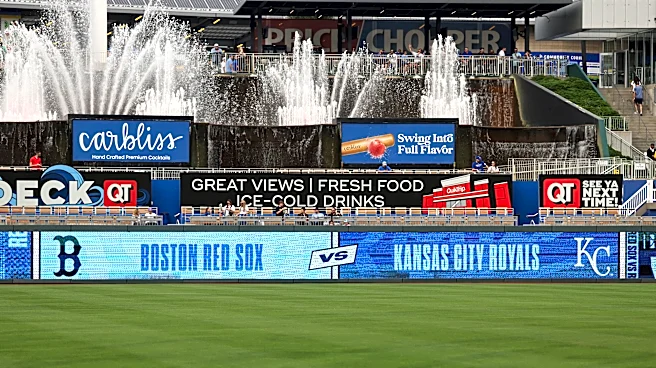



The Kansas City Royals decided to change the dimensions of Kauffman Stadium during the winter. As a reminder, here are the changes the team made, courtesy of the Anne Rogers article about the change at the time it was announced:
According to a team-provided diagram, the left- and right-field corners are being pulled in nine feet, from 356 and 353 feet, respectively, to 347 and 344 feet. The previous distances of 373 in both left and right fields will be nine feet closer, at 364 feet. Left-center and right-center
fields will be moved in 10 feet, from 389 feet to 379 feet.
According to Royals President of Baseball Operations J.J. Picollo, the goal of the team in making the changes was to have a fairer park, not a hitter-friendly one:
“Our goal here isn’t to have an offensive ballpark,” Picollo said. “It’s to have a very fair ballpark. We don’t want it to turn into a bandbox and every ball up in the air turns into a home run. We just want hitters to be rewarded when they hit the ball well, particularly in the gaps.”
We’ve now seen most of a season with the new ballpark dimensions. As a fan who sat in the new seats once this year, I enjoyed the view from out there, so at least on that front the Royals did a nice job. Did the changes to the fence line, however, keep Kauffman Stadium as a relatively neutral park, or turn it into an offensive one?
The K’s big outfield gave it the reputation of being a pitcher-friendly ballpark, but the statistics painted it as a slightly hitter-friendly ballpark, albeit with some strange quirks. Here’s a table—with information gathered from Statcast—about the Royals’ rolling three-year park factors from 2023–2025:
We see that the previous dimensions of Kauffman Stadium helped hitters hit more doubles and triples while suppressing strikeouts (where 100 is average; higher is above average, while lower is below average). The K, however, was the 27th-hardest park to hit a home run in. On balance, this led to a slightly above-average park, but one that played differently than other MLB parks. The front office felt that the different approaches their hitters had to take at home versus on the road were hurting the team, so they decided to make the switch.
So what can we conclude about the changes the team made? The short answer is not much, or at least nothing that you would want to gamble your life savings on Kalshi for. Park factors, for a variety of reasons, can be pretty noisy from year to year. The most accurate models look at either three-year or five-year park factors to determine what they truly are, which is why I used a three-year rolling model in the table above. You wouldn’t determine what a player is going to be for the season in late May.
As someone who is temperamentally a mugwump, I’m comfortable with “Who knows? Let’s collect more data.” That, however, makes for a pretty boring article, and we do have some data after nearly a year to start making observations and inferences. So let’s look back at the Statcast data for 2026 to see the one year park factor for the updated Kauffman Stadium.
This season, Kauffman Stadium has been a good place for hitters to hit extra-base hits of every kind, including home runs. Triples aren’t as high as they used to be, but are still well above average. Home runs are closer to average than they used to be, just on the higher side this season. If you made me bet, I’d say the three-year home run average is going to be closer to 100 than 105, but time will tell.
The K has played like a true hitters’ park this year, supporting extra-base hits while continuing to suppress strikeouts more than any other park besides Chase Field. If the 106 park factor were a three-year average instead of a one-year average, Kauffman Stadium would have the third-highest park factor in MLB this season, trailing only Coors Field and the minor-league stadium that the Athletics currently call home.
When I think of a bandbox, I think of an obscene amount of home runs, and that has not been the case at Kauffman Stadium in 2026. The Royals, however, may have overshot fair and might have made Kauffman Stadium a great park for hitters in the last few years of its life. We will see if it regresses back towards the mean next year or if it remains one of the best parks for bitters in 2027.