



The most telling yard of Hawaii’s season so far is the one it never gained.
In the third quarter at Wyoming last week, the Rainbow Warriors finished a 16-play, 74-yard march that took 9:14 off the clock that ended at the Cowboys’ one. With the Cowboy defense forcing a fourth-down incompletion, the Cowboys marched 99 yards the other way for a touchdown. It was a 27-10 loss, which summed up the first month of the season for Hawaii.
The Rainbow Warriors summer billing promised something else.
The Mountain
West named Micah Alejado its preseason Offensive Player of the Year, a distinction no Hawaii player had carried into a season since Bryant Moniz in 2011. Alejado also landed on the Maxwell, Walter Camp, Davey O’Brien and Johnny Unitas Golden Arm watch lists. Those honors were predicated on a redshirt freshman season with 3,106 passing yards and 24 touchdowns in 11 games; capped by a thrilling Hawaii Bowl win over Cal that saw Luke Weaver step in cold with less than 20 seconds left to throw a winning touchdown pass. Weaver is now SJSU’s starting signal caller.
Currently, Hawaii is 1-3 and 0-2 in conference play with San Jose State (2-2) coming to town off a bye for Saturday’s 9 p.m. PT kickoff for the Dick Tomey Legacy Game.
When Spartan head coach Ken Niumatalolo, who played quarterback for Tomey at Hawaii as a freshman and owes much of his own personal development to Tomey, there was clear separation between rivalry, respect and the game Saturday night.
Any sentiment ends at kickoff.
“I’m more into the execution of our game,” said Niumatalolo. “I’m not looking into the rivalry game. Hawaii’s our next team on the schedule and they’re still a very good football team and I consider Micah an elite talent.”
That’s what makes the ‘Bows start so puzzling. Hawaii’s current diagnosis isn’t from a talent drain. It’s the last 20 yards and an offense that has drifted sideways when it needed to punch into the end zone more regularly.
The résumé vs. the receipts
Alejado is 109-of-181 for 1,020 yards, three touchdowns and one interception. That’s a 60.2% completion rate, down from 66.3% a year ago and 5.6 yards per attempt. Alejado also threw 24 touchdown passes last season and has three through four games.
At this point, the ball isn’t traveling as expected.
Hawaii averages 9.4 yards per completion. And the ‘Bows only completion of 50 yards or more came against New Mexico State; a 55-yarder to Audric Harris.
The most obvious reason for the current dip is the empty spot in the slot. Pofele Ashlock, a preseason All-Mountain West receiver, hurt his knee in the spring. Ashlock hasn’t appeared in the participation report for any of Hawaii’s four games and is not expected to suit up Saturday. In 2025, Ashlock led the team with 76 catches for 827 yards and eight touchdowns.
Without Ashlock, the targets are spread thin with no clear go-to option having yet developed. Tama Uiliata leads the team with 24 catches for 208 yards. Kainoa Carvalho has 18 for 207.
SJSU offensive coordinator Craig Stutzmann knows why that matters in a choice-route system, as his own offense shares that run-and-shoot DNA.
“The quarterback can be an artist with it and yes, you can paint a beautiful picture in that system,” said Stutzmann on how Alejado has praised the creativity of Hawaii’s offensive scheme. “But only if all the colors are on the same page.”
Protection and ball security have added to the damage.
Alejado has been sacked 11 times, five of them in a 21-6 home loss to UNLV. Also, two Alejado fumbles became defensive touchdowns. Stanford returned one 31 yards with 1:12 left to seal a 37-27 loss and New Mexico State went the other way 84 yards to tie a game that Hawaii won 29-19.
Between the 20s, this offense glides like a longboarder on a clean swell, before it wipes out at the shoreline.
Inside the 20 with SJSU on deck
Hawaii’s seven touchdowns on 16 red-zone trips sounds OK from a distance. But in stark contrast, even with a 12-minute third-quarter possession against UNLV earlier in September at home, the ‘Bows never found the end zone that entire game.
At Wyoming, the ’Bows produced two first-and-goal chances from the 5 and neither became a touchdown. The first ended with three incompletions, a false start and a field goal. The second ended at the 1. The final threat: first-and-10 at the Wyoming 14, dissolved into three incompletions and a sack.
But perhaps things should also point to the play-calling as much as the players.
DeVon Rice averages 4.6 yards on 53 carries. At Wyoming, Rice ran 11 times for 75 yards, while Alejado dropped back to pass 47 times. Counting sacks, Hawaii averages 3.2 yards per carry as a team. The run game that could shorten the field near the goal line keeps getting shelved in favor of throws trying to cross it.
The rest of the ledger fits the same picture. Hawaii converts 39.7% of its third downs (27-of-68) and has 25 penalties for 187 yards. Every team that has beaten Hawaii (Stanford, UNLV and Wyoming) is sitting at 2-2.
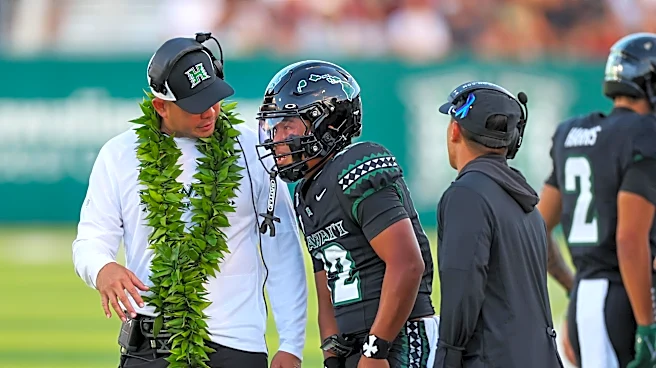
The encouraging sign came in the opener. Through three quarters at Stanford, Hawaii had seven points and 122 yards on 45 plays. Then head coach Timmy Chang let the offense go no-huddle. Over 30 fourth-quarter snaps, the ’Bows piled up 203 yards and 20 points and took a 27-23 lead with 4:06 left. That was the quick, confident Alejado the award committees had in mind.
For Niumatalolo and team, the mountain isn’t dormant, just quiet.
“With Micah at the trigger, they can go off at any time,” said Niumatalolo.
The Spartans’ formula writes itself. Make Hawaii earn every inch inside the 20, collapse the pocket enough times before the quick throws get too effective and somehow keep the fourth-quarter Alejado in the rearview mirror.