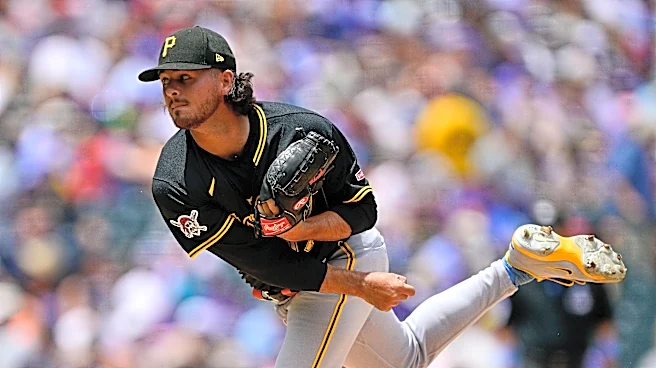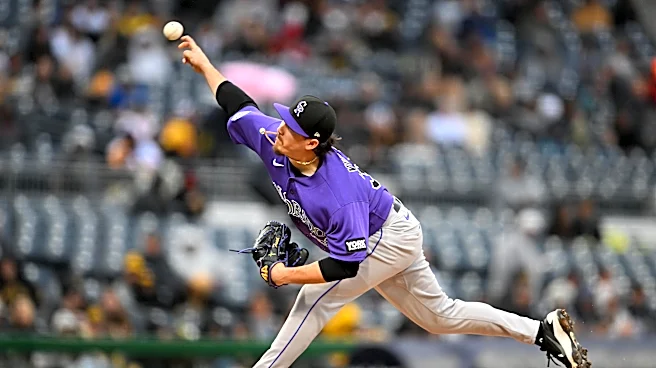








Victor Vodnik’s season does not make immediate sense.
He still averages 98.5 mph with his four-seam fastball. He produces ground balls at one of the highest rates in baseball. His slider has become a legitimate weapon, and hitters have not spent the year driving everything he throws into the gaps.
Yet through July 9, Vodnik owns a 5.72 ERA in 28.1 innings. He has allowed 31 hits and issued a staggering 19 walks, leaving him with almost as many free passes as strikeouts.
The obvious story is that Vodnik
has struggled.
The more useful one is that the shape of those struggles has changed. His recent improvement looks less like a complete fix than a pitcher finding better ways to survive the problems that remain.
Elite velocity, ordinary fastball results

Vodnik’s four-seamer supplies the first contradiction.
Its average velocity ranks in the 96th percentile, but the pitch has generated only a 20.4% whiff rate and a 15.2% strikeout rate. Hitters are batting .333 against it, although a .251 expected average and .386 expected slugging percentage suggest the actual results have been somewhat harsher than the quality of contact.
The movement profile helps explain why velocity alone has not been enough.
Vodnik’s fastball has 12.6 inches of induced vertical break, 3.2 inches below the average of comparable four-seamers. It also has less arm-side movement than similar pitches. This is not a fastball combining elite speed with elite carry.
It has elite speed, but ordinary shape.
That puts more pressure on location and sequencing. When Vodnik commands it, the velocity can still overwhelm hitters. When he does not, they have generally been able to put it in play.
The slider has become the foundation
The best development in Vodnik’s season is the slider.
He has increased its usage from 12.8% in 2025 to 26.9% this year, and hitters have managed a .174 average and .217 slugging percentage against it. The pitch has produced a 36.2% whiff rate, a .179 expected average and a .214 expected slugging percentage.
It is also his only positive pitch by run value.
Vodnik’s slider is not a wide sweeper. At 88.5 mph, it has only 2.3 inches of glove-side movement, less than comparable sliders. Its defining feature is depth: it drops nearly five inches more than similar pitches.
The shape remains compact before falling late beneath the barrel.
This is not an entirely new pitch. Its spin direction, active-spin rate and overall movement were similar last season. It is about one mph harder, but the larger change is trust.
Vodnik has more than doubled its usage and increasingly allowed the slider to organize the at-bat.
That has been especially visible lately. On July 2 against the Miami Marlins, he threw seven sliders and five fastballs, using the breaking ball to generate three harmless balls in play. On July 5 against the San Francisco Giants, he threw the slider 40% of the time and used it for both strikeouts.
Four days later, the fastball produced all three of his strikeouts.
Those are different routes through an inning, which is encouraging for a pitcher who spent much of the first half without a dependable one.
The pitch Vodnik lost
The slider’s emergence has been necessary because Vodnik’s changeup has moved in the opposite direction.
Even across uneven and sometimes limited big-league samples, the changeup had been his most dependable offering. It produced positive run value in each of his first three seasons: +1 in 2023, +5 in 2024 and +4 last year.
In 2025, hitters batted .109 and slugged .130 against it while missing on 44.2% of their swings.
This season, the changeup has fallen to minus-two runs. Hitters are batting .250 and slugging .550 against it, and its whiff rate has dropped to 25.6%.
Vodnik has allowed only three home runs all year. Two have come against the changeup, despite the pitch representing just 17% of his usage.
The pitch itself has been gradually changing.
In 2023, Vodnik’s changeup averaged 88.9 mph with 34.6 inches of total drop. It now averages 92.5 mph and drops 28.5 inches. The velocity gap from his four-seamer has narrowed from 8.2 mph to six.
For the first time in his career, the changeup produces less drop than comparable pitches while generating more arm-side run. In his first three seasons, that relationship was reversed.
The pitch has not lost movement. It has redirected it.
It is harder, runnier and less depth-oriented. The changeup may still follow the fastball convincingly out of Vodnik’s hand, but it no longer creates the same late downward separation.
The contact supports the concern. Average exit velocity against it has increased from 84.1 mph to 91.3, while average launch angle has jumped from minus-15 degrees to 14.
Hitters are no longer rolling it over. They are lifting it.
Owen Caissie drove a 93.8 mph changeup 394 feet on March 29.
Then on June 29, Griffin Conine hit a flat, elevated version 433 feet at 110.1 mph.
The misses were not identical. One was extremely firm and centered. The other stayed high and never got beneath the barrel.
Both remained on hittable planes.
The walks explain the innings
The changeup is part of Vodnik’s regression, but it does not explain every poor outing.
He did not throw a changeup during his five-run appearance against the San Diego Padres on April 23. The Padres still put four balls in play, collected four hits and hit three of them hard.
More broadly, Vodnik has not allowed much extra-base damage. Among his 31 hits are six doubles, no triples and three home runs.
The better explanation is 19 walks.
On May 12 in Pittsburgh against the Pirates, Vodnik allowed three singles and a walk while recording two outs. None of the hits went for extra bases, but the inning became crowded, a run scored and he left with the bases loaded.
Six days later against the Texas Rangers, a leadoff double was followed by consecutive walks. Vodnik departed without recording an out, and all three runners eventually scored.
The expected metrics soften his 5.72 ERA, but they do not erase the underlying problem. Vodnik owns a 4.46 xERA and a solid 36% hard-hit rate, but his 5.03 xFIP remains poor.
Major-league pitchers are striking out roughly 22.0% of hitters and walking about 8.9%, a difference of 13.1 percentage points. Vodnik sits at 16.8% and 14.5%, a gap of only 2.3 percentage points.
Ground balls can clean up some traffic. They cannot be expected to clean up all of it.
Surviving the walks
Vodnik’s recent improvement has come since returning from the 15-day injured list on June 15. He had missed nearly a month with right ulnar nerve inflammation and made two scoreless rehab appearances with Triple-A Albuquerque before rejoining the Rockies.
Over his last seven appearances, Vodnik has allowed one earned run on five hits in 9 2/3 innings, good for a 0.93 ERA and 0.93 WHIP.
The walks have not disappeared. He has issued four during that stretch, but he has also struck out six and avoided the clustered contact that buried several of his earlier outings.
On June 22, he opened consecutive innings with walks. The first was erased by a double play. After the second, Vodnik retired three straight hitters on a groundout, flyout and groundout.
On July 5, a two-out walk was followed by a groundout. On July 9, another two-out walk was followed by a strikeout.
That final appearance was his most encouraging. Vodnik struck out three hitters over 1 2/3 scoreless innings, generating four whiffs on 10 fastball swings. For one outing, nearly 99 mph produced the results its velocity promises.
He still needed 34 pitches to record five outs and issued another walk.
That is the difference between stabilization and restoration.
Vodnik is finishing innings better without consistently starting them better. He has limited the multi-run damage, leaned into the slider and occasionally found enough fastball command to create his own exits.
The walk remains waiting for the next single.
A full recovery would require more strikes, fewer free passes and either a restored changeup or a clearer fastball-slider identity that does not depend on it.
For now, Vodnik has found better ways through innings.
He has not yet made them safe.
On the Farm
Triple-A: Sugar Land Space Cowboys 10, Albuquerque Isotopes 0
The Isotopes fell to 46-45 after being routed 10-0 by the Space Cowboys, who improved to 43-47.
Sugar Land scored all 10 runs in the first three innings, putting up three in the first, four in the second and three in the third. Mason Green, whose ERA rose to 6.02, allowed seven runs over two innings. Eiberson Castellano gave up three runs over four innings and now carries a 4.15 ERA.
Albuquerque managed only four hits, went 0-for-8 with runners in scoring position and struck out 11 times. Charlie Condon supplied the lone offensive bright spot, going 2-for-4 to raise his average to .289 with a .998 OPS. Victor Juarez finished with two scoreless innings, lowering his ERA to 17.05.
Double-A: Hartford Yard Goats 7, Binghamton Rumble Ponies 2
Hartford took control early and never gave Binghamton much room to recover, scoring seven runs between the second and fifth innings on the way to a 7-2 win.
Jack O’Dowd reached three times, going 2-for-4 with a walk, an RBI and two runs scored. Across his first 10 Double-A games, he is hitting .275 with a .912 OPS. Roc Riggio went 1-for-2 with three walks, three runs, two stolen bases and his 21st double, raising his season line to a .256 average and .867 OPS.
Braylen Wimmer led the offense with three hits and two RBI, while Andy Perez also drove in two runs.
On the mound, Jack Mahoney allowed two runs, only one earned, on four hits over 7 2/3 innings, striking out nine and walking one. He improved to 5-1 with a 1.98 ERA.
Hartford improved to 46-38, while Binghamton fell to 31-54. The Yard Goats finished with nine hits, drew seven walks, stole four bases and went 6-for-16 with runners in scoring position.
High-A: Eugene Emeralds 9, Spokane Indians 4
Eugene buried Spokane with a six-run first inning and never gave up control, handing the Indians a 9-4 loss.
Ethan Hedges provided the main offensive highlight for Spokane, going 2-for-4 with his ninth home run and two RBI. He is now hitting .272 with a .763 OPS. Kelvin Hidalgo also had two hits, including his 11th double, and drove in a run.
The Indians managed only five hits and went 1-for-4 with runners in scoring position. Lebarron Johnson Jr. allowed seven runs, six earned, on nine hits over three innings and fell to 1-4 with a 4.65 ERA.
Eugene finished with 14 hits and went 5-for-10 with runners in scoring position. Dakota Jordan led the way with four hits, three home runs and four RBI.
Single-A: Fresno Grizzlies 9, Stockton Ports 2
The Grizzlies improved to 46-39 with a 9-2 win over the Ports, who fell to 37-48.
Fresno jumped ahead with three runs in the first inning and added four more across the final two frames. Wilder Dalis led the offense, going 3-for-4 with his seventh home run, his 14th double, five RBI and two runs scored. He is now hitting .278 with an .862 OPS.
Cameron Nelson also homered, his sixth of the season, while Luis Mendez added his second.
Brady Parker allowed two runs on three hits over six innings, striking out eight and walking four. He improved to 5-3 with a 4.52 ERA.
Fresno finished with seven hits, drew seven walks and struck out nine times. Stockton managed seven hits but went 0-for-9 with runners in scoring position and struck out 14 times.
Rockies Should Target Tyler Bell as a Long-Term Fit at No. 10 | SI.com
In some draft-day reading, Sports Illustrated’s Wesley Dixon makes the case for Tyler Bell at No. 10, citing his polished approach, switch-hitting bat and defensive flexibility. Dixon views Bell as a natural second-base fit who could grow alongside Hunter Goodman, Ethan Holliday, Charlie Condon and Zac Veen.
MLB Pipeline’s final mock draft predictions! | MLB.com
In MLB Pipeline’s final mock draft, Jonathan Mayo sends Virginia outfielder AJ Gracia to the Rockies at No. 10, while Jim Callis projects Kentucky shortstop Tyler Bell. Both expect Roch Cholowsky to go first overall, with the top four likely falling Cholowsky, Grady Emerson, Vahn Lackey and Jackson Flora before the draft becomes far less predictable.
Rockies Reacts Survey: The 2026 MLB Draft is on Saturday! | purplerow.com
Purple Row also asked readers who they thought the Rockies would take with the No. 10 pick. The poll is now closed, but the comments are full of draft-day predictions, preferred targets and plenty of debate over what Colorado’s new front office should prioritize.
Join the conversation!
Sign up for a user account and get:
- Fewer ads
- Create community posts
- Comment on articles, community posts
- Rec comments, community posts
- New, improved notifications system!
Please keep in mind our Purple Row Community Guidelines when you’re commenting. Thanks!