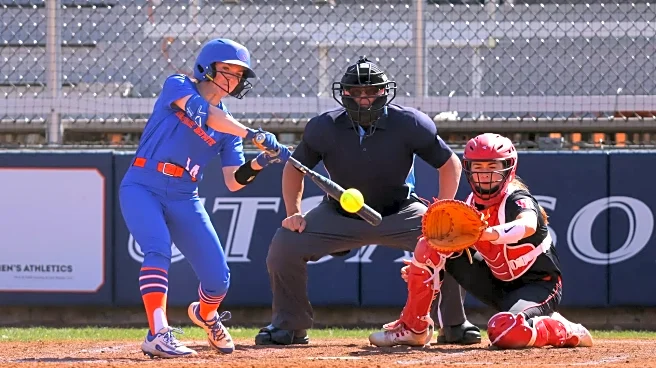

As February quickly approaches, so too does the 2026 Mountain West Conference softball season. This season is set to be arguably the most competitive in MWC softball history, with multiple teams receiving
votes in the recently released preseason Top 25 polls, and former WAC power Grand Canyon joining the conference as an immediate favorite.
Prior to the season, I figured I would take the time to check in on the state of each team in the conference, seeing what has changed, stayed the same, and what can be expected of the teams in the Mountain West during its final season before conference realignment, starting with one of the teams joining the Pac-12 next season, the Boise State Broncos.
Most who don’t follow MWC softball would immediately assume that Boise State’s softball program is probably dominant in the same way that they are in seemingly every sport they compete in.
Rather surprisingly, though, the Broncos’ softball team is rather mediocre, at least by their standards, as the Broncos enter 2026 seeking just their third MWC title. Despite winning a conference-leading 285 games over the last nine seasons, both of the Broncos’ MWC titles were in the regular season (2018 and 2023), and they have yet to win a tournament title, making it to the tournament all three years of its existence but falling short each time.
We’ll take a look at the Broncos’ schedule for the upcoming season, their hitting and pitching cores, and I’ll end with a prediction for how this season will play out for Boise State.
Schedule
The Broncos will open up their season with a nonconference matchup in Moraga, California, on February 5 against Loyola Marymount, a team the Broncos have historically enjoyed success against, winning seven of their last nine contests against the Lions.
Next, the Broncos will make the short trip to Fullerton, California, from February 6-8, to participate in CSU Fullerton’s Easton Classic. BSU will immediately face their first major test, facing off against No. 22/24 Ole Miss, a team which advanced to the Women’s College World Series a season ago, placing 8th. The Broncos will then face off against hosts CSUF, followed by games against CSUN, Portland State, and a rematch with Fullerton to close out the event. The Titans were favorites in the Big West a season ago, knocking off #5 ranked LSU at one point before falling flat in the conference tournament, missing the tournament entirely.
The Broncos then head to La Jolla and San Diego, California, from February 13-15, to participate in the UCSD/USD Tournament. In La Jolla, they will face Weber State and FDU, and in San Diego, they will face Southern Utah, Omaha, and SUU again to close out the event. Omaha is the star matchup of this tournament, as the Mavericks are the reigning Summit League champions.
After this, the Broncos have a few days to prepare for the brutal gauntlet that is Stanford’s DeMartini Invitational, from February 19-22, in Palo Alto, California. Here, they will face off against preseason #18/21 Arizona, reigning WCC champions Santa Clara, #1/1 Texas, and a back-to-back against the hosts, #17/18 Stanford. This will be a formidible test for the Broncos, and a great chance to prove their worth in the eyes of the committee.
The Broncos’ next MTE is in Fayetteville, Arkansas, from February 27-March 1, at the Wooo Pig Classic. Here, they will face preseason #8/8 Arkansas, have a rematch against Omaha, play two games against Kansas, and conclude the event with a matchup against Charlotte.
Finally, the Broncos will head back home to Boise, Idaho, from March 5-8, to host the Blue Collar Classic. Here, the Broncos will face Cal Baptist, St. Thomas, and have two matchups each against Portland State and Weber State, the latter of whom is the reigning Big Sky Conference champion.
Once conference play starts, the Broncos have no more home non-conference matchups, with their only road non-conference games being against Idaho State and a doubleheader against Sacramento State.
In conference, the Broncos will host Fresno State, New Mexico, UNLV, and San Jose State, a relatively light slate given last year’s rankings. On the other hand, the Broncos’ road slate is arguably the most brutal in the conference, facing Nevada, Colorado State, Utah State, Grand Canyon, and San Diego State. Nevada is the reigning regular-season champion, and GCU and San Diego State both made the NCAA Tournament a year ago, each receiving votes in preseason polls.
This schedule is full of challenges for Boise State, especially in Palo Alto and on the road in conference. Last year’s team would give me confidence as to the performance we should expect in these matchups, but unfortunately for Bronco Nation, this year’s team is not the same team it was a year ago.
Hitting Core
The 2026 Broncos are seeking to go out on top, but it seems that this may instead be a rebuilding year for fifth-year head coach Justin Shults’ squad, as the transfer portal and graduation were not kind to the Broncos this offseason.
A year ago, the Broncos were ranked at the top of the conference in batting average with a mark of .345, good for 9th-best in all of the NCAA. They were led in this regard by star center fielder Sophia Knight, whose .486 average was good enough for third-best in the country, and who was the only player in the top 20 who had over 200 at-bats while maintaining that high of an average. She was joined in the top 20 of the Mountain West by fellow Broncos Megan Lake, Quinn Southerland, MWC Freshman of the Year Makenzie Butt, Brooklynn Pettis, and Mykenzie Hanna, along with fellow top-40 hitters Sydney Groves and Leah McAnally.
The problem? Almost every single one of the players I just mentioned is now gone. Knight and Butt transferred to Tennessee, Groves transferred to Idaho State, McAnally went to Iowa, while Lake, Pettis, and Hanna all graduated away from the program.
That is a huge amount of lost production at the plate. The only remaining player from Boise State’s murderer’s row of hitters is now-sophomore Southerland, who hit .364, with 2 home runs, 26 RBIs, and an OPS of .902 in her sneakily great freshman season. Southerland will now go from a pleasant surprise on a hot-hitting team to the predicted leader at the plate for a team that lost the majority of its core in the offseason.
The resulting offseason additions resulted in one of the youngest teams ever assembled by a Division 1 softball team. Boise State only has two seniors on its roster. One is former top hitter Hollie Farmer, who is coming off of a down season where she hit just .195. The other is South Carolina transfer Marissa Gonzalez, who entered the transfer portal in September of 2024 and went unsigned for a whole year. Now she enters her redshirt senior season with the Broncos looking to shake off an entire year of rust, hopefully returning to the form she had in 2023 when she was a rising star in the SEC.
The only returning player other than Farmer that saw a significant amount of action last season is sophomore Chloe Hughes, who hit .264 in her 106 at-bats a season ago.
Outside of those four, it will be up to a chorus of young players and transfers to pick up the pieces as they go. The ones I am looking at the closest are Cal Baptist transfer Kate Penberthy and Utah Tech transfer Jorja Crider.
Penberthy is coming off of a season for the Lancers where she broke their D1 softball record for RBIs in a season with 45, while hitting .288 with an OPS of .835. Crider enters off the back of a freshman season for the Trailblazers where she immediately proved herself to be a star-caliber player, driving in 23 runs in just 26 starts, while leading her team in home runs (7) and in OPS (.961). Crider may easily end up as the Broncos’ best player in 2026 if she keeps putting in performances like she did last year.
There are several freshmen that could easily make an impact, most notably of them being Twin Falls, Idaho star Molly Hodge, who recorded a career batting average of .528 and a career OPS of 1.494. However, unless most or all of these players can at least get to Southerland’s level, the Broncos’ hitting core will suffer at least some regression from their amazing performance of a season ago.
Pitching Core
Whereas the hitting core was the Broncos’ best trait a season ago, the pitching core was a major weakness. Across all games, the Broncos gave up an ERA of 4.90, good for 7th in the MWC. This underscores just how good they were at the plate, since the Broncos still finished the year in fourth place, where the only teams that beat them (SDSU, Fresno State and Nevada) all had team ERAs below 3.00.
So while the Broncos were getting torn apart by the transfer portal, they also had to try and fix their pitching staff. Thankfully, this is a unit where Boise State wasn’t starting completely from scratch.
The Broncos’ best pitcher from a year ago was freshman Olivia Bauer, who returns to the Broncos for her sophomore season. In 2025, Bauer had a team-high ERA of 3.94 across her 16 starts and 33 appearances, finishing the year with a 9-5 record. Bauer also showed great poise under pressure by delivering a complete game shutout against the Utah State Aggies, the second-best hitting team in the conference, in the Mountain West Championships. Now a sophomore, Bauer should be the ace of the Broncos’ staff again this season.
Fellow sophomores Shannon Keighran and Julianne Rose are the Broncos’ other returning pitchers, both recording ERAs above 5.5 in their freshman seasons. Of note, Rose served as the Broncos’ primary closer for much of the second half of the season alongside sophomore Abby Dowell, who, unsurprisingly at this point, transferred in the offseason, this time to Tarleton State.
The Broncos acquired zero pitchers in the transfer portal, leaving us to look at their freshmen: Charley Duran, Loula-Rae McNamara, and Kodi Crabtree. Of these three, I think McNamara and Crabtree each have the makings of good collegiate pitchers.
McNamara had a career record of 23-7 in high school, posting an ERA of 1.28 in her junior season, holding batters to a batting average of .177. Crabtree, meanwhile, is coming off of a senior season in the competitive Arizona high school softball scene where she posted an ERA of 1.52. Those numbers are both a little better than those achieved by Rose in her senior season of high school, so expectations should be placed around that area for the two.
Like the hitting core, the pitching staff is very young, but with the staff mostly being rounded out by adding freshmen this offseason, I wouldn’t expect too much more from this group this year than what they were able to achieve last year.
Prediction
2025 Result: 34-22 (11-11 MWC), Regular Season: 4th, Tournament: 4th, Missed NCAA Tournament
2026 Prediction: 25-30 (11-14 MWC), Miss Conference and NCAA Tournaments
It may seem a bit bold to predict this sort of regression from a Boise State athletics program, and even I sit here doubting myself while writing this, but I cannot see a way where the Broncos can overcome all of this adversity and break through the glass ceiling in their final season in the MWC.
Obviously, stars can come out of nowhere and from anyone of any experience level, especially in softball. So, while it is certainly not all doom and gloom for a usually hot-hitting Bronco softball team, it is rare you will ever see a team that was quite as decimated as the Broncos were this offseason. This results in expectations for the Broncos that lean more towards a transition season than a contending one.
Transfer additions like Kate Penberthy and Jorja Crider will likely join Quinn Southerland at the top of the batting order, but those three will not be enough unless they each perform at a Sophia Knight-like level. Others will need to step up, and that is never a guarantee with a group of mostly freshmen.
Bauer should still be the team leader in the circle and will likely improve, but with the contenders of the conference all having at least one elite pitcher, Bauer will have to take more of a step forward in her sophomore season than most are capable of in order to carry the Broncos to contending status, à la Sarayah Neiss and last year’s Fresno State squad.
On top of all of this, one must consider the Broncos’ difficult nonconference schedule and their absolutely brutal conference draw, facing the projected three best teams in the Mountain West on the road. Plus, only 6 teams make the conference tournament every season, and with the addition of GCU to grow the conference to 10 teams, that means even less margin for error for the teams around the bubble, which Boise State should be.
Next up will be the preview for the Colorado State Rams, dropping tomorrow at 8 a.m. PST.