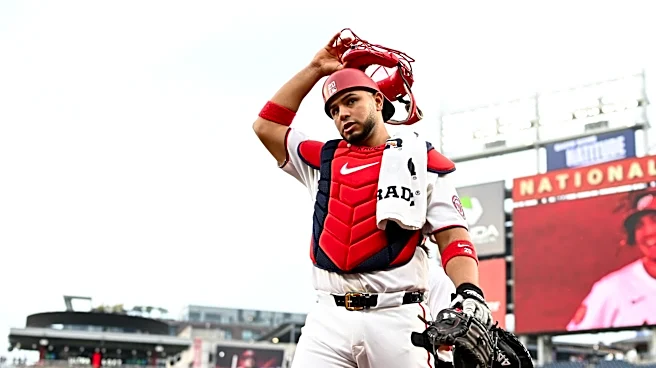



Entering 2026, the catcher position was one the Nationals were dying to get more production out of, as their catching room ranked dead last in fWAR in 2025 with -1.3. Keibert Ruiz had steadily been declining ever since being extended in early 2023, and Drew Millas and Riley Adams each had something to offer in a backup role, but probably not in a starting role. The acquisition of Harry Ford for Jose A. Ferrer in the offseason provided the Nats with a little more long-term clarity about the position,
but probably not an immediate solution.
Turns out, the answer to the Nationals’ catching woes was just a commitment to better coaching; with the new staff in charge, the Nats’ catching room took a major leap, going from last in fWAR in 2025 to 17th in 2026. Now, as the Nationals enter a critical offseason for setting them up for success in the near future, let’s take a look at the Nats’ catching unit as a whole, and make sense of where playing time makes the most sense to go to in 2027.
Keibert Ruiz
Keibert Ruiz took the biggest leap of perhaps any National under the new coaching staff in 2026. He hit .280/.316/.443 with 10 home runs and a 105 wRC+, making him five percent better than the league-average hitter after adjusting for league and ballpark. His 1.9 fWAR was a considerable improvement from his -1.1 mark in 2025, and made him a completely viable starting catcher option for the Nats.
The defensive improvement mattered just as much. In 2025, Ruiz finished with minus-six blocks above average, plus-one caught stealing above average, and minus-nine framing runs. Those numbers illustrate why catching defense requires more than counting runners thrown out. His throwing was respectable relative to his opportunities, but other parts of his game remained costly.
In 2026, Statcast credited Ruiz with plus-two catching runs, including plus-three framing runs, zero blocking runs and minus-two throwing runs, along with a positive ABS contribution. Blocking runs and blocks above average are different measures, but the broader improvement is clear. Ruiz became a more complete catcher, even with room to improve against the running game.
Ruiz’s contract went from practically unmovable last season to now not bad value, and raises the question of if another team called the Nats with an offer for Ruiz, should they consider it? Ruiz certainly now looks like at least a decent platoon option behind the plate, but the presence of some other catching options in Triple-A could make him expendable depending on how the front office feels.
Harry Ford
Ford’s first season with the Nats was hardly a declaration that the position belonged to him. In 38 major-league games, he hit .190/.314/.350 with three home runs and an 87 wRC+. His Triple-A performance also fell short of expectations: a .223/.370/.335 line and 96 wRC+.
There were encouraging details beneath those numbers. Ford walked in 14.4 percent of his major-league plate appearances, showing that his patience could survive the jump. But getting on base cannot carry the entire offensive profile. The Nats need more consistent contact and damage when he swings.
Ruiz and Ford are a sensible catching platoon, as Ruiz performs better against righties and Ford performs better against lefties. Still, Ford may need to take a step forward either offensively or defensively in 2027 to guarantee his starting role moving forward.
Maxwell Romero Jr.
Romero delivered the loudest power numbers of the group, hitting 23 home runs across Double-A and Triple-A while batting .253/.364/.515. He reached Rochester in July, putting himself close enough to matter in the 2027 discussion.
Minor-league production does not automatically translate into major-league success. Nevertheless, that combination of power and on-base ability deserves consideration at a position where the Nats have struggled to generate offense.
Romero should enter spring training with a chance to push the established options. Depending on how Romero performs, Ruiz may become a luxury rather than a necessity for the Nats, one they could move to upgrade other areas such as the pitching staff. At minimum, he gives the Nationals another potential answer if injuries or poor performance disrupt their plans.
Where do Drew Millas and Caleb Lomavita fit?
Millas faces a tougher argument after hitting .185/.277/.262 with two home runs and a 53 wRC+ in 50 games. A backup catcher can survive below-average offense, but that level of production leaves little margin elsewhere. He looks more like depth than someone the Nats should pencil into its preferred tandem.
Lomavita remains a longer-term consideration. He hit 14 home runs with a .244/.311/.453 line and 102 wRC+ at Double-A. The power increased considerably from his six-homer 2025 season, though his overall offensive production was only slightly above league average. His season also ended on the injured list.
Entering 2027, Ruiz offers the strongest immediate case, Ford remains the key development priority, and Romero supplies intriguing pressure from below. For the first time in a long time, the Nats seem to have some solid options for how they move forward with their catching unit, rather than hoping for the best from what they had.