


On Saturday afternoon, the sands of time fell to the bottom of the hourglass for Northwestern.
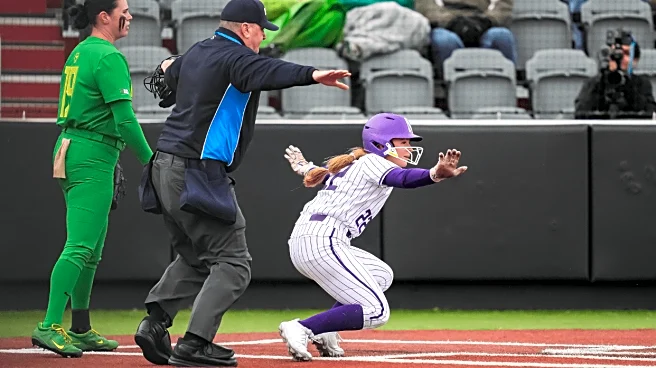
Trailing by four runs in the bottom of the seventh against No. 17 Oregon with the bases loaded and one out, the tying run — Bridget Donahey — stepped into the box ahead in the count, 2-0. Abruptly, the home-plate umpire yelled to the crowd and stopped the game.
Then, the trio of officials walked to the fence, the Oregon defense threw up the “O” with their hands and Northwestern stood around stunned. The game
had ended via college softball’s “drop-dead” rule, a strict three-hour time limit designed to give the visiting Ducks enough time to make their commercial flight back to the West Coast. Under the rule, the score reverted back to the last completed inning, and the ’Cats lost 4-2. Another series gone.
Maybe it was a fitting ending to a chaotic weekend, but that didn’t make it any less jarring or upsetting for the Northwestern squad.
Across three games, the Wildcats never held onto one version of themselves long enough to see it through. In game one, everything snowballed in its favor; in the next, nothing got started; and in the deciding finale, it lingered somewhere in between.
A chaotic series calls for a chaotic column. This week, I’m changing to a new section focusing on aspects I can’t place into the good or bad category. This doesn’t mean I don’t think there were strict positives or strict negatives, but rather that my takeaways as a whole aren’t easily explained this week by mostly good or mostly bad labels.
Grab your favorite snack, a tall glass of water and let’s dive in.
The Question Marks..?
The gloves are up, down and around
Pictured below is a makeshift spray chart from this weekend alone. It includes all playable balls from Oregon (so no homeruns, strikeouts, walks, etc.), and every purple dot you see was a ball in that specific sectioned zone. For example, there were 9 balls in the center zone, covering the positions of the center fielder, the pitcher and the catcher.
The percentages denote the number of balls in a specific zone that were converted into outs. The leftmost zone (42.9%) and the center zone (44.44%) are the most troublesome areas, followed by the right center (66.6%), the left center (78.6%) and the rightmost zone (80%).

I give far more grace to the center zone, as many of the hits in this area were bloopers too far in for Kaylie Avvisato to grab safely. So, while it was low on paper, it’s due to the contact type rather than any defensive failure.
In the far-left zone, Northwestern converted balls-in-play to outs at almost half the right as it did on the far right (42.9% to 80.0%), which translates to multiple extra baserunners coming from one area alone. If that left zone had performed at even the team’s best rate (80%), you’re probably looking at two to three additional outs. That’s potentially an entire inning erased and more runs left on base.
What stands out even more about this zone is how often the Ducks went there. They were consistently putting pressure on the weakest area of Northwestern’s defense. Whether due to early swings against Wildcat pitchers or simply an approach built on punching holes, the result was the same. There were far more balls in play in the least efficient zone, giving more opportunities to reach base.
Digging deeper, these percentages pattern with where the errors came from this weekend: three from Tru Medina at third (left zone), three from Grace Nieto at second (right center zone), one from Bridget Donahey at short (left center zone) and one from Emma Raye (center zone).
There were eight total errors this weekend. And while only three runs officially scored off these, any extended inning is detrimental. Innings that go long force pitchers to face more batters, thereby driving up pitch counts and creating more opportunities for runs to score indirectly. In that sense, the errors function as inning multipliers rather than isolated mistakes.
I have harped on Medina at the hot corner for a while now; she is up to 14 errors on the season (.827 FLD%), with three in conference play, but Nieto is also not doing too hot. The grad student has accumulated 12 errors on the season (.886 FLD%) and four in conference.
However, as with last weekend at Illinois, there were moments when everything clicks. The infield is sharp, decisions are quick, and outs come easy. There were five double plays against Oregon — three in the second game and two in the third. More than double what the ’Cats already had this season (four).
Izzy Cunnea made some great sliding basket-catches and got some tough outs on foul balls in left, relays to home were on point, Emma Raye was aggressive behind the plate and many innings that could have snowballed into multiple runs for Oregon turned into a left on base statistic instead.
The defense showed it can operate at a high level, but the gap between its best and worst moments is too wide. When one side of the field is converting at 80%, and another sits below 50%, it doesn’t take a high-powered offense to exploit it.
The production line
Northwestern’s offense was defined by inconsistency. The ’Cats hit .316 with runners in scoring position this weekend. Seems pretty great, right? Until you break it down: .416 in game one, .000 in game two and .200 in game three. Game one is doing some heavy lifting on that average.
The same thing shows up in run efficiency. Northwestern averaged 1.22 runs per hit in game one, then dropped to zero the next game and just .33 in the finale. This was against the very same pitchers, by the way.
Below are the game-by-game breakdowns. Purple is Northwestern, green is Oregon and each row is one game.

At first glance, it’s easy to ask: Did Oregon simply have an off day?
Its ace, Lyndsey Grein, had no strikeouts and three walks. Coming into the weekend, Grein held opponents to a .163 batting average, but Northwestern hit .222 off her in game one. Taylour Spencer only recorded one strikeout and issued two walks. The outfield played the ball horrendously off the bat and allowed for extra bases; there were also four errors.
Arguably, game one could have been a fluke, especially given the rainy weather that saw Grein struggle with her grip.
After seeing both pitchers the day prior and having success, the expectation would be some level of carryover. Instead, the offense completely stalled: one hit, 10 strikeouts and no real pressure put on the defense. I argue that points less to pitcher dominance and more to an approach shift or lack of adjustment.
While there were highlights of good hitting, it was never strung together or enough to give an edge after the first game concluded. This weekend was like any game against good teams this season; the offense only shone in bursts. Until Northwestern learns to string hits together and sustain pressure, the scoreboard will continue to swing wildly from promising highs to frustrating droughts.
Weeklies
Best game: Game three is my best this week. I know, not giving it to the win is risky, but I think the finale was filled with plenty of twists and turns. It kept you on the edge of your seat, if you will.
The pitchers’ duel through three innings was enjoyable to watch, and Northwestern made some great clutch plays. Bats came alive after a silent Friday game, and for a moment there, Northwestern almost pulled it off.
While a blow-out is fun (if you’re on the winning team), a game where both teams were tied across the major statistical categories and every play mattered showcases a different kind of excitement that keeps me coming back for more.
Also, look at this amazing double play that almost earned the play of the week award!
Best play: I often give preference to outfield because I was a center fielder, but what could be better than Kaylie Avvisato flexing her moves in the first game of the contest? Plus, it made Sports Center top ten, so trust them if you don’t trust me.
Ma’ake’s hit to shallow center was no match for the sophomore, who, after sprinting in, dives in superman fashion to make the out.
After the play, Avvisato dabbed it out while her teammates hugged her and jumped in excitement. Cunnea also made sure to point to the board for the replay, so her teammate could see the fantastic catch she had made on the big screen.
The Bounce Back
Northwestern faces Michigan for another homestand in Rosemont. The Wolverines enter off two run-rule victories against Purdue, and through the six pitchers on the roster, they carry a 3.16 ERA. Its two aces sit at 2.82.
At the plate, Michigan is equally dangerous. Five hitters are batting over .300 in conference, and six boast on-base percentages above the same mark, making sustained rallies a real threat.
For Northwestern, this series is a chance to prove it can string together consistent offense and sharpen its approach against quality pitching. It also gives room for more pitchers besides Marina Mason to have controlled games. If defense cleans it up and offense is consistent, this series can be a big win.