
In honor of the Philadelphia Phillies playing host to the 2026 Major League Baseball All-Star Game at Citizens Bank Park, we here at The Good Phight are launching a yearlong series that focuses on the history of the Phillies and the All-Star Game.
Check back regularly for posts about the Phillies participation (or lack thereof) in the Midsummer Classic over its history.We’re back again, and this one is going to be a doozy. For those who have been following along with this series and who are of a certain
age or know their Phillies history, you knew that this decade would be a full one. And it is, with a whopping 8 one and done All-Stars, the most of any decade in this silly exercise. So please bear with me as this will be an extremely long post and I apologize in advance for the delay in receiving it.
The series so far: 1930s, 1940s part 1, 1940s part 2, 1950s, 1960s, 1970s,1980s part 1, 1980s part 2
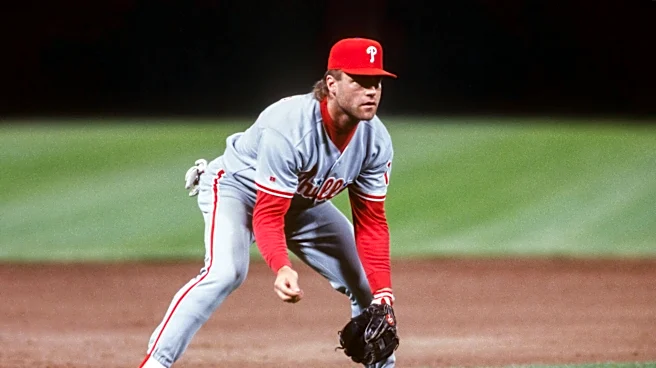
Dave Hollins, 1993
Naturally, our list begins with two members of the 1993 National League champion Phillies. Dave Hollins was the frighteningly intense third baseman of those ‘93 Phillies, but before that, he was the sixth-round pick of the San Diego Padres in the 1987 MLB draft. Hollins was just a junior at the University of South Carolina at the time who hit .302 with 4 home runs a year after he slugged 19 homers his sophomore year. The Padres assigned Hollins to short-season A-ball in Spokane where he hit .309 with 2 home runs in 75 games as a 21-year-old.
It wouldn’t be long before Hollins found himself getting promoted, as he ended 1989 in Double-A after hitting .275 with a .775 OPS. But even with his growing status as a prospect, the Padres and their manager Jack McKeon decided to leave Hollins off the 40-man roster despite having three open spots, thus exposing him to the Rule-5 draft. That’s when the Phillies’ general manager Lee Thomas decided to select Hollins in the second round of the draft, snapping him up from San Diego for no cost. The Padres regretted their decision, with one executive placing the blame on McKeon who “has never been enthralled with younger players” and lamented “Jeez, as hard as third baseman are to find, you don’t just give a prospect like this away.”
But that’s exactly what the Padres did, and Hollins was thrilled about it, saying “As soon as I got the news, it was a boost for my confidence. I think I can make the team. I just hope they give me a shot to show that I can play.” And that’s exactly what the Phillies did, as they were searching for a successor to Mike Schmidt and incumbent third baseman Charlie Hayes did not show enough to warrant off any competition for the majority of playing time. Hollins stayed with the Phillies for all of 1990 but only appeared in 72 games and hit .184. Still, it fulfilled the Rule 5 draft requirements for the Phillies to retain Hollins, so they were now free to move him around their system at will.
And that’s exactly what they did in 1991, as Hollins was demoted to Triple-A following an April where he hit went hitless across 14 plate appearances in just 8 games played. Hollins had made the Opening Day roster despite most expecting him to start in Triple-A, but that poor performance and his ultimate lack of playing time led to him being sent to Scranton anyway on April 23rd, the same day the team fired manager Nick Leyva and replaced him with Jim Fregosi. Hollins meanwhile started out poorly in Triple-A before catching fire in June, hitting .330 with three home runs and 14 RBIs while capturing minor league player of the month honors. It was a well-timed hot streak, as Phillies third baseman Charlie Hayes was bottoming out with his average sitting at .203 by the end of June. Hollins found his way back to the majors on July 11th and showed why the third base job should be his as he hit .326 with a .963 OPS in 48 games after being recalled.
The Phillies entered 1992 with Hollins firmly entrenched as their starting third baseman, as the team had shipped Hayes to the Yankees in early January. Hollins took full advantage of his first chance at every day playing time, as he turned in a season that landed him 20th in MVP voting despite the Phillies finishing in last place. Now being known as “Mikey”, a nickname coined by teammate John Kruk to refer to the uber intense persona Hollins would slip into, the 26-year-old Hollins hit .270 with 27 home runs. His season highlight may have come very early into the year though, as Hollins collected 5 RBIs on a two-run homer and a three-run triple on April 27th against his old team the Padres. “I do get up a little more for them than any other team,” Hollins admitted after the 12-9 win. “It’s just the fact that I did play for them. It gives me incentive to play well because I do like to beat them.”
That exact sentiment, the feeling of proving someone wrong out of pure spite, would fuel Hollins and many of the 1993 Phillies. Hollins, along with Kruk, Darren Daulton, Lenny Dykstra, Pete Incaviglia, and Mitch Williams made up the core of what became known as “Macho Row,” the group of veteran throwbacks and castoffs that became the heart of the ‘93 Phillies as they stormed their way to a shocking NL pennant. The hard-edged Hollins was a big part of the team’s record-breaking fast start, as he hit .302 with 8 home runs through the end of May. But Hollins had been playing with a sore wrist until finally a groundball in infield practice on June 10th that aggravated the injury led to imaging that revealed a fracture in the hook of the hamate bone. Hollins underwent surgery on June 15th and was originally anticipated to miss four to six weeks, but he returned to the lineup almost exactly two weeks to the day of his surgery on June 28th.
But Hollins wasn’t quite the same after the injury, as he was hitting .237 across 15 games by the time the All-Star break came around in July. Hollins acknowledged that he may have come back a little early but felt the need to be in the lineup as long as he was cleared to play in order to try and bring stability, adding “So I’ll take my lumps for a while, then I’ll be ready to go.” Despite his poor post-injury performance, Hollins’ strong first half of the season was enough to have him named to the 1993 All-Star team at Camden Yards in Baltimore. Unlike his teammates Kruk, Daulton, and pitcher Terry Mulholland, Hollins did not start the game but rather entered in the bottom of the sixth as a defensive replacement at third for Gary Sheffield. Hollins got his chance to bat in the top of the eighth with the NL trailing 9-3 and a runner on first with one out. Facing Rick Aguliera of the Twins, Hollins ripped a double to right field to put runners on second and third with one out. But the NL couldn’t capitalize on the chance, as Andrés Galarraga popped up to shortstop and Jeff Blauser struck out to end the inning. In any case, Hollins may not have started like his teammates, but he was the only Phillie to collect a hit in the game the NL lost 9-3.
Hollins rebounded enough in the second half to end the regular season with a .273 average and 18 home runs in 143 games. He was given the opportunity to make up for his injury diminished regular season in the postseason though, as the surprising Phillies won the NL east and then dispatched the Braves in the NLCS to reach their first World Series since 1983. Hollins did indeed find a way to contribute, as he homered twice against the Braves including launching a two-run homer off of Greg Maddux in the decisive Game 6. Unfortunately, the magic carpet ride ended one stop short of immortality for Hollins and the Phillies, as they were dispatched by the Blue Jays in the World Series.
Hollins got off to a bad start to 1994 before the season was canceled due to the player’s strike. He was also diagnosed with diabetes, something that would adversely affect the rest of his career. The arrival of 1995 quickly showed that the Phillies nor Hollins would be able to recapture the magic of ‘93. Hollins was ultimately benched and then requested a trade. His wish was granted on July 25th when he was sent to the Boston Red Sox in exchange for Mark Whiten. Hollins went on to appear in only five games with the Red Sox before suffering a broken wrist that required surgery, ending his season in early August. He signed a one-year deal with the Minnesota Twins for 1996 but was on the move again mid-season, this time getting traded to the Seattle Mariners on August 30th in exchange for a player to be named later. That player was someone by the name of David Ortiz.
Hollins spent the next few years learning to treat his now diagnosed as Type-1 diabetes while playing with the Mariners, Blue Jays, and Indians. He was able to get the condition under control enough to have a resurgent season in 1997 with Anaheim, but that would be the last productive year of his career. However, Hollins made his return to the Phillies organization in 2002 when he signed a minor league deal with the club in the hopes of making the team out of Spring Training. He was able to do just that, but his second tour in Philadelphia was cut short after a bite from a brown recluse spider made his diabetes flare up, forcing him to the injured list in April after appearing in just 14 games. Hollins stuck around with the Phillies organization into 2003, but after playing 29 games at Triple-A Scranton, he announced his retirement in late May, ten years after the magical 1993 season.
Terry Mulholland, 1993
It should come as no real surprise that a team full of misfits and castoffs from other organizations such as the 1993 Phillies were that they would have two one and done All-Stars. Before Terry Mulholland became the anchor of that ‘93 Phillies rotation, he was the 24th overall pick of the San Francisco Giants out of Marietta College in 1984. Scout Ken Parker was on his way back to San Francisco for the draft and decided to stop at the D-III school in Ohio to watch the 6’3 lefty Mulholland, who was projected to be a third or fourth round pick, make a start. Parker immediately called the Giants’ front office after the game and declared “This is our guy.”
That guy moved quickly throughout the minor leagues despite having a quirky pitching motion, starting with the ball behind his back before releasing it in front of him. He reached Triple-A by the beginning of 1986, and despite not lasting long in spring training, a good showing while pitching for Phoenix convinced the Giants to promote the 23-year-old Mulholland to the majors on June 8th. He was to start the second game of a doubleheader against the Reds, making him the seventh rookie on their MLB roster. Mulholland, an avid baseball card collector, was thrilled to be facing off against “all the guys I’ve got cards of at home” such as Dave Parker.
Mulholland dazzled in his debut, tossing 7.1 innings of one run ball with five hits allowed, three walks, and six strikeouts in a 3-1 Giants win. Although he was called up as an injury replacement for Roger Mason, assistant GM Ralph Nelson asserted that Mulholland was here in San Francisco to stay provided he didn’t “pitch himself off the team.” In Nelson and the rest of the front office’s estimation, Mulholland must have done just that, as he was optioned back to Phoenix on July 5th after appearing in seven total games with a 4.09 ERA. He returned on July 30th and remained in the majors the rest of the year, finishing his rookie season with a 4.94 ERA across 15 appearances and 10 starts.
The Giants elected to keep Mulholland in Triple-A for the entirety of the 1987 season where he struggled to the tune of a 5.07 ERA in 37 games and 29 starts. 1988 was another up and down year for Mulholland figuratively and literally, as he bounced back and forth from Triple-A and the Majors but did accumulate a 2-1 record and 3.72 ERA across nine games and six starts with the Giants.
Mulholland entered 1989 once again in the minor leagues until being promoted in late May due to a shoulder injury to Kelly Downs. The now 26-year-old lefty mostly served as the long reliever out of the bullpen, appearing in just five games and totaling 11 innings by the middle of June. But that’s when Mulholland’s fate changed, as the Giants traded him to the Phillies along with Dennis Cook and Charlie Hayes in exchange for closer Steve Bedrosian. That trade occurred at the same time as another notable one in Phillies history, as Mulholland’s future 1993 Phillies teammate Lenny Dykstra arrived in a trade from the Mets in exchange for Juan Samuel. In any case, the Phillies, a team on their way to another dismal season, elected to keep Mulholland in the majors for the rest of the year. It wasn’t a great introduction to Philadelphia, as Mulholland pitched to a 5.00 ERA in 20 games and 17 starts across 104.1 IP.
1990 would be a much better year for Mulholland. Finally starting the season in the majors, he rewarded the Phillies’ faith (or lack of better options) with the best year of his career to date, logging a 3.43 ERA across a then career-best 180.2 innings. The highlight of his and the Phillies season came on August 15th, when Mulholland threw the seventh no-hitter in Phillies history and the first by a Phillie at Veteran’s Stadium, fittingly by blanking his old team the Giants in a 6-0 win. He collected eight strikeouts and allowed just one baserunner on a throwing error in the seventh from Charlie Hayes. But a double play immediately after that error allowed Mulholland to face the minimum and complete the no-hitter on just 105 pitches. Hayes redeemed himself later by getting the final out by spearing a line drive off the bat of Gary Carter. The no-no came at a time when Mulholland was still struggling to lock down a spot in the Phillies rotation. He would remain there the rest of the season and averaged over seven innings pitched over his final nine starts.
Firmly entrenched in the rotation in 1991, Mulholland blossomed into an old school workhorse. He tossed a career-high 232 innings across 34 starts, going 16-13 with a 3.61 ERA. 1992 was much of the same, as Mulholland again threw over 200 innings and led baseball with 12 complete games. But the Phillies themselves were not ascending with their rotation anchor, as they finished in last place and completed their sixth straight season of finishing below .500.
1993 of course saw a drastic change in the team’s fortune, and Mulholland was right at the center of it. He anchored the rotation as the Phillies got off to a record setting hot start and rode that momentum all the way to a surprising World Series berth. But before that came the All-Star game, and Mulholland was named as the starter for the National League. The starting nod made him the first Phillie to receive the honor since Steve Carlton in 1980. Mulholland had a rather uneventful first inning, retiring the side outside of allowing a one-out walk to Paul Molitor. The final out of the inning was Joe Carter in a bit of foreshadowing for later events. The second didn’t go as smoothly for Mulholland, as he allowed a home run to Minnesota’s Kirby Puckett. He would finish his All-Star apperance with two innings pitched, one run allowed on one hit, and two walks. Mulholland himself later described his start as “below par.”
Mulholland struggled a bit in the second half as well, posting a 4.19 ERA across 12 appearances and suffering a pulled muscle in his hip on September 6th. His status for the postseason was in some jeopardy, but Mulholland recovered enough to make three starts during the Phillies World Series run. However, the team would go 1-2 in those starts, as Mulholland allowed 13 total runs in 15.2 innings pitched. His lone win came in Game 2 of the World Series where he went 5.2 innings and allowed three runs on seven hits while the Phillies beat Toronto 6-4 to even the series. However, Mulholland was also the starter for the fateful and decisive Game 6 and allowed five runs in five innings before Carter walked the series off against Mitch Williams in the ninth.
That World Series start would turn out to be the last Mulholland would make in a Phillies uniform until 1996, as he spent the next two years with the Yankees and the Giants after Philadelphia traded the lefty to New York on February 9th, 1994. It was a pure cost saving move, as Mulholland was a year out from free agency and the Phillies had already told him that they would not give him the three-year deal he had asked for. In return for their one-time ace, the Phillies received Bobby Muñoz, Kevin Jordan, and Ryan Karp.
But Mulholland struggled so bad in his two years away from Philadelphia, posting a 6.11 ERA across 53 appearances, that he found his way back to Philadelphia on a minor league deal to begin 1996. The reunion didn’t last long though, as the Phillies traded Mulholland again, this time sending him to the Mariners at the trade deadline in exchange for Desi Relaford. Despite that trade occurring in early August, Mulholland finished second on the 1996 Phillies in pitching wins with 8, just one behind Curt Schilling’s 9.
Mulholland would improbably go on to pitch for another ten seasons in the major leagues, making stops with seven teams before ending his career with the Diamondbacks in 2006 when he was waived on June 21st. The highlight of Mulholland’s post Phillies career came in 1998 when he pitched to a 2.89 in 70 appearances, mostly in relief, and was a valued member of a Cubs team that won 90 games before ultimately being swept by the Braves in the NLDS.
Mariano Duncan, 1994
Duncan may have also been a member of those hallowed 1993 Phils, but he had to wait another year until he received his All-Star honor. But much before that, Duncan was one of 11 children born to Enrique Duncan and Nilda Nolasco in the Dominican Republic. He was also one of four brothers in the family to have reached the major leagues. Duncan and his brothers, along with other locals such as future Phillie Juan Samuel, would use cardboard boxes for gloves, rolled-up socks for balls, and tree branches for bats to play ball growing up.
By age 15, Duncan had dropped out of school to focus all of his efforts on baseball. That risky decision paid off, as he was signed by the Dodgers on January 17th, 1982, for a sum of $5,000. The deal came after Duncan was originally rejected by the Dodgers at a tryout, forcing him to redouble his efforts. Duncan was made to be a switch hitter and assigned to play shortstop when he was sent to rookie ball in Lethbridge, Alberta, Canada. That’s where the 19-year-old Duncan struck out in 21 of his 55 at-bats and committed 15 errors at shortstop in 30 games. Despite harboring ideas of giving up on his dream, Duncan remained with the Dodgers and improved in 1983, hitting .266 and leading the Class-A Florida State League with 56 steals in 109 games while playing the outfield.
The 21-year-old Duncan found himself in Double-A in 1984 after playing winter ball. Now playing second base, Duncan hit just .253 but once again showcased his speed, leading the level with 11 triples in 125 games. After another offseason in winter ball, Duncan reported to Triple-A to begin 1985. However, he received a call less than 24 hours before MLB Opening Day that informed Duncan that he was being promoted and would be not only making the Dodgers roster, but that he would be starting at second base and leading off in place of the recently injured Steve Sax. It was a rough debut though, as Duncan had the displeasure of starting his big-league career against Nolan Ryan, who promptly struck out the rookie on three pitches in his first at-bat. Duncan was then moved to shortstop once Sax returned from injury and the starter there in Dave Anderson went out with an injury. All in all, he played 142 games his rookie season, hitting .244 with 38 stolen bases and finishing third in Rookie of the Year voting.
1986 was not as kind to the 23-year-old Duncan. His production at the plate slipped and he began to fall out of favor with manager Tommy Lasorda before suffering a broken foot on August 19th that cost him a month of playing time. Duncan finished his sophomore season hitting just .229 in 109 games but increased his stolen base total to 48. He decided to give up switch-hitting in 1987, opting to become a right-handed hitter only. But the injury bug hit him hard again, as he suffered a bruised hip on a takeout slide and required knee stiches after being spiked, with both instances occurring in a little over a week. Upon his return, he committed three errors in an inning and left after five innings with a migraine, tipping his cap to serenades of boos from the home fans. His season ended for good on August 16th when he tore a ligament in his knee, finishing his 1987 season with just 76 games played.
Things got worse in 1988. Duncan got into what amounted to be a stare down with Dodgers star free agent signing Kirk Gibson that turned into a minor altercation to begin spring training. Later, Duncan along with teammate and close friend Pedro Guerrero missed a bus and the start of a spring game, resulting in Duncan being demoted to Triple-A five days later. Duncan accused Lasorda of being a liar, saying that the manager had assured him of his spot on the MLB roster, and threatened to stop playing baseball before being talked out of by his father and Guerrero. The Dodgers again bounced him around the infield, having him play second base in winter ball but having him go back to shortstop in Triple-A. Injuries also set in again, as a rib stress fracture and a broken hamate bone limited Duncan to 56 games in the minor leagues while the Dodgers went on to win the World Series.
He made the Dodgers roster in 1989 but didn’t stay with them long, as L.A. traded Duncan to the Reds on July 18th. Cincinnati’s starting shortstop Barry Larkin suffered an injury in the All-Star game, so Duncan was used in his stead. The trade ended up working wonders for Duncan in 1990, as he hit .306 in 125 games and led the NL in triples while helping the Reds win a World Series under new manager Lou Pinella, who was hired to replace the banned from baseball Pete Rose. However, Duncan would request a trade in the offseason, as the Reds re-signed second baseman Bill Doran, a mid-season acquisition whose back spasms allowed Duncan more playing time, to a three year-deal. A trade wouldn’t come though, and Duncan played all of 1991 with the Reds but saw his playing time drop to 100 games as he acted as insurance for the oft-injured duo of Larkin and Doran. He decided to leave in free agency and signed with the Phillies on a two-year, $4.5M contract.
Philadelphia GM Lee Thomas had plans of trading for Duncan in 1991, but the deal died when Von Hayes, who was to be part of the return for Duncan, suffered a broken wrist. Manager Jim Fregosi stated that the team envisioned Duncan as a super utility player, playing everywhere in the infield and spending some time in the outfield. That’s exactly what happened with Duncan in 1992, as he started games in left field, shortstop, second base, and third base. The approach allowed Duncan to play in a career high 142 games and saw him set career highs in hits (153) and doubles (40).
1993 of course proved to be a magical year for Duncan and the Phillies. He hit .282 and played 124 games as the Phillies went on their run to the World Series. Duncan was responsible for one of the most memorable moments of that beloved season, as he smacked a game-winning grand slam off of Lee Smith with two outs in the bottom of the eighth inning on May 9th, adding another win to the Phillies impressive early season record of 22-7. He added another grand slam on September 28th, helping seal the division clinching win over the Pirates.
The Phillies exercised the option on Duncan’s contract for 1994 and he rewarded them for it by being named the starting second baseman for the NL at the All-Star game, joining Fregosi, Dykstra, Doug Jones, and Danny Jackson as the Phillies representatives for the game to be held in Pittsburgh. The selection surprised Duncan, as he believed he had better seasons in his career and was nursing a foot injury at the time, but nevertheless he was able to beat out Ryne Sandberg, who retired on June 14th, and Craig Biggio in the voting.
Duncan hit seventh in the NL’s starting lineup, sandwiched in between David Justice and Ozzie Smith. Despite receiving the starting nod, Duncan only received one at-bat and grounded out to third off of the Yankees’ Jimmy Key. Duncan’s All-Star season was also cut short, as the 1994 players strike that began on August 12th wiped out the rest of the regular season and the postseason. His contract actually expired during the strike, but Duncan agreed to return to Philadelphia on a one-year deal in 1995 once the labor dispute was settled. The 32-year-old Duncan took a dramatic pay cut, signing for just $350k and incentives after making $2.2M the prior season. Duncan’s agent Tony Attanasio hinted at possible post-strike collusion from the owners causing the “embarrassing” contract but also acquiesced that Philadelphia may have brought the opportunity for the most playing time and that Duncan loved playing there.
Unfortunately for Duncan, his time in Philadelphia ended not much later, as the Phillies waived him in August after he played in only 52 of a possible 94 games despite hitting .286. The Reds claimed Duncan and he went on to hit .290 in 29 games for the first-place club who ultimately lost in the NLCS to the Braves. The Phillies meanwhile chose to play the recently promoted Kevin Jordan in Duncan’s absence. Jordan hit .185 in 24 games of his rookie season in 1995.
Duncan signed a two-year deal with the Yankees following 1995 and was tasked by manager Joe Torre in mentoring a young shortstop named Derek Jeter. That partnership turned out well for Duncan, as he was able to capture a World Series ring with the Yankees, the second of his career. Despite this, Duncan’s Yankees tenure didn’t exactly end well, as owner George Steinbrenner declared in 1997 that Duncan would never play second base for the Yankees again after a particularly brutal game in the field, leading Duncan to demand a trade. A trade materialized on July 29th, and Duncan was sent to the rival Toronto Blue Jays. In a twist of fate, the trade also resulted in former ‘93 Phillies teammate Pete Incaviglia being called up to the Yankees.
The 34-year-old Duncan would play 39 games with Toronto, hitting just .228 with a .531 OPS. Those games would be the last he would play in the majors, as he spent the next few years playing in Japan, spring training games, and the minors before an Achilles injury ended his career for good in 1999.
Tyler Green, 1995
In a series of improbable and sometimes forgettable All-Stars, this one might be the most improbable and forgettable. Tyler Green was a big, 6’5 right-hander from Wichita State that the Phillies selected with the 10th overall pick in the 1991 draft. It was actually the second time Green was drafted, as the Reds selected him out of high school in the third round of the 1988 draft, but Green opted to pitch in college instead. The Phillies chose to select him with their first-round pick and sign him to a $330k deal despite Green suffering shoulder problems his senior year that helped contribute to a 4.51 ERA. Such type of injury would become a recurring theme in Green’s short career, as his first year in professional ball would end after just two months and five games played due to an elbow injury that shut him down for the year.
Despite this, Green entered 1992 with high expectations. His short time playing in 1991 was tantalizing, and he flashed his potential in spring training while being named by Baseball America as the player from his draft the closest to reaching the majors. Nevertheless, the Phillies opted to start Green in Double-A Reading with the hope that he would be in Triple-A by July. The team didn’t want to bring him to the majors just yet because doing so would expose him to the upcoming MLB expansion draft.
The plan started off well, as Green did indeed get promoted to Triple-A Scranton on June 29th after going 6-3 with a 1.88 ERA in 12 starts. But his shoulder problems once again reared their ugly head, as Green was sidelined after just two appearances with Scranton. The worst news came at the end of the season, as it was determined that Green required offseason surgery on the continuously ailing shoulder.
The 23-year-old Green made the MLB team out of spring training in 1993 and made his MLB debut on April 9th, but it was as a one inning relief appearance where Green allowed a two-run homer to the Cubs Mark Grace in the ninth inning of an 11-7 Phillies loss. He was then optioned back to Triple-A on April 13th but returned on July 31st when starter Tommy Greene went on the injured list. Tyler Green made his first career start on August 1st against the Pirates and went 4.2 innings while allowing three runs on nine hits in a 5-4 Phillies win. He made one more start in place of Greene but it was with much worse results, as Green allowed four runs on five hits in just 1.2 on the road against the nascent Marlins.
Green entered the 1994 season in a camp competition with Bobby Muñoz, Jeff Juden, and Mike Williams for the fifth spot in the Phillies rotation. He ultimately lost out in that competition, as Green was sent to Scranton once again to begin the season. He appeared in 27 games, all but one of which were starts, and pitched to a miserable 5.56 ERA with a 7-16 record before the 1994 player’s strike ended his chances of finding his way back to the majors that season.
1995 started much of the same way after the strike concluded, as Green was once again involved in a competition for a spot in the Phillies rotation. It was a crucial year for Green, as the Phillies were beginning to run out of patience with their former prized prospect and wanted to see the now 25-year-old make some real progress. He checked off the first box when he made the MLB rotation out of spring training. As the season got underway, it appeared that Green was finally blossoming into the frontline starter the Phillies believed he could be, as he went 8-4 with a 2.81 ERA in 14 first half starts.
His performance was enough to get added to the National League’s All-Star team, seemingly confirming that he had finally arrived in the majors. Green joined teammates Dykstra, Daulton, Mickey Morandini, and Heathcliff Slocumb (more on those last two in future editions) as the Phillies representatives in the home of the Texas Rangers in Arlington. He entered the game in the fifth inning with the AL leading 2-0. Green allowed back-to-back singles to Cal Ripken Jr. and Wade Boggs before striking out Kirby Puckett and getting groundouts from Iván Rodríguez and Kenny Lofton to end the threat. The NL would come back to win 3-2 thanks to a trio of home runs from Craig Biggio, Mike Piazza, and Jeff Conine.
The Phillies entered the second half at 39-29 and 4.5 games out of first place thanks to losing eight of their nine games to that point in July. They were still within striking distance and would be leaning on Green to help get them back into the thick of the race. However, Green had a nightmare second half that has seldom been replicated since, as he appeared in 12 games (11 starts) and was rocked to the tune of a staggering 10.68 ERA with an 0-5 record. He allowed 12 home runs in just 44.2 second half innings, including two separate instances where he allowed three homers in a game. The lowest point for Green came on September 8th, as he allowed five runs on four hits and recorded just one out in a 12-3 loss at home to the Astros, a team the Phillies were in direct competition with for a Wild Card spot. Manager Jim Fregosi announced following the game that Green was being removed from the rotation, a stunning fall for a pitcher was in the All-Star game not even two full months prior.
The downward spiral continued in 1996 for Green, as he started the year with shoulder problems once again. Originally thought to be mild tendinitis, it was later revealed that Green had a torn labrum that required surgery and would keep him out for the entire 1996 season. He returned to the Phillies in July of 1997 but never came close to recapturing his first half of 1995 form, as Green made 14 starts and pitched to a 4.93 ERA in 76.2 innings. 1998 was even worse, as Green went 6-12 with a 5.03 ERA across 159.1 innings in what would be his last time pitching in the majors. He then underwent surgery in October to remove a bone spur from his pitching elbow.
Green remained in the Phillies organization through 1999 before entering free agency with the team making no attempt to resign him. He signed a one year-deal with the Royals to begin 2000 but was released before the regular season began. Green then caught on with Cleveland in June but made just 12 minor league appearances with a 7.68 ERA, effectively ending his career at age 30.
Sources
Baseball-Reference.com
William C. Kashatus, “Macho Row: The 1993 Phillies and Baseball’s Unwritten Code”, University of Nebraska Press, 2017
The Index-Journal, June 11th, 1987
Paul Hagan, Philadelphia Daily News, February 8th, 1990
Sam Carchidi, The Philadelphia Inquirer, January 17th, 1990
Michael Bamberger, The Philadelphia Inquirer, March 26th, 1990
Michael Bamberger, The Philadelphia Inquirer, January 11th, 1991
Larry Holeva, The Times-Tribune, April 6th, 1991
Lancaster New Era, April 24th, 1991
Larry Holeva, The Times-Tribune, July 7th, 1991
Tom Robinson, The Times-Tribune, July 7th, 1991
Ralph Bernstein, The Daily Item, January 10th, 1992
Lancaster New Era, April 28th, 1992
Paul Hagan, Philadelphia Daily News, July 13th, 1993
Paul Hagan, Philadelphia Daily News, June 29th, 1993
Paul Hagan, Philadelphia Daily News, June 12th, 1993
Paul Hagan, Philadelphia Daily News, July 20th, 1993
Bob Brookover, Courier-Post, July 13th, 1993
Chuck Gormley, Courier-Post, July 22nd, 1995
The Grand Rapids Press, July 25th, 1995
Bill Ballou, Telegram & Gazette, August 10th, 1995
The Buffalo News, August 30th, 1996
The Buffalo News, June 16th, 1995
Bill Plaschke, Sarasota Herald-Tribune, July 23rd, 1997
Jim Salisbury, The Philadelphia Inquirer, January 6th, 2002
Bill Conlin, Philadelphia Daily News, March 14th, 2002
Bucky Walter, The San Francisco Examiner, July 31st, 1984
Glenn Schwarz, The San Francisco Examiner, May 7th, 1986
Glenn Schwarz, The San Francisco Examiner, June 6th, 1986
Joan Ryan, The San Francisco Examiner, June 9th, 1986
San Francisco Chronicle, July 5th, 1986
David Bush, San Francisco Chronicle, July 30th, 1986
Ray Ratto, San Francisco Chronicle, March 23rd, 1987
Ray Ratto, San Francisco Chronicle, May 25th, 1989
Ralph Bernstein, The Evening News, June 19th, 1989
Don McKee, The Philadelphia Inquirer, August 16th, 1990
Paul Hagen, Philadelphia Daily News, August 16th, 1990
Paul Hagen, Philadelphia Daily News, July 13th, 1993
Sam Donnelion, Philadelphia Daily News, July 14th, 1993
Frank Fitzpatrick, The Philadelphia Inquirer, September 27th, 1993
Jayson Stark, The Philadelphia Inquirer, December 12th, 1993
Frank Fitzpatrick, The Philadelphia Inquirer, February 10th, 1994
Paul Hagan, Philadelphia Daily News, February 15th, 1996
Sam Carchidi, The Philadelphia Inquirer, August 1st, 1996
Malcolm Allen, Society for American Baseball Research (SABR) Biography for Mariano Duncan
Thousand Oaks Star, August 20th, 1986
Tom Jackson, The Sacramento Bee, August 14th, 1987
The County Telegram-Tribune, March 4th, 1988
Terry Johnson, News-Pilot, March 28th, 1988
News-Pilot, July 19th, 1989
Paul Hagen, Philadelphia Daily News, December 11th, 1991
Frank Lawlor, The Philadelphia Inquirer, July 4th, 1994
Philadelphia Daily News, June 22nd, 1994
Frank Fitzpatrick, The Philadelphia Inquirer, April 14th, 1995
Bob Ford, The Philadelphia Inquirer, August 10th, 1995
Cecil Harris, Mount Vernon Argus, July 30th, 1997
Sam Carchidi, The Philadelphia Inquirer, June 26th, 1991
Dick Polman, The Philadelphia Inquirer, August 7th, 1991
Sam Carchidi, The Philadelphia Inquirer, June 19th, 1991
Frank Fitzpatrick, The Philadelphia Inquirer, February 25th, 1992
Mike Jensen, The Philadelphia Inquirer, April 6th, 1992
The Philadelphian Inquirer, June 29th, 1992
Frank Fitzpatrick, The Philadelphia Inquirer, November 29th, 1992
Frank Fitzpatrick, The Philadelphia Inquirer, October 8th, 1992
Paul Hagen, Philadelphia Daily News, March 1st, 1993
Bill Conlin, Philadelphia Daily News, March 31st, 1993
Frank Fitzpatrick, The Philadelphia Inquirer, April 10th, 1993
Sam Carchidi, The Philadelphia Inquirer, July 31st, 1993
Paul Hagen, Philadelphia Daily News, August 2nd, 1993
Frank Fitzpatrick, The Philadelphia Inquirer, March 15th, 1994
Michael Bamberger, The Philadelphia Inquirer, March 29th, 1994
Paul Hagen, Philadelphia Daily News, April 13th, 1995
Frank Fitzpatrick, The Philadelphia Inquirer, April 15th, 1995
The Philadelphia Inquirer, April, 25th, 1995
Bob Ford, The Philadelphia Inquirer, July 4th, 1995
Phil Sheridan, The Philadelphia Inquirer, September 9th, 1995
Paul Hagen, Philadelphia Daily News, March 18th, 1996
Paul Hagen, Philadelphia Daily News, March 7th, 1996
Paul Hagen, Philadelphia Daily News, March 23rd, 1996
Philadelphia Daily News, November 11th, 1999
Dick Kaegel, The Kansas City Star, April 3rd, 2000
News Herald, June 6th, 2000