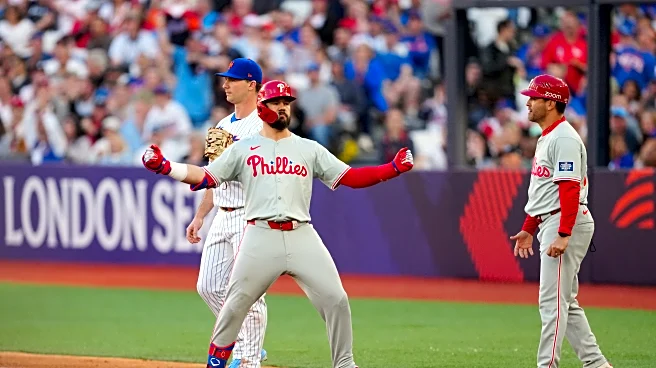




The news that broke on Tuesday that Kyle Schwarber has agreed to return to Philadelphia for the next five years was met with the appropriate levels of exuberance, cautious optimism and casual pessimism. There is nothing wrong with having a little bit of all three. It’s natural to feel like this is going to be a good contract to start with an ending that could be gorier than anything Eli Roth would dream up.
The exuberance is to be expected. While 2025 was a clear career year for Schwarber, it was also
one that saw him vault to the top of the short list of best hitters in the game. His batting average is still one that may give fans of old schools statistical milestones a bit of the heebie jeebies, but the numbers that we pay more close attention to in evaluating hitters – the hard hit rate, walk rate, barrel rate – these are things that Schwarber does better than all but a handful of hitters in the game today.

This is one of the best approaches had by a player in the game. While it’s not something that one usually puts on a 20-80 scouting scale, if it were, Schwarber’s approach would be an easy 80.
There is also the idea that the Phillies are a team that is starved for power. While their 212 home runs hit as a team was good for ninth in the game in 2025, 56 of that belonged to Schwarber. Take away those 56 home runs from the lineup last year, the team drops to 156, which would have placed them 27th in the game. Obviously Schwarber would have had some home runs, the lineup surrounding him had down years in terms of over the fence power. Had he decided to take his talents to another city this offseason, the team would be in a tough position trying to make up for that power when there isn’t much more of it available on the free agency market. One could point to hitters like Pete Alonso and Cody Bellinger as potential options to replace that power, but they don’t really have it in the same way that Schwarber does. So yes, bringing Schwarber back should be something that gets people excited because the lineup still possesses that power threat.
However, there is a bit to be pessimistic about and it mostly has to do with the years that were necessary to bring him back into the fold. Giving a player that is 33 years old and can only play the DH position a five year contract is almost anathema to the early days of sabermetrics. Teams aren’t usually willing to lining up to give a player of that type five years, yet there seems to have been more than a few willing bidders. According to Ken Rosenthal, the contract reportedly agreed to was matched by the Orioles.
Seeing the Reds also get to five years meant that it was necessary for the Phillies to get to that fifth year if they wanted to bring him back.
It’s just that that fifth year is probably going to be ugly, right?
What makes me think that things may not go as poorly as imagined is that Schwarber is already at or near the top in the metrics that make an elite hitter elite. His bat speed and exit velocity are both in the 98th percentile. If we can account for some age related slippage in these numbers as he ages, the descent likely wouldn’t represent a fall off a cliff as a hitter. This wouldn’t be the same as a hitter slipping from the 65th or 70th percentile down to the mid-40’s. Instead you’d have an elite hitter slipping to merely a good hitter.
That’s not something to be taken lightly.
Of course, this also assumes that the decline isn’t as steep. There is the possibility that it is a steep decline and that the team will regret adding that fifth year. To which I would argue – when discussing a deal with a player like this, what’s the difference between the fourth year and the fifth year? If the team is willing to accept some kind of drop off in ability in that fourth season, there shouldn’t be an issue accepting that fifth year either. It’s the price of doing business when it comes to getting the signature on the bottom line.
It would be foolish to not at least acknowledge the fact that as a player in his mid-30’s, Schwarber is on the side of 30 players usually start to see their skills diminish. Giving longer term contracts to players his age is risky, but it’s no more risky than thinking a different free agent is a tweak away from a career altering injury. Schwarber’s profiles suggests that the gains he has made the past four years are real and can be kept. The contract he has been given was well earned, something the Phillies were not alone in wanting to complete. It’s okay to be hesitant about it, but the performance Schwarber has done the past four years should overwhelm the skepticism.