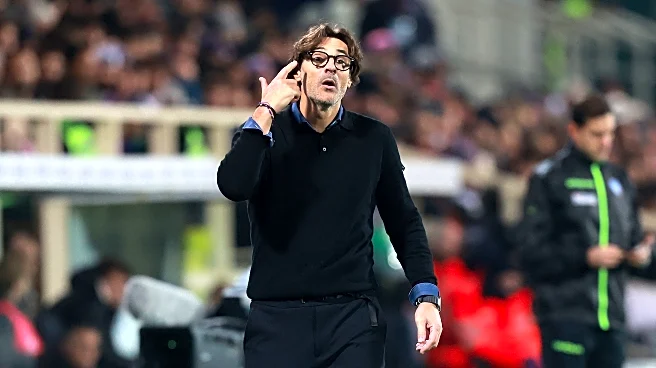




After more than a month, Paolo Vanoli finally ditched the 3-5-2 he inherited from Stefano Pioli and wonder of wonders, Fiorentina responded with a 5-1 win over Udinese. That result probably had more to do with Maduka Okoye’s early red card than anything else but we, as fans, love nothing more than mixing up causation and correlation. I wrote about the possibility a couple weeks ago, analyzing pros and cons, but the reality differed considerably from my projection.
The biggest miss from that article
was based on the information at the time, which said Vanoli wanted to install a 4-3-2-1. That made sense because Fiorentina ain’t got no goddamn wingers, Randy. Sticking a couple of number 10s in there made sense with the personnel available, although my primary concern—the extra burden on the fullbacks—was a real issue with Dodô out of sorts and Robin Gosens injured.
Ahead of kickoff, I thought it was another 3-5-2 with Dodô and Fabiano Parisi as the wingbacks and Albert Guðmundsson floating around behind Moise Kean; if you want the lines in order from left to right, it seemed like de Gea; Ranieri, Comuzzo, Pongračić; Parisi, Ndour, Fagioli, Mandragora, Dodô; Guðmundsson; Kean. From the word go, though, it was clear that this wasn’t a 3-5-2. Parisi was out on the right, Guðmundsson was mostly on the left, and Ranieri stayed much wider.
I’m using a combination of my notes, my memory, and WhoScored’s heat maps to create this diagram, but it’s still an approximation that reflects an average moment that never actually happened rather than the dynamic reality of the 90 minutes.
 Share My Tactics" />
With the caveats that Fiorentina was lucky here—Okoye’s sending off after 7 minutes, Rǎvzan Sava’s poor response to Rolando Mandragora’s opener, Parisi not getting a second yellow at 68’—there were a few features of this approach that I want to focus on, either promising relationships or potential weaknesses or just weird little features. Before I do that, the caveat again: it’s hard to conclude too much from a game in which one team plays with just 10 for 80 minutes. Against a whole opponent, things will be very different.
Pongračić and Comuzzo are an archetypal pairing
Marin Pongračić talked last year about how hard it was for him to figure out how to play in a back 3 after growing up in the Red Bull system, where everyone plays 4-4-2. Aside from a good 2 months when everything around him was functioning, he’s never looked right in a back 3. Similarly, this was Pietro Comuzzo’s best performance of the year by miles. What’s the difference?
Part of it is the opponent. Comuzzo and Pongračić are big, robust defenders who’d rather mix it up with burly strikers than chase quick wingers up and down the line or getting stuck 1-v-1 against a lone forward; they’ve now got support and can be more reactive to what happens in front of them rather than proactive in closing down high up. They’ve also got less responsibility in possession because there’s another technically proficient player elsewhere, which minimizes the number of vertical passes they need to make and instead lets them knock the ball around between them until someone comes to get it.
Finally, Comuzzo and Pongračić are a complementary pairing, fitting into Michael Cox’s dog and cat paradigm. Comuzzo is an enthusiastically all-action man-marker, hurling himself into challenges without fear and chasing forwards around to ensure they don’t get a moment of breathing room. Pongračić is more reserved, preferring to stand off until it’s time for him to sweep up, when he can use his speed to slam the door shut. He’s not a good man-marker (his cosplay of toughness, with all the grabby little fouls used to mask the odd softness in his approach) means he needs a muscly meathead next to him, and that’s exactly who the Ginger Prince is.
The real positive is that there’s depth to replicate this sweeper-stopper relationship when one of Comuzzo and Pongračić is unavailable. Pablo Marí doesn’t have Comuzzo’s athleticism but he’s a physical and fearless man-marker. Mattia Viti has looked more like a cat to me in his limited minutes, opting for a cerebral approach over a confrontational one. Luca Ranieri can probably fill either role.
The imbalanced fullbacks are the secret sauce
Speaking of Ranieri, he was also solid. He made some early mistakes as he second-guessed his new job, but once he settled in, he was quite good. His positional discipline and willingness to stay deep means that Nicolò Fagioli, Cher Ndour, and Albert Guðmundsson could roam the half spaces, secure in the knowledge that Ranieri was defending the wing. By staying deeper, he also avoided pressure and could focus on simple passes rather than penetrative ones. Late on, his off-ball running became a major feature as he bustled forward to meet several balls in behind. It was a role that played to his strengths and hid his weaknesses, particularly in the air.
On the other side, Dodô’s job was very different. He was encouraged to get forward at any and every opportunity. This year, he’s spent too much time ducking inside, making the center of the pitch even more congested. Here, he was mostly an overlapper tasked with putting in crosses, although he still had the freedom to move inside because Parisi and Cher Ndour were diligent at dropping back to cover for him. He still made some pretty simple mistakes but he had a little more pep in his step and seemed happier, particularly when he beelined to Vanoli after Mandragora’s goal to hug the embattled coach.
More importantly, both fullbacks have an outsized emotional role on this team. Dodô is (and I apologize for mixing my birds) the canary in the emotional coal mine. He’s such a smiley, chipper presence who loves nothing more than bigging up his teammates; look at his dance routines with Kean, for example. Ranieri’s also a grinning presence, but his grin is pure psychosis. His goofiness conceals a courageous and intensely competitive personality that allows him to occasionally become a game’s protagonist when his teammates wilt; think of the Real Betis game last year, when his running duel with Antony defined the tie and he even scored a massive goal. Ranieri and Dodô are indicators of a healthy Viola ecosystem.
As far as depth goes, Viti’s got Vanoli’s trust in that leftback role; when he came on late, it was Ranieri who pushed inside. I trust Viti’s realism and diligence to do the job out there. The right side is tricker; Niccolò Fortini’s a hard-working, enthusiastic presence but doesn’t have Dodô’s technical or tactical abilities yet, and Fortini’s also needed higher up. Eddy Kouadio also isn’t ready to replace our little Brazilian. Once again, the whole thing could fall apart if he’s missing, which feels like it’s been the case for many of the years he’s been here.
The midfield rotated fluidly for the first time since last season
I’ve never quite trusted Nicky Beans as the regista and think he belongs higher up but he played really well in this one. Having just 2 centerbacks meant there was a lot more room for him to drop deep and pick up possession to start moves; previously, was moving back into a heavily congested area that allowed opponents to press him easily while keeping the middle blocked. I wrote about this a couple months ago through a Pongračić lens but you can easily read it to see how Fiorentina’s regista was always getting crowded out.
As Fagioli mostly dropped deep, Rolando Mandragora also stayed a little deeper than usual. That was partly to offer Dodô some cover and partly to get on the ball more because Udinese couldn’t press him with a man deficit, but he didn’t do all that much in possession (although his opener was sick as hell). He wasn’t bad but he wasn’t that interesting in a tactical sense to my mind. I’d be interested to see Amir Richardson in this role, as his non-stop movement and desire to play 1-2s could help Fiorentina play out from deep.
The midfielder who really jumped off the screen to me was Ndour. He’s always an off-ball threat but he was tasked early on with being the closest player to Kean. His running was rewarded with a free header that he put away (his first in Serie A and third overall this year), but his job wasn’t just charging forward to provide another vertical threat. He also shuttled across to cover Dodô quite a bit. Both running over the top and covering a fullback is an unbelievably demanding brief, both physically and mentally. I’m not sure it’ll work against 11 but Ndour deserves a ton of credit for his performance, particularly without the ball.
Cher’s the key here, I think. Fagioli getting more space to pick his passes over the top was really important to unleashing Kean but Ndour’s energy stitched it all together a bit like Edoardo Bove did last year. The only other option to replicate that impact is Simon Sohm and I don’t trust his defensive instincts as much. If this new system breaks down, I think it’ll be because the third midfielder, the runner, is being asked to do too much.
The wingers’s jobs fit them perfectly
Just as the fullbacks had imbalanced responsibilities, so did the wingers. Parisi held the width and dribbled straight at opponents, winning fouls and allowing Dodô to overlap. He also dropped deeper in defense to help protect Dodô, who can be vulnerable to bigger attackers. Guðmundsson, on the other hand, was primarily an attacker. With Ranieri holding down the fort, the Icelander could freelance more, drifting around the left half space and combining with Fagioli and Ndour or drive at goal.
This was smart from Vanoli too. Parisi’s always been a good dribbler when he’s got space to attack 1-v-1 because he’s so quick but he struggles against a deep block. Guðmundsson also lacks physicality and needs to be schemed into space, so letting him drift in from a wide position with Ndour effectively serving as his blocker worked perfectly. Getting those two to work as wingers in this system pretty closely followed some of my hairbrained theories from October.
There are other options to perform these jobs on the roster, too. Jacopo Fazzini is a perfect replacement for Parisi as a pacy, dribbly boy out wide who thrives in 1-v-1 battles and can help out defensively. Jacopo Fortini, if he’s ever healthy, feels like a natural Guðmundsson replacement on the left; he’s more of a dribbler but could offset his lack of impact in the final third with a greater defensive contribution, and this job is closer to what made him look good at Empoli.
The wild cards are Robin Gosens and Christian Kouamé. The former is an off-ball monster attacking the back post and that would be wasted as a defensively-inclined leftback, especially since he’s vulnerable defending space. I could see him replacing Parisi on the right, maybe, but he’s always played on the left. The solution could be using Fazzini from the right to shoehorn in more creativity when Gosens plays on the wing, but I worry that would limit anything going forward down the left. Paradoxically, losing Gosens has helped the rest of the team settle, which is a very unfair reflection on Robin, who’s always been an exemplary pro.
Kouamé’s the other interesting one. His on-ball struggles are well-documented but he’s more than dutiful tracking back and could be an interesting off-ball runner who can attack the back post. I’ve always had a fondness for Chris, who’s clearly a wonderful teammate and has been negatively affected by so many injuries, so I’d like to see him reinvent himself as a more functional player instead of the explosive striker he was as a teen. As another aerial threat from out wide, he should at least be a change of pace off the bench.
So what doesn’t this fix?
I saw a couple potential weaknesses in this system that a competent team with all 11 players could exploit. The first is set pieces. Udinese won 3 corners in the first 8 minutes of the 2nd half and Oumar Solet got his head to all 3; his goal wasn’t a header, in fairness, but came in the aftermath of another set piece. That’s not a coincidence: this XI lacks aerial presence. Dodô, Parisi, and Guðmundsson are tiny. Fagioli, Ranieri, and Mandragora are below-average in the air, and Pongračić remains a mystifying negative in that department as well. Comuzzo and Ndour are sporadically maybe a tick above average but not much more.
Fiorentina’s conceded more chances from dead balls than any team in Serie A and the lack of aerial ability in this side will only make it worse. There aren’t any obvious replacements, either, aside from Gosens and Kouamé. Richardson’s so thin that he’s not as good as his height implies and the other guys off the bench are lacking too. Fouling less would limit those opportunities but the Viola have conceded the 6th-most corners in the league, so expect those situations to be problematic no matter what.
I’m concerned about the depth, too. Dodô, even at 80% capacity, is irreplaceable, as is Fagioli; I simply don’t trust Hans Nicolussi Caviglia to get the ball forward or even to show for it. Those are personnel issues that could be addressed in the January transfer window (paging Fabio Paratici) but any long-term absences for either of that pair would scupper this whole thing. Throw in the demands of Ndour’s tuttocampista job, particularly against a team playing with 11, and this could all fall apart.
More than that, though, it’s the mental aspect. Fiorentina still made too many basic mistakes in dangerous positions. Carelessness is a learned habit and unlearning takes time and energy. Maybe the positive reinforcement of a win gives the players enough trust in Vanoli to listen to him more and put in the necessary work but one result isn’t enough to change half a year of toxicity. It’s a Catch-22 but the only way to create a good, winning mentality is to win games, and you can’t win games until you’ve got a good, winning mentality.
Is it lazy to bring it all back to vibes? Yes. Yes it is. But it’s also true. We saw the beginnings of positivity, whether it was Dodô’s celebration with Vanoli or Kean hitting the griddy for the first time in months, but it’ll be weeks before we know if that was just situational, a random atoll of joy in the midst of an endless ocean of sullenness, or the sustainable birth of a new Viola continent. At the end of the day, all the tactical tinkering and analysis of formations and players and strengths and weaknesses matters less than the question, “Are they playing hard for each other?”