
What is the story about?
R1:
Walter Johnson
R2: Goose Goslin
In what may constitute a slight upset, the more slugger-ish Goose Goslin took down the more singles-and-speed Sam Rice to claim the “first sequel” of greatest Washington Senators.
In the immortal words of Pete “Maverick” Mitchell—“talk to me, Goose!”:
Up next: A shortstop and a skipper—all in one!
Round 3

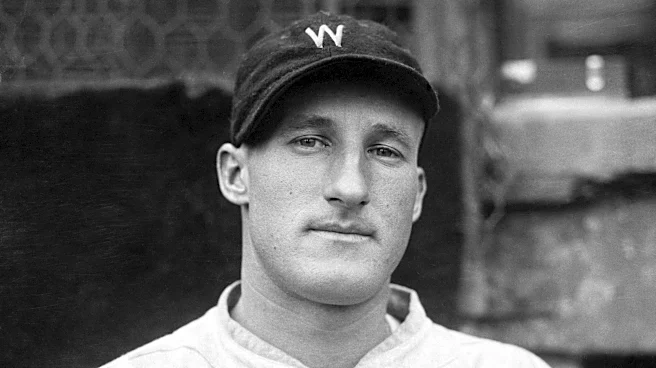
- Sam Rice (1915-1933): 2,889 H, 479 2B, 183 3B, 346 SB, .323 BA, .804 OPS, 113 OPS+, 54.1 bWAR. An outfielder who hit left-handed but threw right-handed, Rice was the ultimate speed-and-contact player for the Senators. After a stint in the U.S. Navy and a stop with the Petersburg Goobers of the Virginia League, he twice led the league in hits, once in stolen bases, and once in three-baggers. His career hit total—2,987—remains the closest to 3k of any retired player without reaching that milestone, a fact that may have kept him out of the HOF until the Veteran’s Committee voted him aboard in 1963. Perhaps best known for a controversial catch in the 1925 World Series.

- Joe Judge (1915-1932): 2,291 H, 421 2B, 157 3B, 210 SB, .299 BA, .802 OPS, 115 OPS+, 48.3 bWAR. As a batsman, Judge was functional and fleet. But in an era known for shoddy defense with bad baseballs and awkward hand-wear, Judge was a consummate glove-man at the first sack. At retirement, he led the American League in fielding percentage, putouts, assists, total chances, & double plays. The kid from Brooklyn—discovered by his block’s postal worker, who gave young Joe his first glove—preserved Walter Johnson’s only MLB no-hitterwith a fantastic snare for the final out in 1920. Ironically, he effectively ended the Big Train’s career in 1927 when he smashed a BP bottle-rocket into the hurler’s shin and broke his ankle. Judge died at the age of 68 in 1963 while shoveling snow outside of his D.C. home.

- Buddy Myer (1925-1927, 1929-1941): 1,828 H, 305 2B, 113 3B, 118 SB, .303 BA, .801 OPS, 109 OPS+, 42.3 bWAR. A college baseball star at Mississippi State, Myer was the Nick Punto of his era—bouncing around multiple infield positions as a proto-utility player. At the plate he was known for a keen eye, with OBPs routinely at .370+ (including five .400+ OBP years). Buddy’s 1935 season was his apex, seeing him take home a batting title (.349), score & drive in 100 runs, and finish 4th in MVP voting to slugger Hank Greenberg. Never one to back down from a challenge, the diminutive (5’10”) Myer once brawled with Ben Chapman (surprise, surprise) when Chapman spiked Myer and hurled antisemitic insults at him—leading to fans charging the field and multiple disorderly conduct arrests.

- Clyde Milan (1907-1922): 2,100 H, 1,004 R, 495 SB, .285 BA, .706 OPS, 109 OPS+, 40.8 bWAR. Before Ty Cobb re-wrote the record books for speed on the base paths, Clyde “Deerfoot” Milan was the gold standard of stolen bases. Twice leading the American League in bags swiped (88 in 1912; 75 in 1913), Milan averaged 40 steals per season over his 16-year MLB career. What Clyde lacked in Dead Ball Era power numbers (17 career round-trippers) he made up for by choking up on the lumber and compiling a .353 career on-base percentage. In 1911-1913 he garnered three consecutive top-9 AL MVP finishes. Milan could man all three OF stations and often led the league in assists, double plays & Range Factor. A high error total speaks as much to Clyde’s ability to even have a chance at suppressing more flying spheres than his contemporaries.

- Joe Cronin (1928-1934): 1,090 H, 242 2B, 72 3B, 51 HR, 577 R, 673 RBI, .304 BA, .842 OPS, 118 OPS+, 37.0 bWAR. Joe Cronin played just seven seasons for the Senators—but he certainly made the most of them. A doubles and triples machine (once leading the league in each), the swaggering shortstop cracked the 100+ RBI mark five times in Washington via his penchant for clutch knocks. Per Connie Mack: “With a man on third and one out, I’d rather have Cronin hitting for me than anybody—and that includes Cobb, Simmons, and the rest of them”. In 1933, he became a player/manager—and in his first year at the helm led the Nats to a pennant (alas, a World Series loss to Bill Terry’s New York Giants). Joe would join the Cooperstown ranks in 1956—then be named American League President in 1959. During his tenure (‘59-‘73), the AL would expand by four markets and shift around four other franchises.