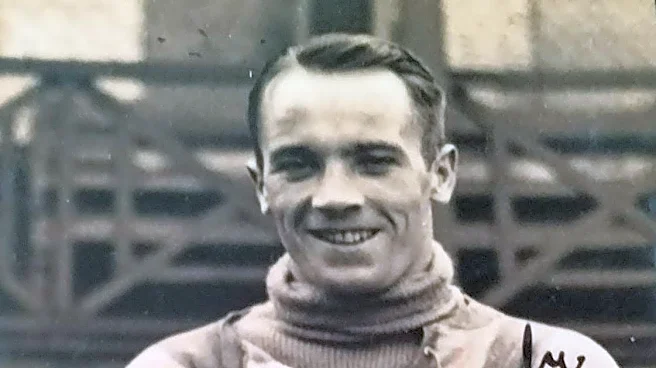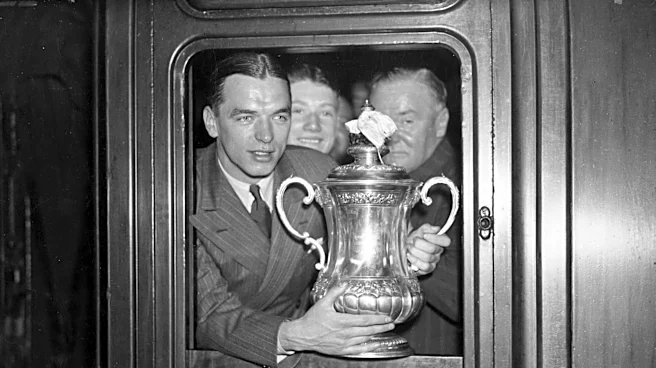







When I was researching events that took place on this day in history, I saw that Alex Hall died in 1991, yet the sad part on my behalf is that my first thoughts were, “Alex Who?”
Such is the changing face of media and attempts by many clubs (especially Sunderland AFC) to start to recognise players from the past that contributed so much to the history and progression of the club that more recent players may well be remembered and noted in the future far more than perhaps they were in the past.
I think
this came to the fore quite recently when Sunderland’s ‘Legends’ Way’ was first mooted.
The initial shortlist featured nearly all of the 1973 FA Cup-winning team — they’ll all have a mention on the slowly growing Legends’ Way outside the South Stand (The Roker End), and rightly so, but not so for the 1937 FA Cup team.

Imagine if in the present time, a player won the Premier League one season and the FA Cup in the next.
They’d would certainly be heralded and not forgotten, and that’s a wrong that the current owners have moved quickly to put right after all these years.
With the release of the brilliant new home shirt, which is becoming one of the best sellers ever, attention has been drawn to that great team of the 1930s via the collared design and adaption, the old shield surround and the names of the 1937 team stitched onto the inside of the collar.
One of those names is one Alexander Webster Hall.
Alex was born in Kirknewton, Midlothian in 1908, and in a very touching piece of symmetry, died in Kirknewton, Midlothian nearly eighty three years later. I’d like to think that his family roots and ties were always to that area, and that he passed away surrounded by family and friends.
Hall was described as “robust” right (or left) back and played for the club from 1928 to 1939. After playing amateur football in Scotland for East Calder Swifts, Oakbank Amateurs and Wallyford Bluebells, he was signed up on professional form with Dunfermline Athletic and it was from Dunfermline that he joined Sunderland in the April of 1928 for the princely sum of £750.
He’d only been a professional for four months before Sunderland spotted him at just twenty years of age and was described as a “raw talent” — maybe a nod to the way we try to do business these days as well.
He made his debut soon afterwards in the final fixture of the 1928/1929 season. However, he was allowed to settle and develop in the reserves for a period of time after that, being an understudy to Bill Murray. However, he didn’t play another senior game until 27 December 1930 against Manchester City, and didn’t become a regular in the team until the 1934/1935 season.
Hall was able to use both feet (modern players, take note!) hence being utilised at right and left back. He was mostly used at right back however, and was a tough tackler and a very powerful player.

He played almost every game of the league-winning season of 1935/1936 and in every round of the 1936/1937 FA Cup run that ultimately saw Sunderland beat Preston North End 3-1 in the final — one of only six players to do so.
Hall appeared in a total of 233 games for the Lads, only scoring once.
His career was cruelly interrupted when war broke out in September 1939, which profoundly impacted football across the country. Unable to continue to play for Sunderland, he played for Hibernian , initially as a guest player, before he transitioned to a coaching role in 1945, mainly being in charge of the youngsters and third team.
After leaving Hibs in 1947, he took a coaching role in Malta, taking charge of Sliema Wanderers. There was a growing trend at the time for British coaches to ply their trade in Malta and he returned to Scotland in 1952.
Alex was originally an engineer, balancing his trade with playing football at a young age. There isn’t much evidence to suggest whether he took up his manual trade again, but we do know that he returned to Kirknewton, where he enjoyed a quiet retirement.
In the years following his death, a Scottish branch of Sunderland AFC Supporters was named in his honour, reflecting his popularity with fans north of the border, and as I alluded to earlier, the club as a whole is honouring players like Alex to a much greater degree now, and long may that continue.
Time passes, but players and staff that’ve been worthy servants of this great club should never be forgotten.