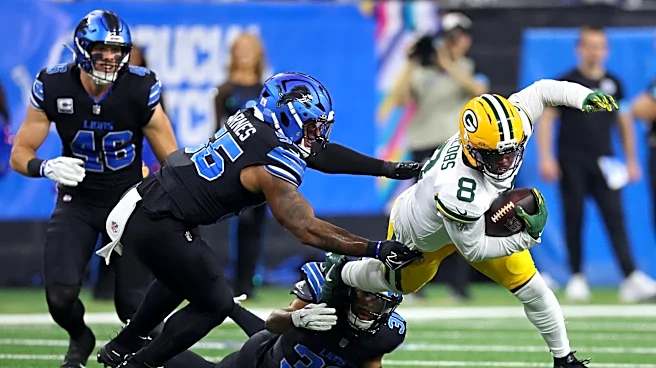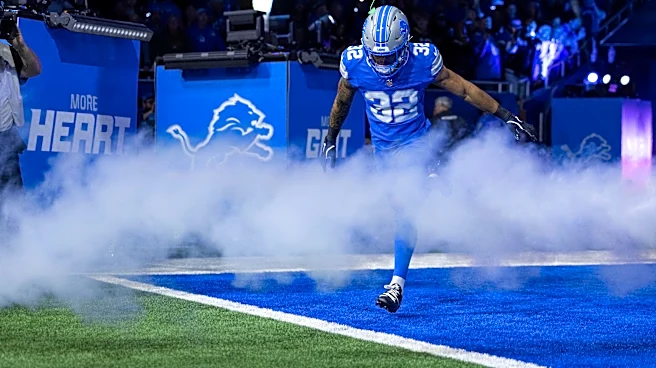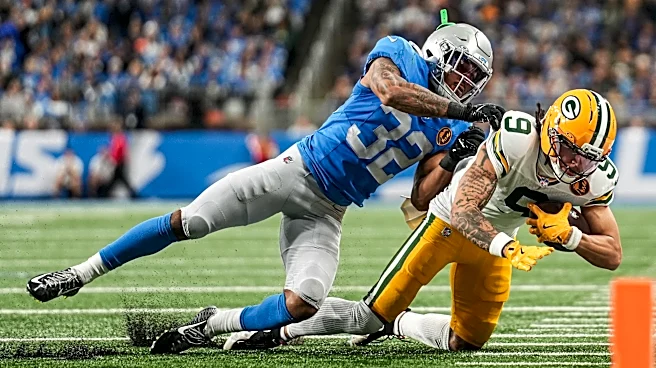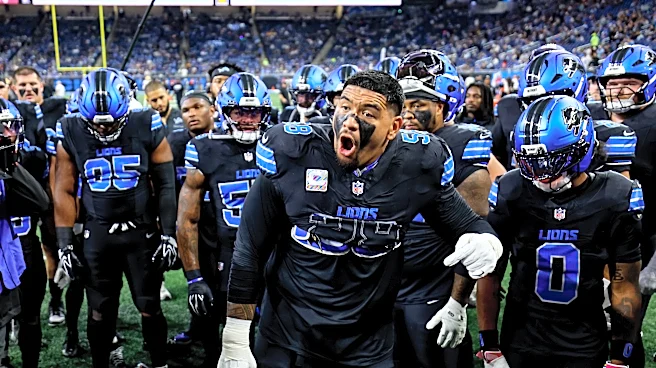

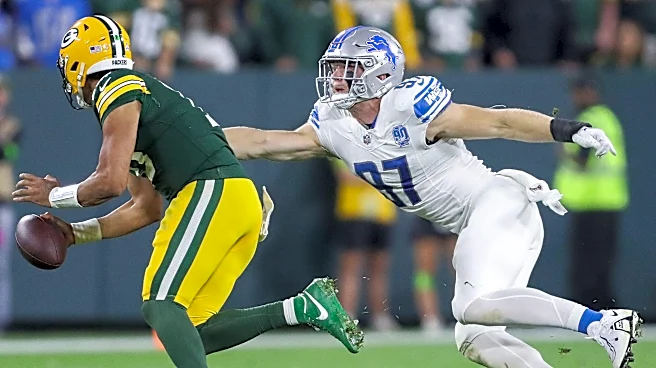

The Detroit Lions eeked out a win over the Green Bay Packers, but generally looked like the better team for most of the game. How does that translate to a weekly report card? Let’s take a look at my instant grades before a rewatch.
Quarterback: A-
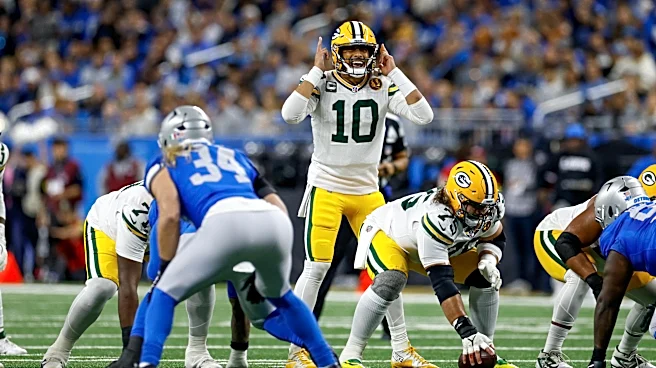
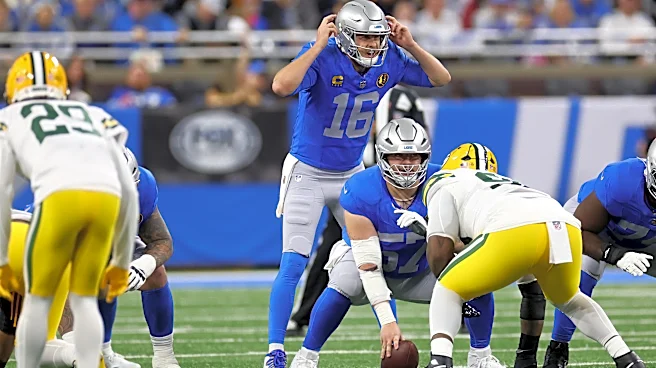
Jared Goff was red-hot in the first half, dicing up what was one of the best pass defenses in the league coming into the game. He went 13-of-17 for 207 yards, a touchdown, and a 136.2 passer rating. He was accurate; he was reading defenses well, and he managed the pocket
well.
However, he did take a pretty significant step back in the second half. He put a couple of balls in danger’s way, struggled to find open receivers, and finished the final two quarters by completing just 9-of-15 passes for 96 yards and a score (101.0 passer rating). The statline would’ve looked worse if a couple of his interceptable passes had been actually picked off.
Still, considering this was one of the best pass defenses in the league, he deserves a ton of credit for moving the ball pretty consistently through the air.
Running back: C
It doesn’t matter if it was Cade Mays who jarred the ball loose; Jahmyr Gibbs CANNOT fumble in the red zone. That was a huge play that was just one of many opportunities for the Lions to pull away in that game.
The rest of his game was really odd. Of Gibbs’ 29 carries, 12 went for at least 7 yards, but eight went for 0 yards or less. There was a little too much dancing from Gibbs, but at the same time, how many running backs are turning this play into a significant gain?
Tight ends: C
I’m sure conspiracy theorists will be loud about Sam LaPorta only getting two targets all game, and I will admit it was particularly hard to explain why he wasn’t more involved, but I suppose with Amon-Ra St. Brown and Jameson Williams tearing apart a good Packers secondary, you can’t complain.
Upon live viewing, I don’t really have any positives or negatives to say about the tight end group, but LaPorta’s catch on the final drive of the game was huge.
Wide receivers: A-
As just alluded to, St. Brown and Williams seemed near unstoppable for the majority of this game. St. Brown, in particular, was dominant in a matchup against one of the better nickel corners in the league (Javon Bullard). He pulled in nine catches for 153 yards on 11 targets. Meanwhile, Williams came down with 91 yards and two touchdowns (and nearly a third) on nine targets.
Both players deserve a ton of credit for finding spots in the Packers’ zone coverage and taking advantage of all the opportunities they had.
Offensive line: B-
Early on, the offensive line looked absolutely dominant against the Packers. Goff had plenty of time, particularly on play-action passes, which allowed him to hit several explosive passing plays. In fact, Goff only saw pressure on 21.2% of his dropbacks, the third-lowest figure of Week 7.
However, many of the aforementioned inconsistencies in the run game were due to lapses in run blocking. Too often, Gibbs was hit in the backfield. In fact, the Lions averaged -0.80 yards before contact, which was easily the worst performance of Week 7. I’m eager to see what went wrong there, because the Packers do not have that good of a front seven, particularly with all of their injuries.
Defensive line: B
Aidan Hutchinson was dominant again, tallying a sack, forcing a holding penalty, and earning nine pressures on the day, per PFF. And Detroit’s run defense was absolutely smothering until late in the game. But in the fourth quarter, this unit seemed to run out of gas a little.
And there weren’t really any other standout performances along the defensive line (except for DJ Wonnum’s special teams play, but that’s later). Against an absolutely injury-devastated offensive line, I was hoping for a little more.
Still, hard to be disappointed on a day in which the Lions produced pressure at an average of 2.39 seconds (sixth-best of the week).
Linebackers: D
It was a pretty brutal day for the Lions’ linebackers on live viewing. Most of the Packers’ damage was done over the middle of the field, be it Tucker Kraft (four catches, 48 yards, 1 TD) or Josh Jacobs (five catches, 55 yards, 1 TD). The Lions’ linebackers weren’t particularly strong in man or zone coverage.
But I can’t in good faith give them a failing grade, because their play was also critical in holding the Packers to just 60 rushing yards and 3.2 yards per carry.
Secondary: A-
Shout out to one of the biggest winners of the week: Pride of Detroit’s own Anthony Balaj. He endured a week of hate from Packers fans for this article:
The Lions held up their end of the bargain. Here was Jordan Love’s statline on passes with at least 20 air yards:
1-for-6 for 14 yards, 1 TD, 1 INT, and a 39.6 passer rating
… and that one completion was a broken play in which Jack Campbell fell down in coverage.
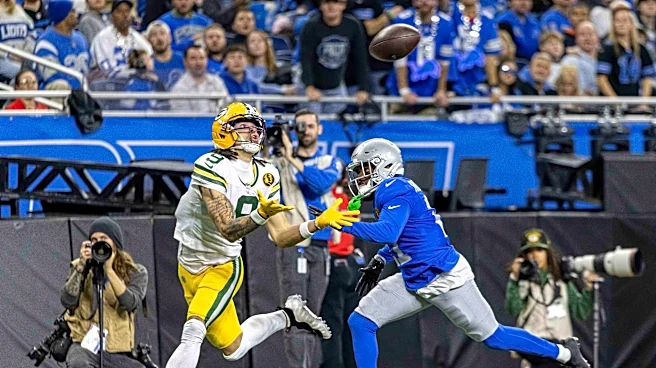
The Lions secondary was phenomenal in defending the deep pass, and really strong in most situations despite facing one of the hottest two-headed attacks in Matthew Golden (six catches on 12 targets, 39 yards) and Christian Watson (five catches on eight targets, 57 yards).
And I just can’t handle the beauty of Brian Branch’s interception. It is quite literally a picture-perfect defense of that pass. Sure, it may not have actually meant much in the game—the Packers were about to punt and Detroit was likely to get the ball there anyways—but, man, that got the juices flowing on the sidelines and in the stands of Ford Field. Let’s watch it again:
Special teams: B+
DJ Wonnum’s tipped field goal turned out to be one of the biggest plays of the game, so that tips the scales pretty heavily on what I would consider a pretty average-to-below-average day from the special teamers.
I thought DeAndre Carter looked promising in the return game, nearly breaking two big returns on the day. However, he did commit a costly penalty on a kick return in the fourth quarter—Detroit’s second penalty on kick return of the day. And while Jake Bates was perfect on his field goals and extra points, he did put two kickoffs in the end zone, giving the Packers strong field position.
Coaching: B
Let’s start with the fourth down hysteria. Admittedly, I wasn’t a fan in the moment, but I’ve come closer to Dan Campbell’s side after hearing his argument and seeing some of the analytical data. I no longer have a strong feeling on it, but I will say this: the Lions’ short-yardage running game has not been good this year, and that should factor into the decision. Going into this game, the Lions’ success rate in short-yardage situations (FTN Fantasy’ “power rate” statistic) ranked 20th in the NFL. And given it was closer to fourth-and-2 than fourth-and-1, it made that call a toss-up, in my opinion. You can really have the same discussion about Detroit’s decision to go for it and pass on a field goal earlier in the fourth quarter.
I think there’s enough nuance to those discussions to call them 50/50 toss-ups, and I’ll always feel better about erring on the side of aggression, particularly with an offense that currently ranks top-five in most categories. And, ultimately, Campbell’s strategy worked on the last decision. It was largely made knowing that the Lions offense would have the ball last, and that’s an advantageous place to be. If Green Bay had even made the field goal, Detroit was still in a stellar position to win the game.
However, there were some curious coaching decisions throughout the game. For one, I thought Campbell should have challenged the spotting of the football on the second-and-1 run prior to the controversial fourth-down decision. Additionally, Drew Petzing dialed up a poorly designed quick screen to Gibbs on a third-and-5 that failed spectacularly and held Detroit to a field goal. On a fourth-and-2, Kelvin Sheppard dialed up a play that left no one within 10 yards of Tucker Kraft (execution problem?).
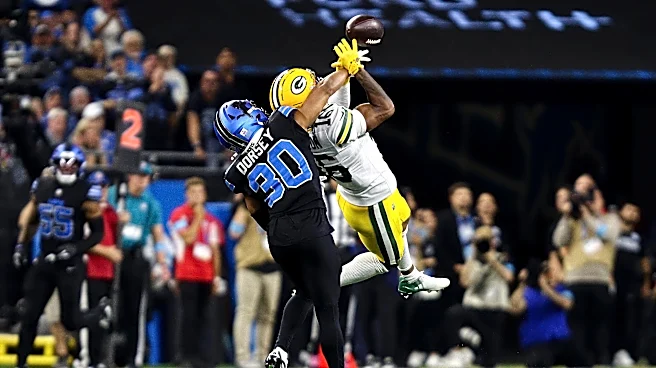
I’ll also give the Lions credit for their defensive game plan. Inspired by the Cowboys last week (yes, I know, not the greatest place for defensive inspiration), Detroit opted to run a rotation of defensive backs to keep everyone fresh, knowing that they were going to play a lot of man, and run a lot of deep routes. That strategy undoubtedly worked and gave underutilized players like Khalil Dorsey a chance to shine.