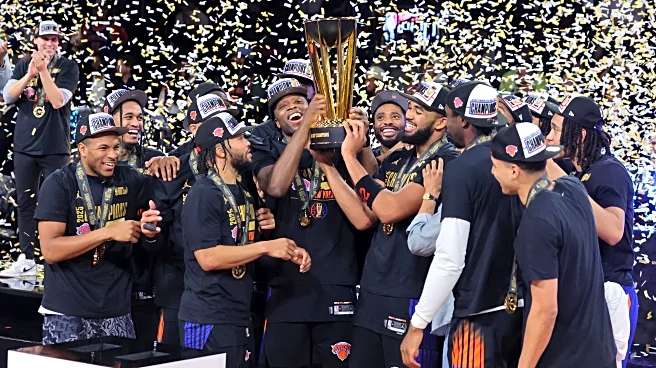

The New York Knicks are the winners of the 2025-26 Emirates NBA Cup, courtesy of a 124-113 win over the San Antonio Spurs in the tournament’s final game last night. The game itself was fairly exciting,
close until the Knicks ran away with it late. It showcased one of the “now” teams in the Eastern Conference and one of the future potential dynasties in the West. Basically, it was everything the league hoped it would be when they conceived of the Cup three years ago.
Even though the game itself was interesting—preceded by intriguing games, matchups, and moments leading up to the finale—it feels like the whole event is very much “of the moment”. After watching the Los Angeles Lakers, Milwaukee Bucks, and now the Knicks hoist the trophy, we have an idea of what this is all about. There’s still not a great answer to why, or what this all means.
The NBA has tried to solve this financially, giving the players on the winning team a cool half-million dollars each, throwing a couple hundred thousand to the runners-up. Merry Christmas in those households! That’s cool, but neither the teams nor the fans see much tangible benefit from participating in, or winning, the tournament.
Several solutions have been proposed to this, incentives to sweeten the pot.
I’ve heard people suggest that the Cup win count for a half game in the standings, in effect breaking ties between the winning team and all others. That only matters if the team is going into the playoffs in a defined seed and ends up tied with someone. It’s nice the same way the third present down in your Christmas stocking is nice. It’s not exactly going to change the experience.
I’ve thought about opening up a special “Cup Contract” slot for the winner, a $5 million salary slot, financed by the league, not counting against the cap, giving the winning team access to an extra player for free. That’s too complex. It also puts the NBA on the hook for lots of extra salary unless those contracts run only one year.
The solution that makes the most sense is adding a pick in the NBA Draft for the winner. But we run into a Scylla and Charybdis situation here. A second-round pick is too little incentive. A pick at the end of the first round is next to it. It also obligates the winner to pay another first-round salary for a potentially-marginal player. It’d almost be better to award the first pick of the second round for the sake of flexibility. Promoting the pick further up into the first round runs the risk of over-empowering the winner, especially if that team was already good. The Cup is not worth creating a significant draft imbalance.
Fortunately, there’s a way to solve this problem. Make the reward a first-round pick, but have that pick scale with the performance of the team who wins it. This is achievable with a Mirror system.
Let’s say the team that wins the NBA Cup gets one extra pick. We’re going to add “-C” to the designation for “Cup”. The “-C” pick at any given position comes right after the regular pick. If the pick was “16-C”, whomever got the regular 16th pick would select first, then the 16-C pick owner would select, then pick 17 would commence and the draft would proceed as normal. Get it?
- 14 Portland Trail Blazers
- 15 Milwaukee Bucks
- 16 Phoenix Suns 16-C New York Knicks
- 17 Dallas Mavericks
The reason we need the “-C” designation is that the pick doesn’t fall in the same spot each draft. That’s the imbalance problem. Giving a team that otherwise would have drafted 30th an extra pick at slot 15 could be game-breaking. Instead we do this:
- Determine where the winning team’s organic first-round pick would fall. It doesn’t matter if they’ve traded it away already. We just want to know where they’d normally pick if they were holding their own first-rounder.
- If that position falls in the lower half of the draft (picks 16-30) this is easy. Just duplicate/mirror that pick, put the “-C” at the end of the duplicate, and award it. If a team would pick 30th, they get two 30th picks. If the team would have selected 20th, they have Pick 20 and Pick 20-C. They’re not out of scale with their normal draft position. They just get one more pick at that level.
- We can’t do the same thing for picks in the upper half of the draft (selections 1-15). That’s too powerful of a reward, especially in the highest ranges. So instead of exactly duplicating the pick, we invert it. Whatever your organic pick is in the top half of the draft, you’ll get an inverted mirror-image (the opposite position in the order) in the bottom half. The 14th pick is second from the bottom in the 1-15 order, so the “-C” pick will be second from the top in the (16-30) bottom half, or pick 17-C. A team with the first overall pick would be awarded pick 30-C, the last overall pick in the bottom half. If you have pick 3, you’ll get 28-C. Pick 4 would produce 27-C. And so on.
Just remember… is the Cup winner’s organic selection spot already in the bottom half of the draft? Then they’ll get an exact duplicate of that pick. If the winner’s pick would fall in the top half, invert that position in the bottom half and award the extra pick at the appropriate level.
Remember also that the winner’s “-C” pick comes after the team who would normally select at that level. If the Cup win gives me the 17-C pick, I’m not bumping the actual 17th pick out of their position, rather the 18th pick and below.
This has the effect of providing a meaningful first-round pick between 16-30 to the winner of the Cup, but the pick either activates at the exact level they’d be at anyway (for already-successful teams) or gives them a decent boost at a lower level (for teams in the lottery). Low-level draft teams get a low-level pick. High-lottery teams get a low-first-rounder for extra help. Mid-range teams get a second mid-range pick. That’s a more tangible reward than the min-max, playoffs/lottery teams get, but that’s actually an argument for this system because…
A. Those mid-range teams are the ones you want fighting hard for the Cup, to make the experience meaningful. And…
B. This would be the only incentive in the whole league that favors middle-of-the-road teams instead of high-achievers and tankers. The NBA Cup is the place for those otherwise-forgotten teams to shine.
If the Oklahoma City Thunder win the Cup, golf clap and give them a second 30th pick in the draft. If the Brooklyn Nets manage to win it, cheer and give them pick 26-C to go along with their organic 5th pick. If the Chicago Bulls fight through, they’re going to get the 11th pick in the lottery and pick 20-C, not a bad reward for overcoming those odds. No matter which way you slice it, you gave the winning team and their fans something to celebrate without creating problems for the rest of the NBA ecosphere. Correcting one of the blind spots (for middle-of-the-road teams) in the league’s incentive system is a bonus.
What do you think? Would an extra pick like this make the Cup experience more interesting? Share your thoughts below.