







As the NHL playoffs draw ever nearer to the Conference Finals, we have international hockey at hand in Switzerland. In this article, we are going to go over the teams that have qualified for this tournament, which begins today.
The New Jersey Devils at Worlds: Please see here for the Devils-centric preview.
The Schedule: The IIHF has posted the schedule here.
The Format: The top four teams from each group will advance to the single-elimination bracket. See more rules and regulations here. Please note
that the IIHF has forgotten to update this, and it will give information for the 2025 tournament. The rules should still be the same, though.
Group A
The Powerhouses: USA, Switzerland, Finland
These are the three countries who have the greatest share of New Jersey Devils on their rosters, and they are also largely expected to lead the way in Group A. The Team USA roster, led by Matthew Tkachuk, is quite a bit of a step down from their Olympic roster. To some extent, AHLers and prospects are to be expected in this tournament, but I do think that Team USA could have done a better job at getting present NHL talent than they have here. I am thus not expecting them to make it far into the single-elimination bracket unless they gather some talent from the recently or soon-to-be-eliminated NHL teams.
Team Finland is far more used to taking non-NHLers and making them competitive in international tournaments. Their roster, however, features two top six centers in Aleksander Barkov and Anton Lundell, who will be eager to play their best hockey as Barkov returns from his season-long knee injury. With the strong Finnish style of hockey, I expect them to clean up against lesser teams while being a challenge to Team USA.
Team Switzerland, despite only having a few NHLers, might have one of the best shots of advancing deep into the tournament because of the quality of their top-end. Captained by Roman Josi, the Swiss National Team also features Nico Hischier, Timo Meier, Pius Suter, Nino Niederreiter, and J.J. Moser. If the Swiss depth can hold up their end of the bargain, they should make their home crowd happy, especially if Leonardo Genoni replicates his excellent Olympic performance in net.
The Plucky Middle Group: Germany, Latvia
With the disappointing playoff finishes of Edmonton and Ottawa, some may have hoped that Leon Draisaitl and Tim Stutzle would join the tournament. They have not, leaving Mortiz Seider as the lone elite skater on the roster. Germany, with some former NHLers, should be able to beat up on the teams in the following selection of nations. But will they be able to put up as competitive performances as they did during the Olympics? It’s very doubtful.
With even less NHL talent than Germany, Latvia will be hoping that the young Sandi Vilmanis can lead them to some wins in the round-robin stage. It will be interesting to see which of these two teams can battle for advancement to the elimination stage, though I think Latvia may have an edge because Germany is missing so much of the elite talent that they generally rely on.
The Nontraditional Hockey Nations: Austria, Hungary, Great Britain
The Hungarians completely lack NHLers on their roster. Great Britain is no better, largely made up of players in British leagues. Austria, though, at least has two players who have been drafted to NHL teams in Gregor Biber (2024, 98th UTA) and Vizenz Rohrer (2022, 75th MTL). While Biber is still struggling to break out in the Swedish Hockey League, Rohrer had a down season for the ZSC Lions, making him familiar with the Swiss setting, before scoring a goal and an assist for Laval after his Swiss season ended. It would be a surprise if any of these teams made it out of the round-robin stage, but Austria has the best chance of doing so. Since this is an international tournament, though, guys sometimes have an extra chip on their shoulder, and we can hope that some fun story makes it out from these less traditional hockey countries.
Group B
The Powerhouses: Canada, Sweden, Czechia
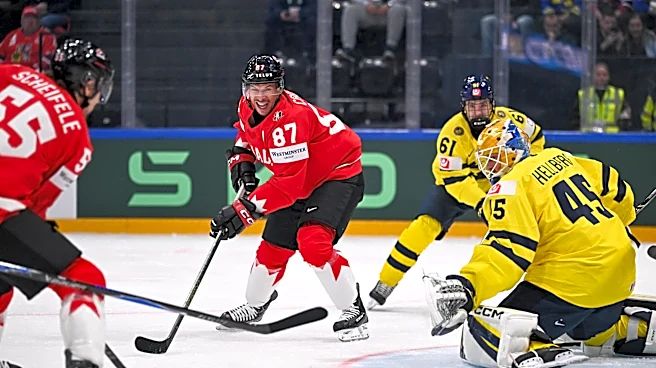
Canada seems pretty annoyed that they lost in February, because they brought a roster to Worlds that can beat most other nations in the Olympics. With Sidney Crosby, Macklin Celebrini, Ryan O’Reilly, John Tavares, Robert Thomas, and Mark Scheifele, there is no shortage of top centers from Canada for this tournament. The Devils, of course, have Dawson Mercer and Connor Brown attending. My question here is whether Team Canada will ride Jet Greaves or Cam Talbot. Talbot, 38, had an .883 save percentage this season for Detroit, while Jet Greaves, 25, had a .908 save percentage in 55 games for Columbus. If Greaves does well in this tournament, he could present himself as a more legitimate option for Team Canada in future Olympic competitions.
Sweden is taking a somewhat weakened roster for a national team of their caliber. Perhaps they are tired of playing for Sam Hallam, but none of Sweden’s top players are attending this tournament. They do have some solid NHLers in Mattias Ekholm, Oliver Ekman-Larsson, and Lucas Raymond, among some bottom six forwards. But viewers should be most interested in seeing 2026 draftees in Ivar Stenberg and Viggo Bjorck alongside other recently-drafted prospects such as Anton Frondell and Jack Berglund.
The Czechs are sitting even weaker than the Swedes here. With Boston’s early elimination, I was thinking that we might see guys like Pavel Zacha (who missed the Olympics due to injury) or even David Pastrnak, but neither are attending. The Czechs do have Filip Hronek leading their blueline, while Devils prospect Matyas Melovsky is among the forwards. Also of note, this could be one of the final tournaments for Czech legend and team captain Roman Cervenka, who only had a short NHL career but has been a mainstay of national teams and will turn 41 in December.
The Plucky Middle Group: Slovakia, Denmark
Slovakian hockey is surely on the rise, but they will be without their top three players this tournament. Simon Nemec is sitting out due to needing a new contract. Juraj Slafkovsky is one win away from the Eastern Conference Finals as of this writing. Dalibor Dvorsky is sitting out as well. Even Tomas Tatar, who is no longer in the NHL, is taking the time to rest and recover during the offseason. The Slovaks do have some interesting players still, such as Adam Sykora and Filip Mesar, but they are not as well equipped for upsets as they were during the Olympics.
The Danes are in a tough spot, as usual, with Carolina making another playoff run. While Nikolaj Ehlers might have been available in previous years, he has joined goaltender Frederik Andersen on the Hurricanes. This has left just one NHL draftee on their roster in Mads Sogaard, who had a bad season in the AHL this year for Belleville. With an older roster, though, the Danes should be able to beat some of the worse teams who have less of a professional history in hockey.
The Nontraditional Hockey Nations: Norway, Slovenia, Italy
Norway does not have any established NHLers on their roster, but they do have four draftees in Stian Sol berg, Mikkel Eriksen, Tinus Luc Koblar, and Noah Steen. Of those four, only Stian Solberg (2024, 23rd, ANA) looks poised to make the NHL. He had 12 goals and 24 points in 71 games with 102 penalty minutes for the Gulls in the AHL this season, and he could end up being the leader of the Norwegians moving forward. With a generally young roster, I am interested to see whether they do better and worse than the other teams around their general category. Who knows? Maybe they can even compete for an elimination round appearance.
Slovenia is less threatening. With only one NHL draftee on their roster in Jan Golicic (2024, 118th, TBL), they have their work cut out for them. Italy will also have a tough time this tournament. Away from their Olympic performances, in which Damian Clara kept them alive longer than they otherwise would have been, Italy is not a hockey country. And even worse for them, Clara will not be participating in this tournament, leaving them with no NHL draftees on the roster.
Note on Relegation
Per the previously linked IIHF rules and regulations, the bottom two teams of the round-robin stage will be relegated to the 2027 Championship Division I Group A. Germany, the host of the 2027 tournament, is protected from relegation. Currently, Kazakhstan and Ukraine sit atop the board in Group A, with France and Poland not far behind. It looks certain that Kazakhstan will be elevated in 2027, though the second place is up for grabs.
Your Thoughts
What do you think of Worlds this year? Will Canada run away with it? Will you be watching, if you can? Leave your thoughts in the comments below, and thanks for reading.