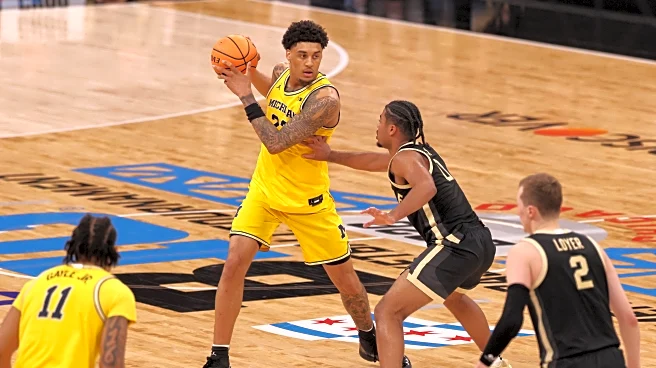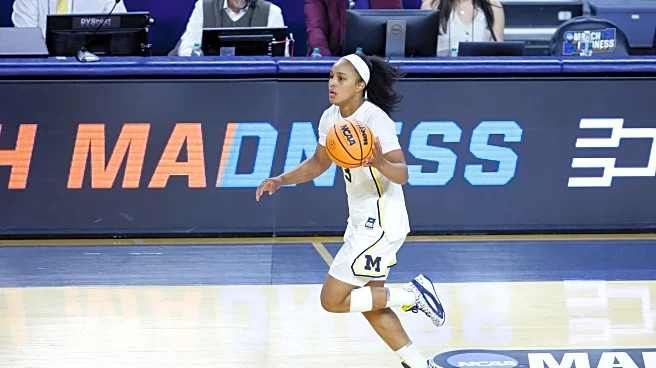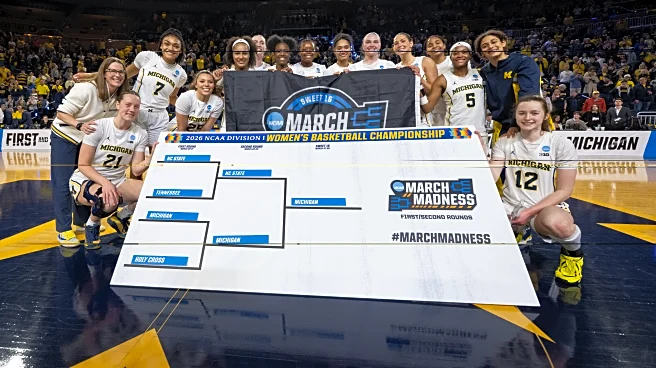

The No. 2-seed Michigan women’s basketball team advanced to the Sweet Sixteen for the third time in program history, facing No.-3 seed Louisville on Saturday at 12:30 p.m. ET (ABC).
In order to make a program-first Final Four out of Fort Worth Regional 3, the Wolverines’ (27-6) path to the Final Four includes beating the Cardinals (29-7), and then the winner of No. 1-seed Texas (33-3) and No. 5-seed Kentucky (25-10).
Here’s a look at three reasons why Michigan will and won’t reach the Final Four.
Why Michigan WILL make the Final Four
- Versatility and depth
The
Wolverines are an adaptable team, relying on a variety of roles and scorers to find success. While sophomore guards Olivia Olson (AP All-American third-teamer), Syla Swords (All-Big Ten first-team) and Mila Holloway (All-Big Ten honorable mention) often draw more attention as the three scorers averaging double figures for Michigan, the Wolverines garner support from a wide cast of players, with eight averaging at least 10 minutes per game. Despite junior guard Macy Brown missing Michigan’s second-round win against No. 7-seed North Carolina State with an apparent lower-body injury, Michigan still has a deep arsenal of offensive weapons.
“I’ve been saying all year, our versatility and our depth, you know, if you choose to face guard one of our three, or if you choose to not play some of us, we’re all capable of scoring, we’re all capable of knocking down shots,” senior guard Brooke Quarles Daniels said. “So that’s just something that they’re going to have to bear. You know, they were letting me take open shots, we were knocking them down. And I think that’s one of the biggest things that you don’t want to do as a team, is to allow the third- and fourth-string options to just really get comfortable. Because our one through two is very consistent with scoring.”
Throughout the season, the Wolverines have discussed their ability to channel offensive success from a variety of players. They’ve gotten 20-point contributions in the NCAA Tournament from Olson, Swords and Holloway, and generous support from the complementary cast. With teams keying in on Swords and Olson defensively with double-teams or box-and-one schemes, and opponents with multiple forwards targeting Olson one-on-one and trying to get her in foul trouble, those supporting scorers will be even more important moving forward.
“They present a lot of problems,” Wolfpack coach Wes Moore said Saturday. “Play really hard. They crash the boards hard. They’re going to press. A little bit different than Tennessee’s press but still man to man, similar press. And, you know, again, got a lot of players that can hurt you. Again, three starters in double figures. So Olson, obviously a great player. Swords shoots the heck out of it. Holloway can score at all three ranges.”
Michigan is deep defensively, on the glass, and on attack. With a variety of strong options, even with defensive efforts concentrated on the tandem of Olson and Swords’ combined 34 points per game, the Wolverines can capitalize offensively on other mismatches, particularly in transition.
- Strong defense and a disruptive full-court press
Michigan’s full-court press was a difference-maker against the Wolfpack. Forcing 22 turnovers with 10 steals and generating a 35-5 advantage on points off turnovers, the Wolverines pounced on NC State’s substitute point guards in Zoe Brooks’ injury-induced absence. Guards Zamareya Jones and Destiny “Ky’She” Lunan were swarmed before even reaching half-court, and the Wolfpack never looked comfortable offensively in the second half.
“We bother a lot of teams with our pressure, and that starts with (senior guard) Brooke (Quarles) Daniels,” Swords said. “She was All-Defensive team for Big Ten. She’s guarding the best player, whether it’s the point guard, whether it’s the shooting guard, no matter how tall they are, she’s constantly picking them up full court for however many minutes, 20, 40 minutes she’s playing. She knows that’s her role, and she’s great at it.
“Then it comes from Liv too, being able to run into the trap of Te’Yala Delfosse. But it was definitely like Liv said, a group effort, and everyone just trusting each other to scramble to come back, and we were really disruptive with that.”
The Wolverines’ complete team effort and buy-in to the press, combined with seemingly-endless stamina and trustworthy supporting players off the bench, allow that press to function at capacity. Even with Quarles Daniels missing some minutes in the second round due to foul trouble, her replacements and complements continued to wreak havoc, perhaps to an even greater degree.
For opponents, the most problematic part of Michigan’s press is that it is disruptive regardless of which combination of rotation players are on the court. The length and height of the Wolverines’ guards — all but Quarles Daniels and Holloway are at least six feet tall — limit passing lanes and corner their opponents. Once a primary ballhandler passes, if there isn’t a strong backup option, that handoff practically equals points in the other direction.
“Against their press, you needed two really good ball handlers because they can trap one and make somebody handle it that doesn’t really want to handle it maybe,” Moore said postgame on Sunday.
When functioning at its peak, Michigan’s defense is incredibly disruptive, flustering and speeding up even the most experienced teams. The Wolverines have limited top teams like No. 1 overall seed Connecticut to four points in a quarter (granted, back in November), No. 1-seed UCLA to 13 and No. 2-seed Vanderbilt to 11. Michigan limited NC State to 63 points in the second round, and Holy Cross to 48 in the first round. While its potential opponents on the way to the Final Four (No. 3-seed Louisville in the Sweet Sixteen and No. 1-seed Texas or No. 5-seed Kentucky in the Elite Eight) average 79.9, 85.0 and 75.6 points per game, respectively, the Wolverines allow just 62.5, setting up a defensive collision course with their opponents’ offense.
- Rebounding
The Wolverines are an unconventional team. They frequently play with four or five guards, foregoing the conventional center position for nearly half the game. However, Michigan is incredible on the offensive glass, possessing a nose for the ball that gives the Wolverines extra possessions.
Take Michigan’s leading offensive rebounder, for example. As a 5-foot-7 guard, Quarles Daniels has snagged 96 on the offensive glass, marking 26 more than sophomore wing Te’Yala Delfosse’s second-best on the team. Quarles Daniels ranks sixth in the Big Ten in offensive rebounds, and second among guards. The Wolverines rank third as a team in rebounding (40.5 per game), and second in offensive rebounding (15.2). Despite frequently facing a size difference in the paint, Michigan boxes out effectively and swings the shot differential in its favor by controlling the game on the glass. Against three teams that employ a multi-forward attack, rebounding will be paramount for the Wolverines and could be a sneaky advantage, given Quarles Daniels’ undersized nose for the ball.
3 reasons why Michigan WON’T make the Final Four
- Playing 40 minutes of complete basketball
Michigan has arguably the three best losses of any team in the country. UConn’s only single-digit victory, UCLA’s tightest Big Ten contest, and undefeated, then-No. 5 Vanderbilt: all decided by three points and a final shot are certainly competitive matchups. Yet one thing these losses all had in common, preventing the Wolverines from getting over the hump and beating a team better than them, is an aberration from their identity for a quarter. Against the Huskies, it was a 22-5 first quarter deficit. Against the Bruins, it was being outscored by 13 in both the second and third quarters. And against the Commodores, it was a 26-13 second quarter.
Playing from behind and having to overcome a deficit has been Michigan’s Achilles heel in top-ranked matchups. The Wolverines have overcome deficits in many tight wins, including gritty, overtime road wins at Michigan State or Ohio State. But getting stuck in the position of being down significant margins of at least three possessions and having to claw its way out of a hole could be insurmountable in the Sweet Sixteen and beyond. To reach a Final Four, Michigan will have to play games aligned with its identity for a complete 40 minutes.
“All year long, we’ve been trying to better our second half, whether that’s third quarter, trying to come back from the deficits,” senior forward Alyssa Crockett said Sunday after the second-round win. “Because third quarter, we usually dig ourselves a hole back when we started, and then fourth quarter, we always try to rebuild. And I think today, like we came out second half punching even though we were missing shots.”
When the Wolverines play consistently for 40 minutes, they’re one of the most formidable forces in college basketball. But the key will be doing just that. If they can’t, it opens the door for opponents to capitalize and end Michigan’s season short of a program-first Final Four.
- Formidable paint presence
Despite their rebounding strengths, the Wolverines struggle to contain formidable forwards. When playing AP All-American first-teamers earlier this season, Michigan surrendered a 16-point, 20-rebound double-double to Sarah Strong (UConn) and a 16-point, 16-rebound double-double to Lauren Betts (UCLA). In their first game against All-Big Ten first-teamer Ava Heiden (Iowa), the Wolverines gave up a 24-point, 10-rebound double-double. In the Big Ten Tournament, they surrendered a 13-point, 10-rebound double-double to All-Big Ten second-team forward Hannah Stuelke (Iowa).
While Michigan wouldn’t face a forward of Betts or Strong’s caliber in the Sweet Sixteen, the Wolverines would take on AP All-American first-teamer Madison Booker of No. 1-seed Texas or AP All-American honorable mention and All-SEC first team and All-Defensive team Clara Strack of No. 5-seed Kentucky in the Elite Eight.
Michigan doesn’t have a player taller than 6-foot-3 on its roster, and its starpower is driven through its guards. To take down a team led by post play, particularly at an All-Conference or All-American level, the Wolverines will have to limit their foul trouble while keeping the ball away from the paint. Michigan’s found success by preventing star paint powers from even getting the ball. Swarming ballhandlers and forcing turnovers with its press or above the three-point line is the Wolverines’ proven way to limit paint touches, and is a necessity in these matchups.
However, Michigan will need to find success offensively beyond the arc to counteract the matchup.
- NCAA Tournament experience
It’s no secret that the Wolverines are young. There’s only one senior in their starting rotation, and sophomores comprise five of their top six minutes-getters.
While Michigan has played elite competition, this is the Wolverines’ first Sweet Sixteen with this group of players. No player has been to the second weekend of the tournament before, besides sophomore Kendall Dudley with UCLA (and she averaged just six minutes per game after the first weekend).
Yet Michigan often makes up in talent what it lacks in experience. And in terms of minutes played, those sophomores — particularly the three-headed monster of Olson, Swords and Holloway — are on par with upperclassmen.
But compared to the Wolverines’ 2022 Elite Eight team and other Sweet Sixteen teams this season, Michigan isn’t driven as much by senior leadership as it is by young talent. Where the 2022 team had All-American senior forward Naz Hillmon, the 2026 team has sophomore guard Olivia Olson.
So with the lights brighter and the stage bigger than ever in Fort Worth — potentially facing the Longhorns in their home state — the second-weekend experience of the Wolverines’ opponents could be a difference-maker.