
Defense is often analyzed backwards. We start with physical profiles, matchups, schemes. But on the floor, everything begins somewhere else: with reaction speed. Modern NBA offenses don’t give you time
to think. And whether we like it or not, the Phoenix Suns are a perfect illustration of that reality.
Instinct comes first
For me, the cornerstone of any effective defense is instinct. Action–reaction. Helping without hesitation, jumping a passing lane before it fully opens, closing out without a mental pause. Defense moves too fast to run through conscious processing. If you’re thinking, you’re already late.
You see it clearly during big defensive rallies: the moment there’s a micro‑hesitation, on offense or defense, the balance breaks. The other team almost always wins the possession, whether it’s a bad pass, a steal, a block, a rushed shot…hesitation has many outcomes. Half a second of mental advantage is enough to flip a possession.
For the Suns, this point is central because the team doesn’t rely on an army of on‑ball dogs who can erase a star in isolation. Our defense lives or dies on collective reading, and our disruptive, interconnected style this season is the proof.
Sure, we have guys like Dillon Brooks, Ryan Dunn, and Jordan Goodwin who can lock someone up for a night, but we’re still far from the defensive monsters who can destroy an opposing star over an entire series or a full season (Rudy Gobert, Draymond Green, Alex Caruso). And that’s exactly where Jordan Ott’s system makes sense: we don’t rely on elite individual tools, but on a chain of instinctive actions and relationships.

Communication: instinct shared
Within that same instinctive sphere, communication is essential. Talking, calling things out, guiding, warning — it’s projecting your instinct onto others. You can be limited individually, but if you talk well, you structure the defense and reduce collective uncertainty.
Jusuf Nurkic was a great example in Phoenix: he’s not an old‑school rim protector, nor an athletic freak, but he talks constantly. He calls screens, guides help, slows things down. If there’s one thing you couldn’t criticize him for, it was that. And you can feel that same quality now in Utah.

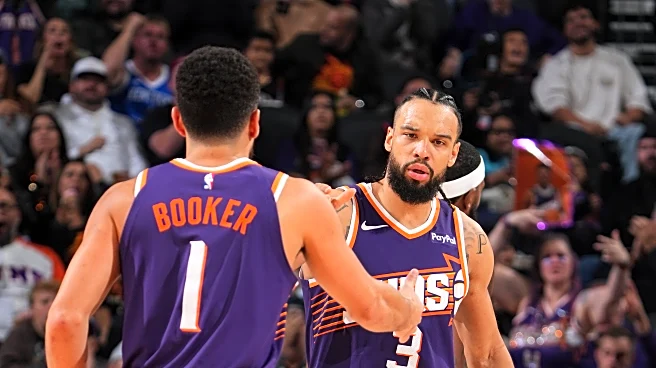
Royce O’Neale does it too, often more quietly: pointing, shading, discouraging without necessarily intervening. Even Devin Booker, long labeled an average defender, has grown in this exact area. His reads are quicker, his communication more consistent, and it changes everything.
And of course, there’s Dillon Brooks, a real dog who barks at everyone, positively with teammates, negatively with opponents…especially when the opponent is LeBron James. Defensive talk gives everyone half a second. And in defense, half a second is huge.
Athleticism and physical tools as amplifiers
Only after instinct comes athleticism: lateral quickness, repeat‑effort capacity, verticality. Partly innate, but mostly optimizable. A mediocre athlete can become a very functional defender if he knows how to move, stop, restart, manage angles. That’s where the myth of pure 1‑on‑1 defense collapses. Yes, an average defender will get beaten in isolation. But how many true, clean 1‑on‑1s still exist in today’s NBA? Very few. Everything is screens, help, pre‑rotations. Modern defense is collective or it doesn’t exist.
On the flip side, raw athleticism without instinct often produces spectacular…but late defenders. Ryan Dunn is a fascinating example. The energy is there, the motor is insane, the highlights are electric. But the reads aren’t consistent yet. Sometimes he compensates with his body for what he hasn’t anticipated. It’s not a criticism. It’s a normal stage. Defensive instinct is built through time and repetition, and he’s in the right environment to grow.
In the same family as athleticism, you have physical traits: size, wingspan, mass, strength. They set a floor and a ceiling. They help with deterrence, contests without jumping, absorbing contact. Mark Williams is the perfect example (2.3 STL%, 1.8 BLK%), but measurements alone don’t make you an elite, consistent defender.
Finally, there’s the technical and structured cognitive side: navigating screens, timing, system knowledge, film work. Crucial, of course — but also the easiest to train and compensate for. A player struggling on screens can switch, deny, or adjust the scheme. Defense is a series of real‑time adjustments.
The counter‑argument: without physical tools, defense has a ceiling
Without size, speed, wingspan, verticality, you’re mechanically less effective. You contest fewer shots, cover less ground, and make fewer “recoverable” mistakes.
In that view, instinct wouldn’t be enough. You can read a play perfectly, but if your body can’t execute, the read becomes useless. The NBA is full of elite scorers who can score through good defense simply because the defender doesn’t have the physical tools to truly impact the shot.
Seen that way, physical and athletic tools would be the prerequisite, with everything else coming after. It’s a seductive and logical argument, but only partially true in my opinion: physical tools set the ceiling, instinct determines the actual impact.
Where I disagree is the hierarchy. Yes, physical tools set a defensive ceiling. They determine what you can theoretically do. But they don’t determine what you actually do on the court.

The real question isn’t “Does physical ability help defense?” Of course it does. The real question is: “What turns physical tools into consistent defensive impact?” And the answer is the same: instinct and reading.
An athletic defender who processes slowly arrives late… very fast. He jumps high, but too late. He runs fast, but toward the wrong angle. He contests hard, but after the pass. The result: spectacular defense, average effectiveness.
Conversely, a physically limited defender with sharp reads acts before the offense exploits the advantage. He doesn’t contest higher, he contests earlier. He doesn’t cover more space, he cuts the right line. He doesn’t need to recover because he’s not late.
That’s where instinct becomes the priority: it reduces the number of actions your body needs to compensate for. In today’s NBA, that’s even more true. Offenses are designed to beat physicality: maximal spacing, multiple screens, pace changes, quick passes. Relying solely on athleticism means accepting that you’ll always be reacting. Relying on reading means taking the initiative back.
In the end, defense is about being faster and more accurate than the offense. The Suns’ defense, when it works, is born from instinct and communication. The game plan is ready, the scouting is done, but once players are on the floor, they know what to do. They know when to pressure, when to trap, when to switch…
Athleticism and physical tools amplify. Technique stabilizes and extends. Reverse that order, and you get clean, disciplined defenders, but rarely dominant ones. Sure, there are exceptions. But over time, the best NBA defenses aren’t the ones that jump the highest. They’re the ones that think, and react, the fastest.
Saying physical tools come first is thinking of defense as a sum of attributes. Saying instinct comes first is thinking of defense as a living system, one that anticipates instead of absorbing.
And in a league where the offense always has a built‑in advantage, anticipation remains the only sustainable way to defend. For Phoenix, that’s probably where the real margin for growth lies.