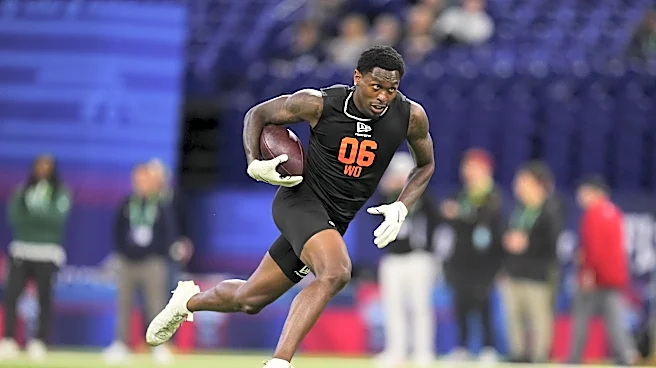








With the NBA Draft less than a month away, we continue looking at potential prospects the Suns could have their eye on, especially if they opt to trade into the first round. Today, we turn our attention to the 26th overall pick, a draft slot currently owned by the Denver Nuggets.
Why 26? Because we’ve explored before what a trade could look like if the Suns decided to do the Nuggets a favor and acquire the Cameron Johnson pick. It’s also a good opportunity to get a feel for who lives at the back end
of the first round.
So here are some prospects to be aware of.
Prospects at 26
I struggled a bit trying to figure out who should go in this group. Ultimately, I settled on players who were clearly not worth taking at 17 because better options were almost certain to be available: I calculated that there was a 97% chance that one of Steinbach, Morez Jr, or Stirtz would still be available at 17.
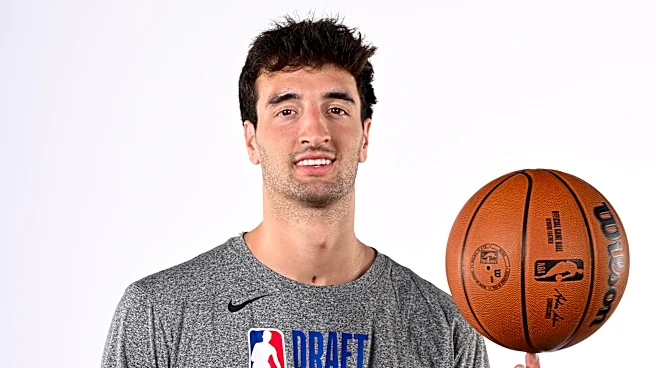
The players in this group have a reasonable chance of still being available at 26, but will almost certainly be gone by the 29th or higher. Previous player summaries I wrote included Ebuka Okorie, who is projected to go between 19 and 35, and might be a target for the Suns with the 26th or 29th pick. Henri Veesaar (whom I also profiled) is also projected to go around 26. If the Suns are set on acquiring an athletic PF, and Morez Jr is off the board,
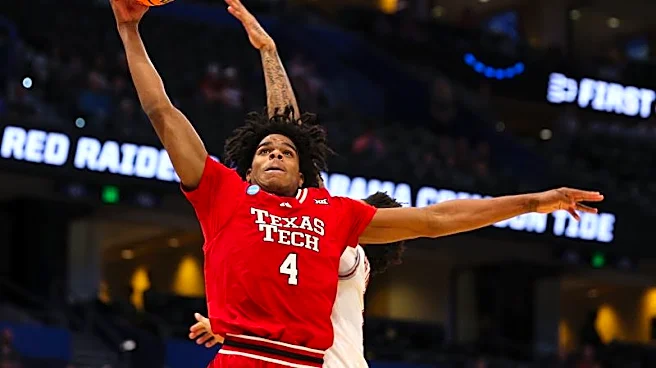
Christian Anderson (Texas Tech, Sophomore, PG)
Christian Anderson (Texas Tech) is a 6’1” 180-pound point guard. He is evaluated as an elite, high-volume three-point shooter and dynamic playmaker. Projected as a mid-to-late first-round pick in the 2026 NBA Draft, he has drawn stylistic comparisons to NBA lead guards like Tyrese Haliburton for his offensive brilliance as a pick-and-roll ball-handler and deadly shooting versatility.
Key Statistics
38.3 MPG, 18.5 PPG, 3.6 RPG, 7.4 APG, 1.5 steals, 47.2 FG%, 41.5 3PT%, 80.5 FT%
Strengths
- Elite Shooting: Blistering deep-range shooter who connects from well beyond the college line. He maintains fantastic shooting splits (over 40% from 3 on high volume), efficiently transitioning between catch-and-shoot and pull-up jumpers.
- Floor Vision & Playmaking: Possesses a high basketball IQ, operating beautifully as a primary pick-and-roll playmaker. He posted over 7.0 assists per game with a strong assist-to-turnover ratio, often generating “attack-and-kick” sequences that collapse opposing defenses.
- Shiftiness: Uses excellent change-of-pace dribbling and a quick release to create separation against larger defenders
Weaknesses
- Physical Profile: Lacks ideal NBA size and weight, making him inherently undersized for NBA lead guard duties. His slender frame limits his ability to absorb contact at the rim and can be a liability against heavier, stronger guards.
- Defensive Liabilities: His size and strength profile negatively impact his defensive metrics. He is mostly limited to guarding opposing point guards (the 1s) and can be targeted on switches.
- Shot Selection: Because of his elite shooting capability, he occasionally settles into difficult, self-created iso-shots instead of keeping the ball moving.
Draft Range
Between 16 and 39, with an average of 21.6 and a median of 21. There is a 30.4% chance he will still be available at 26 if the Suns pick there.
Why the Suns Should Take a Look
Anderson is one of those love him or hate him prospects. He’s a bit on the small side in a time where the NBA meta has moved away from small point guards: they tend to be a defensive liability and Anderson’s statistics bear out that trend. He’s an average athlete for the NBA as well. However, he’s a pure PG who can shoot, and the Suns need that in the worst way next to Booker (if they can get it through their heads that the Jalen Green experiment is doomed to failure so long as Booker is the cornerstone of the franchise).
The Suns are going to have to break the bank to re-sign Colin Gillespie, and drafting Christian Anderson might be a far cheaper long-term solution. Anderson’s NBA comparisons (Haliburton) are ones that Suns fans have kicked themselves over for half a decade, and this would be a second chance.
If the Suns aren’t high on Stirtz, and they’re determined to pick a PG, he could go at 17. However, there’s a 30% chance (right now) that he will still be on the board at 26, but very little at 29 or above. That said, a PG doesn’t make sense unless Jalen Green is exiled to the stamp-licking colonies.
NBA Comparisons
Tyrese Haliburton, Darius Garland, and Reed Sheppard
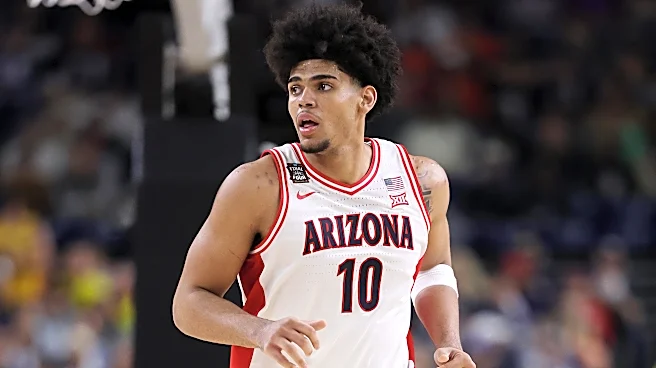
Koa Peat (Arizona, Freshman, PF)
A strong, physically mature 6’7” 235 lbs combo-forward with broad shoulders. He is an agile and fluid athlete who moves well off the ball but relies more on functional strength and timing than elite vertical explosiveness.
Key Statistics
27.8 MPG, 14.1 PPG, 5.6 RPG, 2.6 APG, 1.3 stocks, 52.8 FG%, 35.0 3PT%, 62.3 FT%
Strengths
- Paint Scoring: Highly efficient around the rim. He uses his physicality and body control to carve out space and finish through contact.
- Playmaking & IQ: Possesses a high-level passing feel, often serving as a connective playmaker out of the high post.
- Effort: Displays a strong motor and rebounds well for a small forward.
Weaknesses
- Shooting Mechanics: His perimeter shooting is the biggest swing skill. He struggles with inconsistent release points and mechanics, which were scrutinized during the NBA Draft Combine.
- Spacing Fit: Without a reliable three-point shot, teams will have to weigh whether he is better suited as a small-ball five rather than a traditional modern power forward.
Draft Range
Between 12 and 32, with an average of 22.4 and a median of 22. There is a 26.6% chance he will still be available at 26 if the Suns pick there, but that number is increasing by the day.
Why the Suns Should Take a Look
Peat’s draft stock has been crashing after a disastrous NBA draft combine, where his shooting mechanics and physical limitations couldn’t be hidden any longer. During his time at Arizona, his funky-awkward shooting mechanics were noted, and some observers at the combine believed he was in the middle of retooling them there.
He has average at best size for a small forward, and is undersized at PF. He has good vertical and did well in agility drills, but surprisingly did very poorly in the shuttle run. He was miserable in the 3-point shooting drills at the combine as well, and as a result, I could see him falling all the way to the second round as Noah Penda did in 2025.
Peat’s biggest pluses are his age, motor, agility, and overall feel for the game. If he figures out his shooting mechanics, I could see him carving out a niche as a modern Rodney Rogers sort of tweener forward who is a reasonable threat from three. However, that’s a big “if”, and it’s hard to see how he addresses the Suns’ need for frontcourt size and rebounding. If I were Peat, I’d go back to the UofA and work on my three-point shot and try to make the 2027 lottery.
NBA Comparisons
Rui Hachimura
Allen Graves (Santa Clara, Freshman, PF)
Allen Graves is a versatile 6’8”, 226-pound power forward out of Santa Clara who has emerged as one of the most polarizing, analytics-friendly prospects in the 2026 NBA Draft. After redshirting his first college year, Graves put together a historic freshman campaign in the 2025–26 season, capturing both the WCC Freshman of the Year and WCC Sixth Man of the Year honors. A former high school point guard who underwent a late growth spurt, Graves plays as a modern “connector” piece. He blends high-level passing, defensive awareness, and efficient perimeter shooting into a unique statistical profile that heavily appeals to front offices utilizing advanced modeling.
Key Statistics
22.6 MPG, 11.8 PPG, 6.5 RPG, 1.8APG, 2.8 stocks, 51.2 FG%, 41.3 3PT%, 75.0 FT%
Strengths
- Advanced Feel & Playmaking: Because of his background as a guard, Graves processes the floor remarkably fast. He functions beautifully as a short-roll processor or an extension piece, consistently mapping out standard 4-on-3 advantages and delivering pinpoint skip passes.
- Elite Statistical Instincts (“Stocks”): Graves possesses an incredibly rare defensive footprint for his position. He tied for the most total steals by a freshman in the country (67), boasting a Steals Percentage of 5.3% and a Block Percentage of 5.8%, indicating a high defensive IQ and lightning-quick hands.
- Perimeter Spacing: He is a highly efficient floor-spacer, sinking 41.3% of his three-pointers during his freshman year. His catch-and-shoot capability makes him a lethal option out of pick-and-pop actions.
- Low-Mistake Value: For a young forward handling the ball, his asset management is elite. He averaged just 0.7 turnovers per game despite acting as an offensive hub off the bench. [1, 3, 4, 5]
- Paint Scoring: Highly efficient around the rim. He uses his physicality and body control to carve out space and finish through contact.
Weaknesses
- Functional Athleticism & Burst: Graves lacks true explosion and vertical pop. He requires a clear runway to finish around the rim, rarely finishing vertical lob threats cleanly and struggling with below-the-rim athletic limitations in dense traffic.
- Lateral Quickness in Space: There are sharp concerns regarding whether Graves can consistently guard NBA-level power forwards out on the perimeter. His lack of foot speed leaves him vulnerable to quick counter-moves when caught on an island.
- Volume and Scaling Concerns: While his efficiency numbers are spectacular, they came in a limited 22.4 minutes per game off the bench. Scouts question whether his 3-point efficiency will sustain if his offensive volume scales upward against tighter defenses.
- Competition: Graves played at Santa Clara against lesser competition than most of the big-name Division I prospects in the draft. It is unclear how well he will perform at a much higher level.
Draft Range
Between 20 and 39, with an average of 26.5 and a median of 27. There is a 53.8% chance he will still be available at 26 if the Suns pick there, but that number is increasing after measuring poorly at the draft combine.
Why the Suns Should Take a Look
Graves has a lot to like, and a bunch of big question marks next to him, especially after the draft combine. On the plus side, he’s only a freshman and about to turn 20 years old. He has a great feel for the game, great handles for a power forward, and shoots a ridiculously high percentage on threes at a high volume of 2.6 per game.
Per Tankathon, he has three skills that grade out as “elite”: steals, assist-to-turnover ratio, and offensive rating. He also has three more where he grades out as “very good”. He has great footwork, positioning, body control, balance, and generally looks “fluid”. Fundamentally, he’s a high skill, low athleticism guy.
And there’s one of the two big red flags on him. Graves did poorly at the combine. He measured only 6’7.75” in socks. Wingspan was below average. So was reach, and wingspan minus height. Average at best vertical, and below average agility scores. He was also only average in the 3-point shooting drills. That said, I think the combine is somewhat overrated: Kevin Durant, Stephen Curry, David West, Caron Butler, Kyle Korver, Gordon Hayward, and DeMarcus Cousins all had miserable combines and went on to long, successful, often Hall of Fame careers.
The final big question is how much his stats are inflated because so many of his games were against the Division I equivalents of Little Sisters of the Poor College for the Deaf and Blind? The answer seems to be “some”. In his five games against ranked opponents (UK, Gonzaga x3, and Saint Mary’s), he averaged 26.2 MPG, 13.8 PPG, 7 RPG, on 42/32/88 splits. Still, those are impressive numbers for a freshman, where he was clearly the best player on the team. He’s likely to have more looks on an NBA team where he’s a 4th or 5th option. And, despite middling size and athleticism, he still grades out as a defensive net plus due to his basketball IQ and footwork.
If the Suns draft 26th, I’d be hard-pressed to choose between Zuby Ejiofor, Joshua Jefferson, Henri Veesaar, and Allen Graves: it’s possible none of them will be left by 29.
NBA Comparisons
Kyle Anderson and Boris Diaw
Coming tomorrow, prospects available between picks 29 and 31, if the Suns opt to trade up into the backend of the first round of the 2026 NBA Draft.