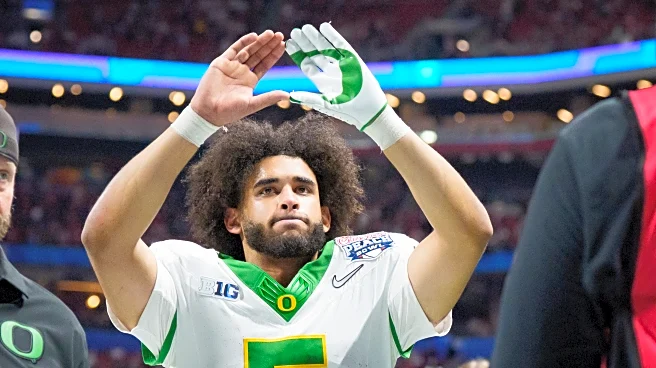


In a somewhat unprecedented move Dante Moore, who was widely viewed as the consensus No. 2 pick in this year’s draft has, decided to forego declaring for the 2026 NFL draft and instead return to Oregon for his senior season.
On the surface, the decision makes sense from a developmental standpoint. Moore has long been viewed as an immensely talented but still relatively inexperienced prospect. That said, it’s an enormous financial risk. By returning to school, Moore potentially passed on $40+ million
in guaranteed money, something I personally would not be comfortable doing. There is tremendous risk involved here as well.
It’s important to acknowledge that we don’t yet have the full picture. There are several plausible explanations. It’s possible Moore received feedback suggesting he wouldn’t go as high as initially projected. This is something we’ve seen happen plenty of times as the process moves from January to April. It’s also possible this decision had nothing to do with draft stock at all. Some will speculate that Moore simply didn’t want to end up with the Jets, though that’s difficult to buy into without evidence. It’s equally possible the Jets themselves weren’t as interested in Moore as public perception suggested.
The truth is, no one knows yet.
What is clear, however, is that Moore’s decision will have significant ramifications for the Jets, both in the short term and the long term. Let’s take a look at the potential negatives and positives of this decision.
Negative #1: The Value of the No. 2 Pick Takes a Hit
This one stings. Regardless of whether the Jets were ever truly interested in Dante Moore, one thing is objectively true: the No. 2 pick became less valuable the moment this announcement dropped.
For the Jets, trading down always loomed as one of the most logical and arguably best paths forward. In the NFL, teams are far more willing to trade up when a quarterback is on the board, and the team moving down typically receives a premium well beyond the pick’s baseline value. Remove that quarterback from the equation, and the leverage disappears.
Without a clear QB prospect available at the top of this draft, the Jets’ trade-down options shrink dramatically. Could a team behind them still fall in love with a non-quarterback and move up? It’s possible, but it’s far from likely. And even in that scenario, the return the Jets could command for the pick would be significantly reduced.
Simply put, Moore’s decision dealt a meaningful blow to the overall value of the No. 2 selection.
Negative #2: You’re Likely Not Finding Your Long-Term QB This Off-Season
The league is weird, so I’m not completely ruling out the possibility that the Jets somehow stumble into their long-term quarterback this offseason. Maybe Malik Willis is that guy. Maybe Tanner McKee becomes available and is. Maybe Kyler Murray has a late-career renaissance. Maybe Ty Simpson, Trinidad Chambliss, or even someone like Garrett Nussmeier or Cade Klubnik shocks people in the draft.
All of that could happen.
But you get the point. When you zoom out and look at it from a long-term perspective, none of those names exactly inspire a ton of confidence. Dante Moore, whether you were personally in on him or not, realistically represented the highest-upside path for the Jets to find a true long-term answer at quarterback based on what was likely to be available to them.
Now that path is gone.
Negative #3: The Top Tier Non-QB Prospects Are Weaker In This Draft Than Most Years
The final negative is, unfortunately, another one that’s more bad luck than anything else for the Jets. Most draft classes feature at least one or two true blue-chip prospects at the very top. In recent years, we’ve seen players like Marvin Harrison Jr., Joe Alt, or Will Anderson sitting there, guys who feel almost “can’t-miss” coming out.
At this point, it’s hard to identify that type of player in this class. The two closest names by consensus seem to be Caleb Downs and Jeremiah Love. The problem, of course, is positional value. Downs plays safety and Love is a running back, two positions generally viewed as the least valuable when you’re picking near the very top of the draft.
Now, things can absolutely change. It’s possible someone like Rueben Bain, Arvell Reese, or David Bailey tests like an absolute freak. It’s possible Carnell Tate or Jordyn Tyson does the same. Statistically speaking, at least one of these players is very likely to turn into a true star.
The issue for the Jets is that identifying which one that will be feels significantly harder than it has in recent drafts. Having said all that, let’s get to some positives about this move.
Positive #1: This Gives The Jets More Time To Build The Roster
Let’s face it, this Jets roster sucks. Anyone who feels the Jets were a quarterback away from magically turning this around was either in denial or not paying attention this season. While there are some things to get excited about like a solid young offensive line and a really good young receiver in Garrett Wilson, the Jets have major holes not just on the top of this roster but even in the depth of it.
With no pressure to take a QB at the top of this class, the Jets should be able to focus on selecting the best players in this roster to help build the team. With a ton of financial flexibility as well, the Jets theoretically should be in a much stronger position roster wise to put a young quarterback on the team next year than they would be this year. It’s not out of the realm of possibility with good moves and more draft picks that by 2027 the Jets actually have the makings of an exciting core to drop a rookie quarterback into.
Positive #2: The 2027 Draft Class Has Legitimately Enticing Quarterback Options
Now tell me where you’ve heard this before. It’s always “just wait until next year’s class.” And most of the time, that optimism is misplaced. In this case, though, there’s a very real chance next year’s quarterback class is meaningfully better.
This year’s QB group is weak, and that’s partly because many of the players who were generating Day 2 buzz: Jayden Maiava, Darian Mensah, Brandon Sorsby, Sam Leavitt, and LaNorris Sellers, all elected to return to school in an effort to improve their draft stock. It’s not hard to imagine one or two of those guys taking a major leap and turning themselves into legitimate first-round prospects by 2027.
Then there’s Arch Manning, who will be eligible next year. The post-season buzz around him was so strong that multiple scouts went on record saying he would have been the No. 1 pick in this class. Julian Sayin is another name to watch, and at this point he’s already being viewed by many as a top-10 caliber prospect.
And, as always, a quarterback or two will likely come out of nowhere because that happens every single year (it literally just happened in this cycle). From a statistical standpoint alone, it’s far more likely than not that at least three quarterbacks receive first-round grades in next year’s draft giving the Jets more options than they would have this year.
Oh and I forgot to mention the obvious: Dante Moore will be available next year as well.
It’s not a guarantee the Jets land one, but with three first round picks in 2027 if the Jets need one they almost certainly will end up with one.
Positive #3: A Potential Lame Duck Head Coach Is Not Taking A QB High
One of the biggest concerns with the Jets potentially taking Dante Moore at No. 2 was that not only was the roster not ready, but the coaching staff might not have been either. After a disastrous season, Aaron Glenn’s long-term job security is far from guaranteed. While I’m not as down on Glenn as most (I don’t think he’s a good coach right now, but I do think there’s still a chance he grows on the job and looks better with a stronger roster), there was a very real scenario where the Jets draft Moore high only to clean house a year later.
That wouldn’t necessarily ruin Moore’s career, but it would absolutely make things harder than they need to be.
Moore returning to school gives the Jets another year to evaluate Glenn properly. If things don’t improve significantly, Glenn will almost certainly be gone and in that case, the Jets could suddenly become a very attractive job opening in 2027. Pair a potentially deep quarterback class with a younger, hopefully more complete roster and another year of strong draft capital, and the Jets would be in a much better position to hire a head coach they believe is truly equipped to develop a rookie quarterback.
On paper, at least, that path makes a lot more sense than forcing everything to align prematurely.
Summary:
In the short term, it’s hard to argue that Dante Moore’s decision not to declare was a good thing for the Jets. The value of the No. 2 pick took a hit, and it significantly lowered the odds of the Jets having a true long-term answer at quarterback on the roster next season. For fans hoping for a quick fix or immediate dopamine next year – it hurts.
That said, when you step back and lay out the potential positives, it’s not hard to see how this could ultimately help the Jets take a more sustainable long-term approach, something many have been calling for. Instead of hoping a quarterback magically fixes everything, the Jets finally have an opportunity to build up the roster properly and reach a point where they can actually support one from Day 1.
How the Jets respond this offseason will matter a lot. But there’s at least a reasonable case to be made that, in the long run, this could end up being the best thing that happened to them.