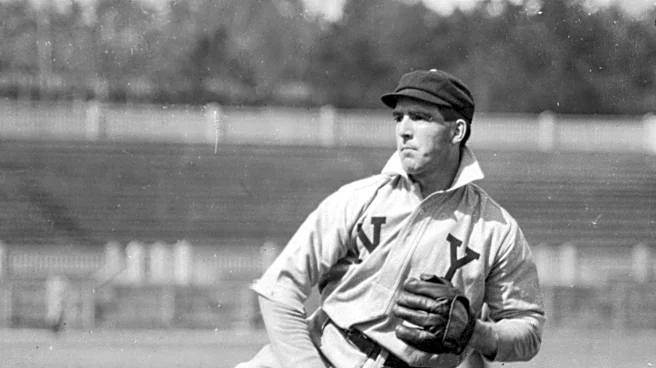






Before he was known as Slow Joe, Judd Bruce Doyle was a right-handed pitcher growing up in the middle of Kansas. Like most of the time, his love of baseball was not born in an organized league, but in the school lot and in local games in his community featuring players of all ages.
Judd Bruce Doyle
Born: September 15, 1881 (Clay Center, KS)
Died: November 21, 1947 (Tannersville, NY)
Yankees Tenure: 1906-1910
Born before the turn of the century, Doyle was small even by the standards of the time. He
was reported by most accounts at 5-foot-8 and 150 pounds. However, growing up working on the family farm made Doyle what many call country strong or stout. Despite having some strength behind his small frame, Doyle relied on changing pace and his arm slots to keep hitters off balance, much like former Yankee folk hero Nestor Cortes. Doyle and his mix of overhand and submarine deliveries tossed a drop ball, rise ball, changeup, and the legendary spitball.
Doyle’s professional baseball journey started right after he graduated from Clay Center High School in 1901. This kicked off a five-year run through the amateur ranks. In 1902, Doyle suited up for the Fort Worth Panthers and the New Orleans Pelicans. Then, in 1903, Doyle joined the Baton Rouge Red Sticks in the Cotton States League. In his first season in Baton Rouge, Doyle went 16-9 and helped the team win the league championship. He started the 1904 season back in a Red Sticks jersey, but would finish that season and play the 1905 season for the Wheeling Stogies.

After playing well for the Stogies, Doyle finally landed the coveted contract with a professional team when his rights were sold to the New York Highlanders in August of 1905. Slow Joe burst onto the scene a few days later, making his debut on August 25, 1906. In his first start, Doyle threw a six-hit shutout against the Cleveland Naps. He followed that up with another shutout against the Washington Senators in his second game. The rookie appeared in nine games total, tossing 45.1 innings with a 2-1 record and 2.38 ERA.
Following the hot start to his career, Doyle came into the 1907 season expecting to be a big part of the Highlanders rotation. Doyle appeared in 29 games, making 23 starts. This led to what would stand as his career-high 193.2 innings with an impressive 2.65 ERA and an 11-11 record. Doyle led the Highlanders with 15 complete games and 94 strikeouts. It was also during this run that his reputation for slow playing really took hold. The Washington Times referred to Doyle as the Human Snail due to his long stretches between pitches.

In 1908, Doyle’s third season, Slow Joe was officially the name adopted and used by the press as an unofficial, official name. Doyle’s arm did not handle the large workload from the year before well, and he was limited to 12 games, only four starts, and only 48 innings. Despite being effective when he pitched, the lack of availability started to be the story.

Doyle asked for extra days of rest between starts in 1909, and it led to a rebound. He pitched in 17 games, making 15 starts, tossing 125.2 innings, and going 8-6 on the year. Still just 27 years old, Doyle’s arm simply could not handle the workload of a normal pitcher of the time.
The Highlanders had Doyle on their roster to start the 1910 season but ended up cutting him halfway through the year. The Cincinnati Reds signed Doyle, and he pitched the final part of the season for them. After making five relief appearances for the Reds, Doyle’s major league career was over at just 28 years old after the 1910 season.

Beyond his memorable nickname, Slow Joe Doyle holds a legendary status among modern sports collectors due to one of the rarest and most valuable printing blunders in baseball history: the 1910 T206 “Slow Joe” Doyle error card. During the production of the iconic tobacco card set, the American Lithographic Company accidentally designated Doyle as playing for “Nat’l” rather than “Amer” in his New York uniform. After catching the mistake, the printers pulled the printing plate, scrapped off the “Nat’l” letters, slapped the plate back into the machine, and continued printing. Today, fewer than a dozen authentic copies are known to exist, making it more rare than the famed Honus Wagner T206 card.
Happy birthday, Slow Joe!