

It’s amazing to look back and see how much life has changed in just a few generations. My life often seems stuck in neutral, one day, week, year blending into the next. I know things are changing; I just don’t often see or appreciate it.
In the very late 1800’s and early 1900’s, my great-grandfather worked as an itinerant blacksmith. He worked out of a covered wagon and when times were tough, and they often were, the entire family also lived in that covered wagon. Imagine two adults and five children
living in a covered wagon.
In the early 1940’s, my mother-in-law would ride her horse several miles from home to her country school, each day, in all sorts of weather. The school had a small shed where students’ horses could be tethered, giving them shelter and some food and water. Understand, she would have been a grade school student. Throughout most of the country, this was a common form of transportation for many rural school children. We rode our bikes. Kids today are chauffeured by their parents in oversized SUVs that have heated and air-conditioned seats. Times change.
Baseball is the same way. Prior to 1953, St. Louis was the only major league city west of the Mississippi River and just barely at that. Baseball was primarily an east coast phenomenon, with three teams in New York and two apiece in Philadelphia, Chicago, Boston and St. Louis. Teams most often traveled by rail. Those teams were often split between the National and American League, and if you lived in a city with just one team, say Pittsburgh, Detroit, Cleveland or Cincinnati, you rarely got a chance to see the star players from the other league. That made the All-Star game, and the World Series must see viewing for the hard-core baseball fan.
Television coverage and inter-league play have eliminated that aspect, for better or worse, you can decide that on your own. I recently read a piece on Substack about the Philadelphia City Series by Russ Walsh, and it led me down an old-time baseball rabbit hole. In a side note, have you noticed how many really good baseball writers there are now on Substack? Every day I see something outstanding from a new writer. For baseball fans, I’m not sure there has ever been a time better than this if you like to read about the grand old game.
City series have a long and storied history. Cities with multiple teams would often have an inter-city playoff before the season started. Even though these games were exhibitions, they were hotly contested. The outcome gave local fans some bragging rights. In 1943 the Yankees and Dodgers played in something called the Mayor’s Trophy Game and in 1944, all three New York teams met at the Polo Grounds to play a six inning, round robin exhibition to sell War bonds.
The Cubs and the White Sox had a long-running City series. Between 1903 and 1942, they met 161 times, with the Sox winning 95 of those games. Even with the advent of inter-league play, the Battle for Chicago is still must see baseball.
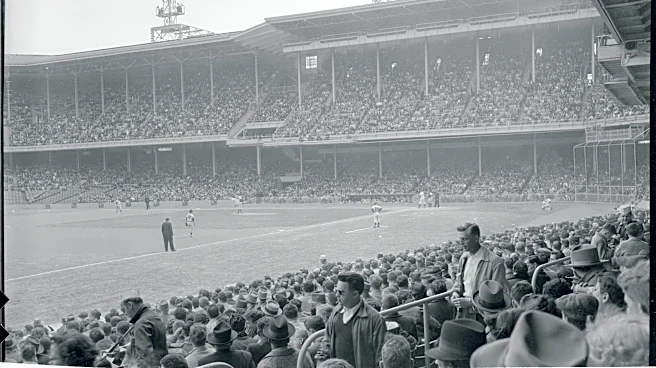
The Philadelphia Athletics and Phillies also had a City Series, which started in 1883 and ran to 1891. The series resumed in 1903 and ran uninterrupted until the Athletics moved to Kansas City after the 1954 season. The City Series hit its peak in the 1920 and early’30s. The 1928 game was flush with Hall of Famers. Chuck Klein was the only one for the Phillies, but the Athletics were loaded with them: manager Connie Mack, Jimmie Foxx, Lefty Grove, Mickey Cochrane, Eddie Collins, Al Simmons, Tris Speaker and Ty Cobb. You don’t think much of Cobb playing for the Athletics, but he did for the final two years of his career. In 1928, at the age of 41, Cobb still hit .323 in 95 games.
The Athletics, once a dynasty, were in the dumps by 1954. Mack was operating on a shoestring and fielded a team of rookies and castoffs. They only won 59 games in 1953 under manager Jimmy Dykes, who had been a reserve infielder on that 1928 team of Cobb and Speaker.
The lack of talent cost Dykes his job. The 1954 Athletics had several players who would make the move west to Kansas City in 1955. Joe DeMaestri, Gus Zernial, Joe Astroth, Elmer Valo, Bill Wilson, Vic Power, Alex Kellner, Arnie Portocarrero, Art Ditmar and Bobby Schantz would all play key roles for the new Kansas City team.
On April 10th, 1954, the two Philadelphia teams met at Connie Mack Stadium for the first of three games to determine who was the champion of Philadelphia. The Phillies were designated the home team for the first game of the three-game series.
Alex Kellner got the start for the A’s and in the 3rd inning helped his own cause by stroking a bases loaded single that scored two.
The Phillies started lefty Curt Simmons, who went three innings before being relieved by knuckleballer Murray Dickson. Dickson was a Missouri native who would later play the final two seasons of his career in Kansas City.
Dickson gave up a double to Lou Limmer and an RBI single to Ed McGhee to make it 3-0 Athletics going into the bottom of the 4th.
Del Ennis, an underrated slugger for the Phillies, took Kellner out of the yard to close the gap to 3-1.
Things fell apart for Kellner in the 6th. Richie Ashburn singled, Earl Torgeson laced a double over the head of Power. Ennis hit an RBI single. Granny Hamner drew a walk and Mel Clark followed with an RBI double.
Marion Fricano came on in relief of Kellner and gave up two more RBI singles to push the Phillies lead to 6-3.
Jim Konstanty took the mound for the Phillies in the 7th. An error by shortstop Ted Kazanski led to two runs. It was 6-5 Phillies going into the top of the 9th. The wonderfully named Spook Jacobs, enjoying his rookie season at the age of 28, led off with a double. Power, who had just come over from the Yankees in a ten-player trade, and would become Kansas City’s first baseball star, pounded a Konstanty fastball into the upper deck of left field to give the Athletics a 7-6 lead.
Moe Burtschy, who could bring the fastball, shut down the Phillies in the 9th, giving the Athletics the win. The game was a slugfest with the Athletics pounding out 15 hits while the Phillies countered with 10.
Game two was played the next day and was a pitchers’ duel. Paul Penson, Bob Miller and Steve Ridzek shut out the Athletics on just three hits.
The Athletics countered with rookies Arnie Portocarrero and Leroy Wheat. Portocarrero was a highly touted prospect who unfortunately suffered an arm injury while playing winter ball after the 1954 season. The duo only gave up one run which came in the 6th.
Kazanski atoned for his error the day before by ripping a double off the left-center wall. Ennis continued his hot hitting with an RBI single. That was the only score of the game, evening the series at one apiece. Portocarrero pitched for the Athletics through the 1957 season before being shipped to Baltimore for Bud Daley. As was life for the Athletics in those days, Portocarrero had a career year with the Birds, winning 15 games with a career best 3.25 ERA in 204 innings. Alas, the arm problems returned and he was out of baseball after the 1960 season. The trade worked well for Kansas City as Daley turned into a mainstay of their rotation for the next four seasons.
The deciding game of the series wasn’t played until June 28th. Nearly 16,000 fans turned out in a steady rain to watch the finale. The Athletics started rookie Harold Raether, a recent University of Wisconsin grad, who was making his professional debut.
The Phillies countered with Tom Qualters, who had been tagged with the derisive nickname “Money bags”. Qualters was a bonus baby who had ridden the Phillies bench for two seasons having suffered much derision from several Philly veterans. The City Series start was just his second appearance in two seasons.
The Phillies welcomed Raether to the big leagues by tagging him for three runs in the first inning.
There was a scary moment in the bottom of the 1st, when Qualters had a fastball get away from him. The pitch struck Power above the right temple, knocking him unconscious. Power was taken to Presbyterian Hospital and held overnight for observation.
Joe DeMaestri, who had three hits in the game, drove home two with a triple and a double. The score stood at 3-2 Phillies when the drizzle turned into a deluge in the 7th. The game was called and the Philles were crowned the champions of the City. For their efforts they were awarded the Ellis Gimbal trophy, named after the department store magnet and philanthropist.
In October of 1954, with the Athletics deeply in debt, Earl and Roy Mack sold the team to Chicago businessman Arnold Johnson, who announced the team would be relocating to Kansas City. American League President Will Harridge faced severe criticism for pressuring the Mack family to sell to Johnson despite a competitive offer from Philadelphia car dealer, John Crisconi, which would have kept the Athletics in Philadelphia. With the sale and move, the City Series died a quiet death.