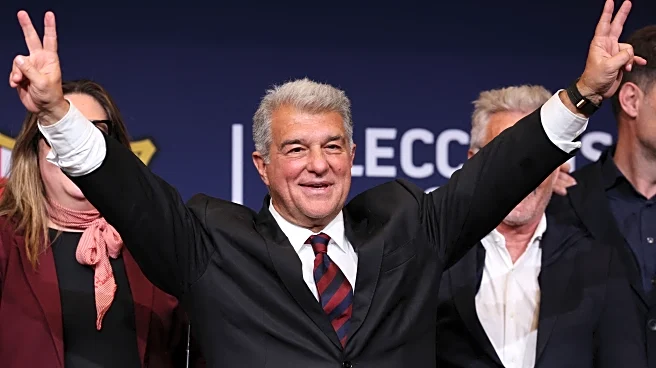




Joan Laporta secured his third mandate as Barcelona president, proving his brand of charismatic leadership is still the ultimate shield for the club. With 68% of the vote against the 30% managed by Víctor Font, it wasn’t close at all. Even with the lowest voter turnout since 1997 – only 48,480 socios hit the polls – Laporta’s win was a landslide. The message was loud: Barça prefers a leader they know to a man with big ideas which are unproven.
The campaign was a marathon focused less on policy and
more on personal jabs. Laporta leaned into his tough guy persona. He didn’t hold back, calling Font a “trilero,” something like a scammer, and “a technocrat hiding behind a computer.” According to El Periódico, Laporta’s strategy was to paint Font’s data driven approach as a path back to ruin. He framed the election as a choice between a leader with a “Barça heart” and a cold accountant. Font spent his energy trying to dismantle the Laporta myth, describing the president’s style as “Trumpist” and accusing him of confusing the institution with his own personality.
Laporta’s big personality is both his greatest asset and his greatest liability. Fans love how he seems like just another passionate fan. Font attempted to turn this into a weakness, showing him as not serious enough and not professional enough. Ultimately, that attack failed to land as much as Font would have wanted.
While Font bragged about his 140 concrete proposals, Laporta dominated the stage at the debate and campaign events. Font’s economic team, led by banker Jaume Guardiola, insisted the club’s health was an illusion. He cited 230 million in losses and 150 million in negative equity. Laporta countered by pointing at the new stadium and a winning team. He essentially told members to trust their eyes, and implicitly, their hearts.
The ghost of Lionel Messi loomed over the ballot boxes, too. It is no secret that the Argentine legend has a fractured relationship with the man who oversaw his departure, that being Laporta. Both candidates tried to claim his legacy. Font proposed a brand partnership and an honorary presidency, and attacked his rival for failing to keep Messi around. Laporta focused on physical tributes, promising a statue and a massive testimonial match once the stadium renovations are finished.
Xavi Hernández became a focal point after revealing in La Vanguardia that Laporta pushed him out as coach and blocked his return as a player in 2023. The president added fuel to the fire, noting that “with the same players, Xavi was losing and Flick is winning.”
Even the presence of Alejandro Echevarría, Laporta’s former brother-in-law who operates without an official title, couldn’t stop him. Font highlighted Echevarría’s power in the shadows, but Laporta defended him as an essential confidant. Meanwhile, Laporta mocked Font’s proposed staff of Carles Planchart, Albert Puig, and Francesc Cos, stating they didn’t “reach the sole of Deco’s shoe.”
There was verbal jousting, promises to bring big players, and competing narratives about the club’s finances. But what ultimately sunk Font was that he didn’t seem to have a good enough “theory of the case” to prosecute Laporta’s reign. While the current president has had his share of misfires, most people were happy to stay the course rather than take a bet on someone seen as not proven. Doubly so after the reign of Laporta’s predecessor, Josep Maria Bartomeu, ended in disaster.
Laporta now has until 2031 to prove his supporters right. He survived a campaign of bitter reproaches and a brief legal entanglement involving a complaint at the National Court. By securing over double the votes of his rival, he showed that at Barcelona, aura and institutional stability still carry weight.