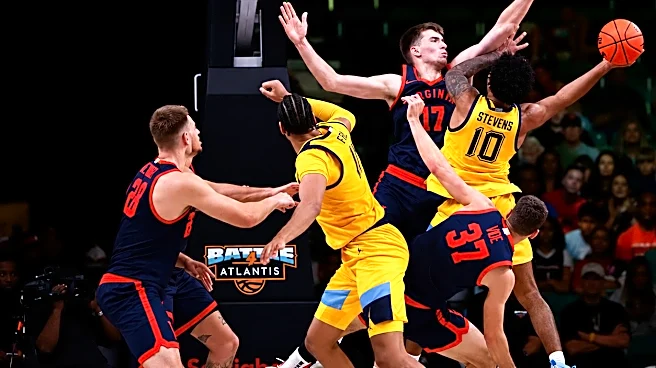

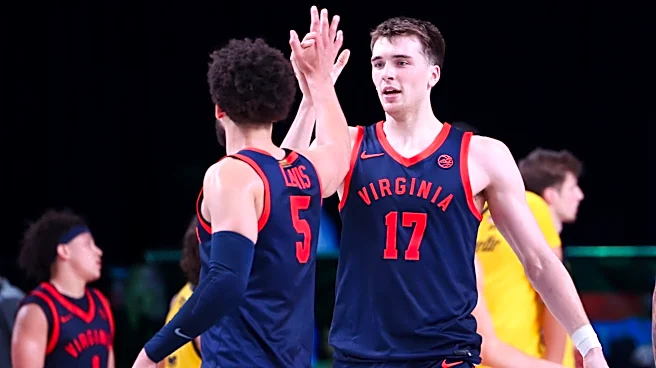
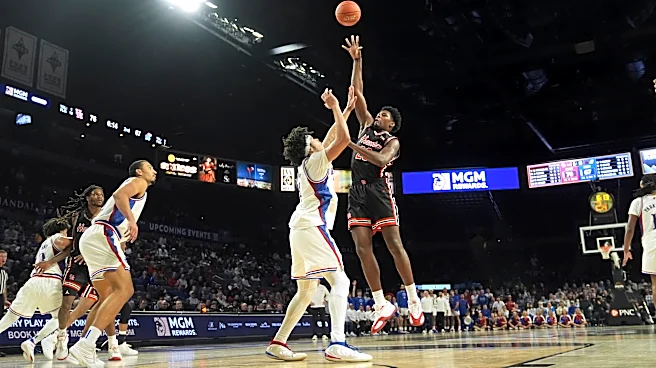
Five days after a 103-61 rout of Loyola Maryland, No. 2 Virginia opened the Battle 4 Atlantis on Wednesday in Imperial Arena, a converted ballroom at the Atlantis resort on Paradise Island. Waiting for the Cavaliers was a Marquette team trying to rebuild under Shaka Smart. The Golden Eagles went 12-20 last season and came in 4-2, with their losses coming at Michigan and against Missouri in Chicago. This offseason, Marquette signed a transfer for the first time since 2022, adding 6-foot-11 center
Sananda Fru from Louisville. DraftKings opened Virginia as a 4.5-point favorite, and the line moved to 5.5 by tipoff.
What followed was one of the strangest games I have covered. After Virginia started the game strong, including two early buckets by Nolan Adekunle, Marquette ripped off a 16-0 first-half run, the worst run Virginia has allowed this season, and led by 10. Virginia answered with a 12-0 run to close the half and led 25-23 at the break. Then it started raining inside the arena. A leak in the roof delayed the start of the second half by an hour and 35 minutes, and a game that tipped at noon took three hours and 45 minutes to finish. After pigeons landed on the court during the Arkansas game earlier this month, Virginia must be wondering what is happening with the arenas it keeps visiting.
In front of a crowd of just 1,181 in the 3,500-seat arena, Virginia moved to 8-0 and covered the closing spread by half a point for just the second time this season. Marquette fell to 4-3.
Here are my six takeaways.
Virginia survived an onslaught, and its defense is the reason why
From the opening tip, Marquette played with an intensity that made it feel more like a football game. It pressed, it switched into what looked like a zone, it jumped passing lanes and it crashed the glass on every miss. The officials mostly let the teams play, and Marquette took full advantage.
Virginia handled it for about five minutes. Adekunle hit a three off a Thijs De Ridder feed and finished a fast-break layup, Sam Lewis hit two threes, and Virginia led 11-5. Then the wheels came off. Virginia went nearly eight minutes without scoring while Marquette ran off 16 straight points. It could not get the ball across half court cleanly, it traveled, it threw passes to teammates who were not ready for them, and one possession ended with Chance Mallory forced into a desperation fadeaway that missed everything for a shot-clock violation. Elijah Gertrude finally ended the drought with a tough mid-range fadeaway, but Marquette still led 23-13 with under four minutes left in the half.
What kept Virginia in the game was its defense. Marquette shot 30 percent from the field and 3-of-30 from three, including 1-of-17 in the second half. Adrien Stevens, who came in shooting 39.5 percent from deep, went 2-of-16 from the field and 1-of-10 from three. Nigel James Jr. went 2-of-10. Virginia blocked seven shots, four of them by Johann Grünloh, and kept forcing Marquette into long, contested looks late in the shot clock.
That is how a team that shot a paltry 34.5 percent and turned it over 18 times still won. This reminded me a lot of the Maryland game. For the second time this month, Virginia played poorly for long stretches against an energized opponent and found a way to win anyway. The ability to weather the storm is the mark of a good team, but Virginia will need to learn how to avoid these droughts if it wants success in March.
A rain delay turned this into two different games
I have seen weather delays in football and baseball. I had never seen one like this in an indoor basketball game. At halftime, rain started coming through the roof of the ballroom, and the second half did not start until about 2:45 p.m. ET. For a while, there was no timetable at all. ESPN’s Tom Crean described both teams as “really in a holding pattern,” and it looked like the game could be suspended or postponed. Texas A&M and Xavier, scheduled to play next on the same floor, were pushed back an hour and 45 minutes. The game tipped on ESPN, and by the time it resumed, the broadcast had moved to ESPN2 to make room for the Maui Invitational final between No. 8 Arizona and Ole Miss.
The delay worked as a full reset. Virginia’s 12-0 run to end the half had flipped the momentum, and the break took that momentum away. It also took away Virginia’s fatigue advantage. Marquette’s fervent, adrenaline-fueled pace had already started to fade late in the first half. The level of intensity Marquette played with early is nearly impossible to sustain for 40 minutes, and the second half was set up for Virginia to take control against a flagging Marquette team. However, the long break allowed Marquette to rest and come out of halftime with the same intensity as before. The pace continued to be breakneck, with several long sequences that left the announcers catching their breath.
The extra rest also changed how Ryan Odom could use his players. With that much extra recovery time, Odom leaned on his starters even more than usual. Grünloh played all 20 minutes of the second half, and only Gertrude, Jan Vide and Martin Carrere came off the bench after the break.
In the end, Virginia’s free-throw shooting decided the second half. After going 2-of-5 at the line in the first half, Virginia went 11-of-12 in the second, while Marquette kept firing away from three.
Turnovers and offensive rebounds reared their heads again
Virginia turned it over 18 times, a new season high, one more than the 17 it committed at Maryland. Thirteen of those came in the first half, which is more than Virginia committed in the entire game against Arkansas (nine), Bucknell (12) or Old Dominion (six). Marquette finished with 11 steals, eight of them in the first half, and outscored Virginia 18-11 in points off turnovers.
Some of that was Marquette’s pressure. James was a pest all game, with three steals and five assists. But a lot of it was self-inflicted: three traveling violations, a timeout burned to avoid a five-second call, passes that caught teammates off guard and a shot-clock violation. Lewis had five turnovers, De Ridder four and Mallory three. The good news is that Virginia fixed it after halftime, with just five turnovers in the second half.
The offensive glass was the other problem. Marquette grabbed 21 offensive rebounds on 46 missed shots, 11 of them in the first half, and won the second-chance battle 20-11. Fru and Royce Parham each had four. The two came in with 40 combined offensive rebounds through six games, so this was not a surprise, but Virginia still struggled to put a body on them. Even in the final minute, Marquette strung together missed threes and offensive rebounds to extend possessions. Marquette also won the paint 30-18. It was made worse any time Grünloh was pulled out to defend the perimeter. When he was not down low to box out, it felt like Marquette was almost guaranteed to get the rebound.
To be fair, Virginia won the overall rebounding battle 45-40 and grabbed 19 offensive rebounds of its own, but its inability to secure defensive rebounds was concerning. Interestingly, the fouling that hurt Virginia at Maryland was not a team-wide problem this time. Virginia was called for 15 fouls to Marquette’s 18 and made more free throws, 13 to 11. The foul trouble was concentrated in two players, De Ridder and Adekunle, which I will get to below.
Still, 18 turnovers and 21 offensive rebounds allowed is a combination that will beat Virginia against the better teams on its schedule.
Johann Grünloh is indispensable, and Favour Ibe’s absence showed why
Grünloh played 39 minutes, a new career high, two more than the 37 he played at Maryland. He played every second of the second half. He led Virginia with 14 points on 6-of-12 shooting and added seven rebounds and four blocks, and 10 of his points came after the delay. The broadcast named him its player of the game, and he was mine, too. Without him, Virginia had no answer for Marquette’s physicality in the paint.
He did a little bit of everything. In the first half, he walled up vertically for blocks and later scored the layup and the lob that started Virginia’s 12-0 run, despite a hard fall midway through the half that left him shaken up. In the second half, he faked and reversed for a layup off a great find from Carrere, drove and reversed on the other side of the rim, hit a three and tipped in a Mallory miss. He also drew Fru’s fourth foul. It was not perfect. Fru scored over him at times, including an and-one late, and Marquette’s best players kept attacking him inside. But Virginia had no one else to turn to.
One reason is that Favour Ibe was not in the Bahamas. The freshman center was unable to join the team for the trip because of his visa situation. Ibe, who is from Lagos, Nigeria, had not played big minutes in competitive games, but he is the only true center behind Grünloh. Without him, Kalu Anya played three minutes, all in the first half, and Odom chose to ride Grünloh rather than go small.
Grünloh’s minutes against Virginia’s three best opponents tell the story: 35 against Arkansas, 37 at Maryland and 39 on Wednesday. He is not Virginia’s best player, but he is its most irreplaceable one. With Xavier on Friday morning, less than two days after this one ended, Virginia needs to get his legs back. Luckily, these two games are the only ones out of the country for Virginia, so Ibe’s visa situation should not come up again this season, but it is something to note.
Chance Mallory could not find his shot, but he and Jan Vide won with effort
Mallory went 1-of-8 from the field and 0-of-4 from three. He missed the front end of a one-and-one in the first half and could not buy a jumper. On most nights, that would make it a forgettable game.
But Mallory found other ways to help. He grabbed a career-high 12 rebounds, nine of them on the defensive end. His previous best was eight, which he did twice last season, and he had not had more than seven in any game this season. He also kept attacking the rim and drawing fouls. He drew Fru’s second foul, James’ third and fourth and Colin Porter’s third, and he went 6-of-7 at the line, 4-of-4 in the second half. Beyond the rim, he also has a knack for drawing fouls on the perimeter, which helped get Virginia into the bonus earlier in the second half. He added three assists and two steals and did not commit a foul in 34 minutes. For a guard his size, he might be the best rebounder you will find. He just has a nose for the ball.
Vide did not score either, but he may have been the most important player off the bench. By the time he checked in during the first half, Virginia had no answer for the press. Vide came up with steals on back-to-back possessions, and his drives set up both De Ridder threes that gave Virginia the lead. At 6-foot-6, he could see over the pressure, and he played with a calm that the rest of the team lacked at that point. He finished with three steals, a team high, two assists and two rebounds in 14 minutes, and his plus-11 was the third-best in the game.
After playing three minutes at Maryland and only the final minute and a half against Old Dominion, this was the most meaningful run Vide has had this season. Backup ball handling has been a watch item since Arkansas. Against pressure like this, Vide might be the answer.
Thijs De Ridder had his worst game of the season
De Ridder finished with 10 points, a season low, on 2-of-8 shooting, with four turnovers, and fouled out in 25 minutes. Through his first seven games, his lowest scoring output had been 15 against Bucknell.
The first half was rough. He drove through contact on a euro-step to draw a foul and missed both free throws, and Marquette’s length blocked him at the rim twice, once on a dunk attempt. He picked up his second foul with about eight and a half minutes left in the half and went to the bench, where Odom could be seen talking to him. He did not score until the final two and a half minutes of the half. But when he did, it mattered. His back-to-back threes, both set up by Vide, put Virginia back in front.
The second half started better. De Ridder attacked the basket, drew fouls and went 4-of-4 at the line. He also took an elbow to the back of the head on a post move. Virginia challenged for a flagrant foul, but the call stood, and Virginia lost the timeout, which was a big swing in the game. Then the fouls piled up. He was called for two blocking fouls six seconds apart, at 7:25 and 7:19, the second a very tough call on a Marquette player who was out of control. He went to the bench with four, came back in, drew a foul and made two free throws on his first trip down the floor, and then fouled out at 4:49 when Parham drove into him.
This is the second time in his three biggest games that foul trouble has limited him. Against Arkansas, he picked up two fouls in the first two minutes. Virginia survived both, but against better teams, it will need its best player on the floor.
Bonus: Virginia exorcised its ballroom demons from a year ago
Last November, Virginia played in another resort ballroom, Colonial Hall at The Greenbrier, and lost 80-73 to Butler in a whistle-filled Greenbrier Tip-Off final. It was the first loss of the Odom era. Virginia went 7-of-15 at the line that day, while Butler went 20-of-29.
On Wednesday, in a similarly unusual setting against another physical Big East opponent, Virginia ground out a gritty win.
Bonus: Nolan Adekunle gave Virginia good minutes as the frontcourt rotation shrank
With Ibe out and Anya playing only three minutes, Adekunle took on a bigger role at the four, especially with De Ridder in foul trouble. He scored 13 points on 4-of-6 shooting and 3-of-4 from three and made his first four shots. Coming out of the delay, he hit a cross-court three off a Mallory feed, went end to end to draw a foul from Fru and made both free throws and buried a corner three, again off a Mallory kick. He also grabbed five rebounds, three of them offensive.
The one blemish was the fouling. He finished with four, including one on a desperation three at the end of the shot clock that sent Marquette to the line for three free throws. Only nine Virginia players saw the floor, and Jurian Dixon, Christian Harmon and Silas Barksdale did not play.
What’s next
Virginia stays at Imperial Arena to play Xavier on Friday at 11 a.m. ET on ESPN2. Then it faces Kentucky on Dec. 2 in the SEC/ACC Challenge.
The turnovers have to come down, and Virginia has to find a way to keep opponents off the offensive glass. But in a game where almost everything went wrong at some point, including the weather inside the arena, Virginia found a way to stay unbeaten.