



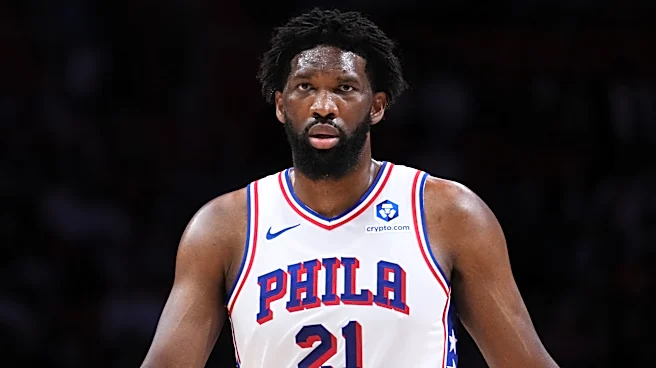
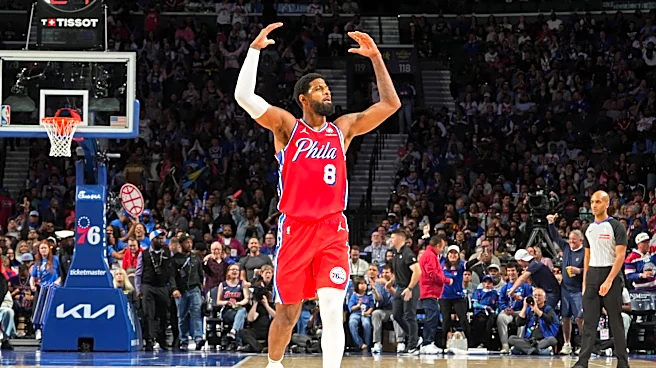
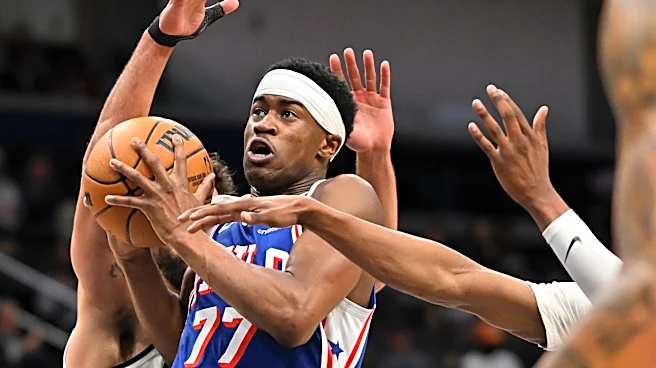
With just over two minutes left in the third quarter of last Friday’s Sixers-Timberwolves game, Andre Drummond ambled to the scorer’s table. Nothing out of the ordinary about that. The Sixers’ backup center was surely about to give Joel Embiid a break.
Except he wasn’t.
Drummond, who to that point had not played in the game, checked in not for Embiid, but for forward Dominick Barlow. That meant that for a short stretch the Sixers used a Ralph Sampson/Hakeem Olajuwon-style Twin Towers lineup. In the year
2026.
It proved pivotal. The Sixers, up two when Drummond entered, pushed their lead to 12 by period’s end. And with Drummond still on the floor as Embiid rested to start the fourth quarter, the Sixers went up by as many as 17 en route to a 115-103 victory.
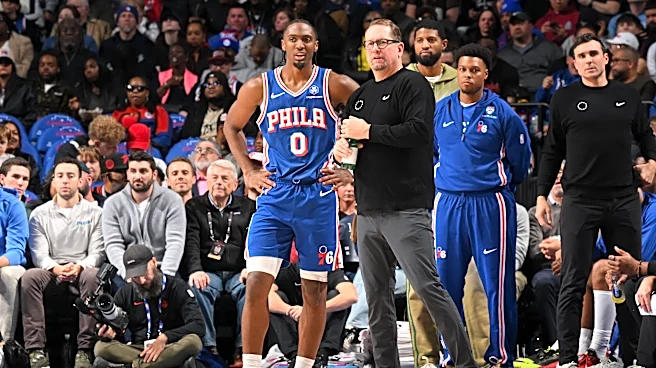
The lineup was an anomaly, having been seen for just 15 possessions all season entering the game, per Derek Bodner of PHLY Sports. And it is unlikely to be seen again. But the fact that Nick Nurse used it at all is illustrative of how adaptable an NBA coach has to be, particularly one who has faced as many rotational obstacles as Nurse has faced this season. And particularly now, with four games left and playoff seeding at stake.
Nurse has more players at his disposal than he has in weeks, now that Embiid, Tyrese Maxey and Kelly Oubre Jr. have returned from their injuries and Paul George is back from his suspension (and despite the fact that Cameron Payne has been lost with a hamstring injury). That obviously gives him more options as his team attempts to navigate a closing stretch that includes visits to San Antonio, Houston and Indiana before the finale next Sunday at home against Milwaukee.
In other words, the Sixers, who enter the week 43-35 and sixth in the East (i.e., in the final non-play-in spot), face two playoff teams (one, the Spurs, with championship aspirations) and two teams already booked for Cancun.
Given Philadelphia’s position – a tie-breaker ahead of Toronto (also 43-35), with Charlotte (43-36) and Orlando (42-36) looming as well – everything is magnified. Every potential advantage must be exploited. Which is why Nurse would do well to be as creative as possible.
When asked about the Drummond-Embiid pairing following last Friday’s game, Nurse said it had been in the back of his mind going in, given the fact that Minnesota often plays two bigs in Julius Randle and Rudy Gobert. Even so, Nurse was prepared to insert Drummond for Embiid before Embiid packed seven of his 19 points into a two-minute, 43-second stretch.
“And,” Nurse said, “I just decided to flip that (i.e., yank Barlow instead). So it wasn’t totally against some pregame thoughts, and it just kind of presented itself there. And obviously it’s one of those lineups that I’ve been wanting to look at a little bit here down the stretch as well.”
Drummond, plus-11 in 9:04, finished with four points, six rebounds, a block and a steal. And he said he wasn’t surprised by the move, even though Nurse has more often used another big, Adem Bona, in tandem with Embiid.
“I just didn’t know it was happening today,” Drummond said.
Nor, he added, did he find it particularly difficult to play alongside another big.
“I mean, I’m not sure how much basketball you’ve watched,” he told a lone visitor to his locker, who first covered an NBA game in 1981, “but I’ve played with seven-footers half my career – from 2012 to about 2017, when the Warriors started changing the game. So it’s not something I’m not used to. I know how to space the floor. I know how to guard. I know how to give guys like Joel the freedom to play his game without being in the way, and I can rebound the ball while he’s doing his thing.”
For one night, at least, necessity had proven to be the mother of invention. And the invention hummed off the assembly line. It wouldn’t have worked the following night against the young, fleet Pistons, when Drummond started, Embiid sat and Detroit won by 23. But it worked Friday.
The point, again, is that flexibility and experimentation are not the worst things, even at this point in the season. Maybe especially at this point in the season. Nurse has also shown that by starting Barlow and bringing Oubre off the bench since Oubre returned March 28, after missing eight games with a knee injury.
In the coach’s estimation, Barlow does his best work while playing with Embiid. The flip side is that Oubre has made it clear more than once that he prefers to start.
“I like to set the tone,” he said Friday, “but at the end of the day, that’s above me. I’m still a hooper, so I just go out there and hoop.”
In fact, he added, he views himself as “a Swiss Army Knife, for being able to pull out anything, out (of) the pocket. So we’ll continue to just take it day by day and just figure it out.”
Or let Nurse do so.
“I think we’re experimenting,” Oubre said. “You know, I couldn’t do Coach’s job. I tell him that all the time. So I think he’s just trying to figure out the best formula to win in the postseason.”
Nurse admitted before Friday’s game that while it sounds “really cool” to say that he’s solidifying his rotation down the stretch, the reality is very different. He wants to explore different options, wants to see how things shake out. (Example: He started Oubre on Saturday against Detroit, an inconsequential move considering the veteran forward scored three points as the Pistons rolled.)
“I think we’ve still got a lot of room for growth,” Nurse said, adding that there are “two or three ideas that as a staff we’re kicking around that we think might be advantageous, depending on who we play.”
So yes, it’s late. But it’s not too late to tinker, given the way the season has played out and all the absences the Sixers have endured. Nurse would love to believe that there’s something more within his team, and that it can be unearthed in short order. It’s just a matter of continuing to poke around, continuing to dig deep.