

How did De’Veon Smith do it? Even watching today, I can’t make sense of it. The former Michigan running back takes the hand-off, follows his fullback into the chaos and disappears. On 2nd-and-2, it’s just what Michigan expected and needed — a hard-charging first-down conversion.
But Smith had higher aspirations. Seconds later, the junior back inexplicably spills out of the fray, into the secondary, throws a helpless BYU defender off him and parades into the end zone.
A collegiate “Beast Mode” run for
the ages. The Wolverines would run away with that 2015 game against BYU, 31-0. It marked a welcome turning of the page in Ann Arbor. But not turning forward — first-year head coach Jim Harbaugh flipped back a few chapters and reintroduced power running and physicality to a Michigan offense that had been facing an identity crisis since 2008.
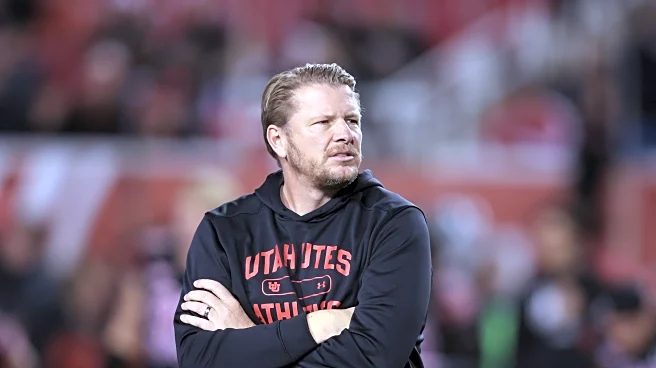
It was refreshing, new, but also familiar. And now tasked with the same assignment is the 35-year-old quarterback coach who sat on the opposite sidelines during Smith’s unforgettable run.
Jason Beck takes over the reins of Michigan’s offense after performing nothing short of a miracle in his one year at Utah. Last season, the Utes ranked fourth in scoring and total offense, and second in rushing. Unlike his last stop, the Wolverines are not in need of an Old Testament turnaround. Chip Lindsey built the body of a Chevelle from the scraps Kirk Campbell left behind; Beck just needs to build the engine.
To get a better understanding of what Beck is bringing to Michigan, let’s dive into three games from last season: UCLA, BYU and Kansas State. UCLA is a great starting point because it was Beck’s starting point and his first game with Utah. Ground Zero. Let’s see what this offense looked like in Week 1.
BYU was a clear second choice. A rivalry game loss against Michigan’s new defensive coordinator, Jay Hill. Any offense can look great in a win, but let’s get a sense of what it looked like when it was contained. Texas Tech was considered, but the sample felt tainted with quarterback Devon Dampier not practicing all week and playing extremely limited.
Lastly, the Kansas State game was selected because this was Beck at the peak of his powers in a tight game where the offense had to win it. The Utes won 11 games last year by an average of 26.6 points per game and this was the only win that came down to single digits.
Let’s check the tape!
UCLA
Dampier transferred with Beck from New Mexico last year and his comfort and growth in the offense were immediately evident. This is a high-octane, uber-efficient offense designed to attack every blade of grass on the field. Almost every play has an RPO tag associated and simultaneously works as a triple option with a mobile quarterback.
The goal is to always attack where the defense is the most vulnerable and where the offense has the numerical advantage. It sounds obvious, but this scheme is an unusual combination of fight-in-a-phone-booth meets speed-in-space. Case in point, Beck loves to use gap schemes concepts with his RPOs to manipulate linebackers, test the eye discipline of a defense and punish hesitation.
12-Personnel QB Power/ Spot Screen RPO + Z Hitch
Beck puts Dampier in empty with one receiver and an in-line tight end into the boundary and a stacked trips look to the field. The trips formation is going to X block with the No. 1 receiver turning for a spot screen. Into the boundary, the Z receiver is going to run a quick hitch with a tight end leaking out to block the corner. This would likely be the read if UCLA showed a single high safety look pre-snap. Up front, Utah is going to pull the left tackle for Power if the Bruins commit to a coverage look with a light box.
It seems like a lot, but it’s all just a numbers game. Pre-snap, Dampier sees split safeties and knows the play is going to the field. With only two corners and a deep safety covering the trips look, he knows it’s going to the spot screen. Even when UCLA drops into a Tampa 2, the play is still effective.

Later in the game, Beck dialed up a unique RPO that further emphasizes his love of physicality.
12-Personnel (6 OL) G/H Counter/ Sprint Draw RPO + Z Out
Utah comes out with an unconventional 12-personnel look that Beck loves. An in-line tight end aligns into the boundary and two receivers are split out to the field. The second tight end is actually an extra offensive lineman (who is an eligible receiver), giving Utah a four-strong look to the field.
At the snap, both the boundary-side tight end and guard are going to pull while the rest of the offensive line down blocks. To the field, the receivers are going to switch release with the X-receiver attacking vertically down the hash and the Z working an out route to create a mini-mesh concept. Dampier can either keep the ball and choose between following his pullers or connecting with his Z receiver, or give the ball on the sprint draw to his running back, which he does.

Although technically an RPO, this feels like a play where Beck saw something during the game and told Dampier to give the ball no matter what. This is a great example of how Beck likes to make every defender accountable on a play. Backside, frontside, there are no plays off against this offense.
However, Beck doesn’t just run RPOs. In his heart of hearts, he would rather win by running over opponents than deceiving them. Hence, his love for extra offensive linemen. And rest assured that on third- and fourth-and-short situations, he is not afraid to go under center with a little extra beef in the backfield.

But he will always keep a defense honest.
This game was a great demonstration of an efficient and balanced attack. Utah threw for more than 200 yards and rushed for more than 200 yards with several base concepts that popped up throughout the season; eight players caught a pass and eight players ran the rock. UCLA was not much of a challenge, but this offense could not have gotten off to a better start.
BYU
One thing about Beck, he is not afraid to run the same play repeatedly until you stop it. On two occasions against UCLA, the Utes picked up a first down with a short yardage package and then returned to it on the subsequent first down play.
Against BYU to start the game, with his offense in the shadow of its own goal post, Beck went with under-center traditional Power twice to give his offense some breathing room. And later in the drive, he ran a jet sweep + QB Counter back-to-back, with Dampier keeping each one to set up a fourth and short.
But here is where he ran into a bit of trouble. Facing a 4th-and-1 with this offensive line, the obvious solution is to go with Jumbo personnel, run Power or a wedge play and move the sticks. But Beck, not unlike most play callers, big-brained this one. This isn’t a bad call, but it puts too much emphasis on a receiver to make a key block when there was a simpler way. At this point in the game, a kill shot wasn’t necessary when the body blow was available.
12-Personnel (6 OL) Zone Read Jet Sweep
Keep your eyes on the near-side slot receiver, lined up tight to the line of scrimmage. He has to block the most dangerous man. He glances at the corner pursuing in man-to-man coverage, looks to the safety, thinks intensesly about how he can’t screw this up, looks back to the corner, thinks some more, and then it’s too late. The hesitation allows the safety to blow by him and make the tackle in space.

Again, the play layering here is excellent. Beck wants to frustrate the defense and then take advantage of it for an explosive. But sometimes all that matters is just keeping the chains moving. Or, old man on the couch here, kick the field goal. If Utah had taken a chippy here and another in a similar situation in the third quarter, they would have left Provo with the win. Utah finished 1-for-5 on fourth downs in Kyle Whittingham’s final Holy War.
However, this game was not devoid of encouraging moments either. Beck knew BYU was weaker on the perimeter and kept testing different variations of the jet sweep until one connected. Like a batter waiting for the perfect pitch to hit a home run, he finally got one down the middle.
12-Personnel (6 OL) Zone Read Jet Sweep
Compared to the play above, this time Beck puts two receivers tight to the top of the formation, shortens the jet motion, pulls the backside guard AND adds a lead block from the running back. With BYU playing zone defense, the guard isn’t even needed. The receivers and running back clear the path and the jet sweep goes 49 yards to the house.

Learning from structural mistakes in real time to exploit a known weakness is what separates good play callers from great ones. This is an outstanding adjustment from Beck to put Utah up in the fourth quarter. Yes, the Utes lost, but despite fourth-down struggles, a banged up quarterback, two turnovers and 12 penalties (two that extended drives), they out-gained BYU by more than 100 yards and only lost by three.
After this loss, Utah would only score less than than 44 points in a game once over its final six games and never lost again. However, one game came down to the wire, and the offense had to win it.
Kansas State
In an RPO-heavy passing attack, it is challenging to push the ball down the field with a limited quarterback. Conversely, with a strong passer, you can lead the country in air yards per attempt as Fernando Mendoza does in Indiana’s RPO-driven scheme. But for Dampier, it is a heavy dose of crossers, out routes and minimal anticipatory throws. And perhaps the best thing Beck teaches his offense is to take the easy stuff.
The first example of this came in the BYU game on the Utes’ first third down of the game. After a miscommunication, Utah was able to gash the defense by quickly exploiting a coverage bust. Something Michigan struggled to do last season.

Beck is an empowering play caller who builds confidence through easy completions. Albeit through a multitude of disguises.
12-personnel (6 OL) Split Zone/ Slant-In RPO
Once again, Beck brings out the heavies. With an extra offensive lineman on the nearside lined up as a tight end, Beck wants to test the discipline of the strong safety (No. 36) to the field. Kansas State appears to be playing Cover 6, which means the strong safety has hook/curl responsibility. Is he going to stay in his zone or is he going to cheat down into the box and help against the run?
Once Dampier brings his tight end in motion for the split zone, it is obvious the safety is looking to jump into the box. At the snap, Dampier reads the safety and pulls the ball for the pass. The run fake commanded such an overreaction that Dampier has both receivers open. The slot is running a seven-yard slant, while the split-end is running a five-yard in breaking route with an additional five yards of cushion.

Although not a difficult throw, the 5-foot-11 Dampier doesn’t risk layering a ball to the slant route. Instead, he takes the easy completion. The throw is off target (the ball should be leading him inside), but it is completed and the receiver helps pick up the first down.
Trailing by 31-21 at the half, Beck knew his offense was going to have to win this one. Instead of panicking or going off-script, Utah came out running the football on its first possession of the second half. And after a few chunk runs, Beck went for an appropriate kill shot.
12-Personnel PA Gap Pass Y-Wheel
Aligning in more traditional 12-personnel, Beck disguises this play-action shot beautifully. At the snap, he pulls the backside guard to kick out the defensive end and slowly leaks out the running back. I imagine if the defensive end were too fast off the edge, the running back could chip the edge until the guard can get there. A nice safety blanket, but the guard arrives in time.
Now, look at the H-back tight end at the top of the formation — he is going to work out to the linebacker, who is trying to get width to play the run. Once he gets right into the face of the linebacker, the tight end is going to release and take off down the sideline, but he has to be patient and really sell the block. This allows the receiver at the top of the formation to occupy the corner down the seam and gets the safety to cheat downhill to stop the run.

By the time Kansas State realizes what has happened, the tight end is streaking three yards free of the nearest defender. After cutting into the lead, most assumed Utah would take over the rest of the game. But that wasn’t the case. With less than five minutes to go, the Utes were in the red zone, trailing by 10, 47-37.
With Dampier’s limitations, Beck had to be patient orchestrating this drive and not abandoning the run entirely. However, Utah needed six points now.
12-Personnel H-Delay
H- or Y-delay is a clever way to gain a chunk of yards with an easy throw. Most offenses (including Michigan’s in recent years) line up the tight end on the opposite side of the formation and have him chip before working a shallow drag route across the field. Beck lines his tight end up on the same side as an H-back with the goal of taking advantage of a green dog linebacker.
A “green dog” is a linebacker who triggers to blitz once he sees his assignment staying in to block. However, if he triggers too fast, he can’t get caught. That was Beck’s thought here. The tight end does a great job selling his chip, but unfortunately stumbles coming off the block. You can see how wide open he would be with every other receiver occupying the rest of the secondary with verticals. But Dampier doesn’t panic or even go to his second read (the slot working a 10-yard curl on the near-side hash). Actually, he had plans of his own before the ball was even snapped.
The play is designed for the delaying tight end, yes, but if Dampier likes the look pre-snap, he has the authority to take a vertical shot. Seeing a friendly look before the snap and no safety help post-snap, Dampier rips a beautiful back shoulder fade to the end zone. These back-shoulder throws have quickly evolved from smart throws to uncover receivers to full-on concepts within complex offenses. Although this comes off more like an “F- it, he down there somewhere” type of throw, expect to see more of these empowered shots from Bryce Underwood next season.

With the lead cut to three points, Utah’s defense finally got a stop and the Utes had the ball back with a chance to win it. On their own 39-yard-line, they faced a critical 4th-and-1 coming out of the two-minute break. Even with no timeouts, a run was still available here since the clock stops after a first down in college. The game is on the line and Beck came out with an old favorite.
12-Personnel (6 OL) Zone Read Long Trap
Game on the line, fourth and short, Beck goes to the shotgun. I can’t imagine being a Utah fan watching this live. A similar variation of the play that failed against BYU, except this time, Dampier is salivating pre-snap at the Cover Zero calls and knows he has the Wildcats in the palm of his hand.
When the ball is snapped, he barely carries out the fake he is so excited. The linebackers overflow to the jet motion and Dampier attacks. His guard pulls all the way down the line of scrimmage to trap the defensive end, and there is no one to fill the hole. The motion by the receiver and the pulling guard gave Utah the numbers advantage and Dampier is off to the races.

Ultimately brought down inside the five-yard line, Utah kills off some more clock and punches it in to go ahead 51-47 with less than a minute remaining. In a game where its defense allowed 472 yards on the ground, Beck, Dampier and the Utah offense won the game. It wasn’t quite a “Beast Mode” run, but it was a powerful statement of a modern physicality that is now returning to Ann Arbor.
Two years ago, Dampier was a reluctant passer at best, completing less than 60 percent of his throws for 2,768 yards, 12 touchdowns and 12 picks against Mountain West competition. However, he was one of the most dynamic quarterbacks with his legs, rushing for more than 1,100 yards and 19 touchdowns. Understanding what he was working with, Beck didn’t try to get Dampier to fit his system. Instead, he built his system to fit Dampier. And once the duo got behind a quality offensive line, the transition to the Big 12 was seamless.
Beck taught Dampier how to play fast and decisively. His total numbers dipped last season, but his efficiency improved across the board as he played the position with supreme confidence. In 2025, Dampier completed 64 percent of his passes for nearly 2,500 yards, 25 touchdowns and only five interceptions. On the ground, he chipped in another 835 yards and 10 touchdowns. Most impressively, he finished seventh in the country in adjusted QBR, ahead of guys like Dante Moore and Ty Simpson. The only quarterbacks ranked higher were Jayden Maiava, the three Heisman finalists, Trinidad Chambliss and Gunnar Stockton.
Dampier is far from a natural passer, but he excelled in Beck’s system. Now with a quarterback like Underwood, Beck is going to be able to further exploit defenses with a more capable passer playing the position in his scheme.
What to expect from Michigan’s offense in 2026
- Michigan’s identity crisis is over. Beck’s spread offense is more similar to Gus Malzahn and Urban Meyer than Steve Sarkisian or Lincoln Riley. It starts with physicality at the line of scrimmage and is backboned by power running. Whittingham gives Beck full autonomy, and the result is one singular offensive vision.
- The most important skill Underwood is going to learn from Beck is confidence. Beck’s system is contingent upon his signal-caller playing fast and free. It is not a complex system to learn, but it requires a confident quarterback being decisive to be successful. Similar to Harbaugh, once a quarterback is confident with the right teacher, growth is inevitable.
- The offensive line is the most vital aspect of this scheme, and the importance of bringing over Utah offensive line coach Jim Harding with Beck cannot be overstated. There are several examples on film of linemen understanding their depth downfield and chopping their steps to prevent a penalty as an RPO develops. Harding did an excellent job teaching his unit patience and discipline without hindering their aggression.
- Everyone eats in this offense. Wide receivers will run the ball and running backs will make catches. Versatility is one of the core components that make it difficult to defend. Furthermore, Beck loves to utilize multiple tight ends and incorporates six offensive linemen as much as any offense at the Power Four level. It is run-first, but Utah’s pass catchers still outpaced Michigan’s by nearly 400 yards.
- Underwood will run the ball more, but not nearly to the level of Damiper. Dampier is a thicker, more natural runner than Underwood, and he still struggled to survive a full season of hits. Moreover, Underwood does not need to be this caliber of runner because he is a far superior passer. Look for Beck to utilize a secondary quarterback running option, wildcat looks, and even a two-quarterback package to ease the mileage on Underwood. And expand his RPO package with a quarterback capable of making more difficult throws.
- Beck can be too smart for his own good. We covered that in the BYU game, and although not exclusive to him, it is a curse of younger play callers. With another year under his belt, expect to see growth when the obvious is available.
- Sadly, short-yardage situations will still feature runs from shotgun — but they should be more effective. Utah was No. 3 in third-down conversions and top-25 in fourth-down conversions.