




Every now and then, our youth rankings ends with a player who feels as if they don’t really belong on the list to begin with. That’s not because we’re fudging players’ birth certificates or bending the rules a smidge to allow one of our favorite players another year on the rankings (it’s not that serious); it’s usually because even thinking of the player in question as a “youth prospect” feels somewhat ridiculous. Wesley França is the epitome of this situation. At age 22, he is undoubtedly one of Roma’s
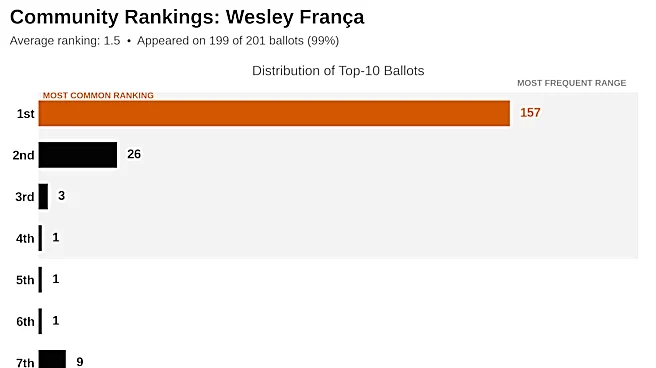
most talented and important players regardless of age, with Mile Svilar, Manu Koné, and Paulo Dybala the only players who are on his level or above in terms of ability. That fact necessarily means that Wesley is our #1 youth prospect almost as a fait accompli.

Number One: Wesley Vinícius França Lima
Age: 22
Position: Fullback
Shades of: Cafu, Maicon, Wilfried Singo
Who Is He?
Wesley França (who we typically just call Wesley) was born on September 6, 2003, in Saõ Luis, Brazil. He started his youth career at age 15 with Figueirense FC, only to move to Clube Atlético Tubarão for one year before landing his first real opportunity to shine at Brazilian giant Flamengo. Once at Flamengo, Wesley quickly notched over 100 total appearances for their first team, establishing himself as a regular in high-stakes competitions and winning the Copa do Brasil twice, the Copa Libertadores twice, and the Campeonato Brasileiro Série A once. He also received personal awards, including a 2024 appearance on the Campeonato Brasileiro Serie A Team of the Year.
That consistent excellence is what convinced Roma to go all-in on a young fullback as a potential long-term solution at fullback. The Giallorossi had long had serious woes at both left-back and right-back, and Wesley was seen as a way to avoid another decade of fullback being Roma’s weakest position.
Roma ultimately paid Flamengo a cool €25 million up front for the now-Brazilian international, with another €5 million in potential bonuses. That made Wesley one of the most expensive defenders in club history, but it wasn’t an unfounded investment given his experience in Brazil. Despite his youth, Wesley knew from the moment he came to Trigoria what it meant to play for a massive club. He had also demonstrated that he could handle the expectations that came with it.
What Wesley hadn’t done was prove that his individual talent and skillset would translate to Serie A. As his spot atop this list might imply, however, that didn’t take very long.
What Can He Do?
In short, Wesley can already be one of the best players on a side that qualifies for Champions League football. It’s pretty easy to see from his highlight reel and any one match he’s played for Roma or the Brazilian National Team that Wesley is a star thanks to his acceleration and agility. That acceleration and agility means that he can easily dribble out of difficult situations, make smart plays under pressure, and make the accurate pass needed to set up a goal.
Yet Wesley isn’t just some speed demon coming down the flank; those kinds of players are often figured out quickly, or have a limited shelf life because speed can’t last forever. Wesley is more talented than just that because he is comfortable attacking from deep, taking defenders on, combining with teammates, and getting into the box himself. That’s a major reason Roma brought him in last summer with the arrival of Gian Piero Gasperini; he’s a natural fit for GPG’s tactics, where wing-backs are expected to spend as much time creating chances as they do defending them. It’s also why it’s clear that Wesley is one of Gasperini’s favorite players in this side.
The numbers back that analysis up. Wesley started 28 of Roma’s 30 Serie A matches in which he appeared last season, playing 2,457 minutes total. Those appearances turned into five goals, making him Roma’s third-highest scorer in the league despite playing primarily as an attacking wing-back. Granted, a lot of that comes down to Roma’s middling attack for much of the 2025/2026 season, but it’s still an indicator that when given the ball, Wesley can score. As for his speed, UEFA recorded Wesley reaching a top speed of 35.26 km/h during Roma’s Europa League campaign. That kind of pace allows him to play aggressively without being completely exposed when an opponent gets around him, because he has the speed to recover.
That’s a critical part of Wesley’s game in a broader sense. Despite being an amazing attacking fullback, he’s also an aggressive defender who is particularly strong in one-on-one situations, using his pace and strength to recover and win the ball. He’s willing to use sliding tackles when necessary, including situations where he has had to make a last-second intervention to prevent a dangerous chance. Some attacking fullbacks are just wingers with a different number on the back of their kit; Wesley is a legitimate defender who can also attack with the best of them.
It’s that combination that makes Wesley such a good fit for Gasperini. The Brazilian defends, carries the ball out of pressure, beats his man with ease, and can make a run into the box when necessary. He can do all of this while still having enough energy to get back into position. There are very few players who can do all of those things at a high level in world football. There are even fewer who do all of those things at 22.
What Can He Become?
It would be easy to look at Wesley’s 2025/2026 season, which was nearly good enough for him to be put on the Serie A Team of the Year, and conclude he’s a finished product. In my book, though, what’s most exciting about Wesley is that he still has so much room to grow into a truly world-class full-back. There are still places where Wesley can become more complete, including defensive positioning and consistency, crossing, and decision-making in the final third. He’s not perfect, but if there’s one thing to glean from our interview a year ago with a Flamengo fan, it’s that Wesley grows by building more experience and maturity; he became a star in Brazil by building up reps, and he can continue to develop in Rome the same exact way.
Roma has a history of Brazilian right-backs becoming club legends. Cafu and Maicon are two of Roma’s most iconic fullbacks in the club’s 99 years of existence, and Wesley has already demonstrated enough to make that lineage worth mentioning. At age 22, he is forcing himself into that conversation after only one season of play; if he can play for Roma for a few more seasons before a move to a super club, there’s no doubt that he would cement himself on the Mount Rushmore of Giallorossi-Brazilians. Of course, I’d prefer he stay here until he retires or returns to Brazil, but with reports already linking Wesley to clubs like Manchester City and Real Madrid, it’s a reasonable thing to assume that at some point, Wesley will move to greener pastures.
Until then, Roma needs to view Wesley as a foundational piece for this side, both under Gian Piero Gasperini and into the future. I’ve written ad nauseam about Roma’s need to actually keep exciting young players around instead of selling them off to pay off Financial Fair Play balances; if this summer is any indication, The Friedkin Group and Tony D’Amico are trying to follow that plan.
Wesley is the clearest example of why that plan matters, and why Roma needs to hold on to its best prospects until someone offers a Yan Diomande-sized transfer fee for their services. I’d like to think that Roma didn’t spend €25 million on Wesley to develop him for somebody else. The hope has to be that Roma spent €25 million because they believed in his ability to become a superstar in a Roma kit, under the tutelage of Gasperini. His first season in Europe made it clear that this isn’t an idle prediction; in many ways, he’s very nearly there.