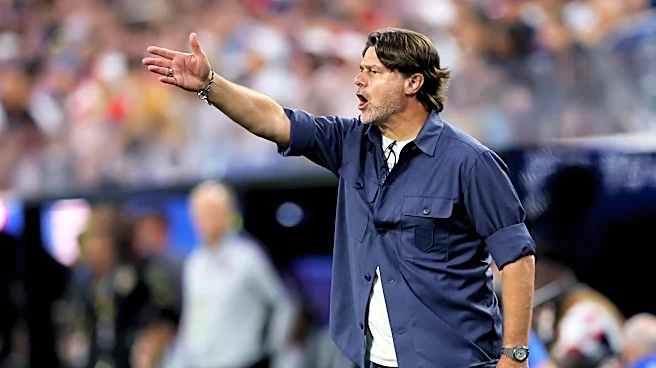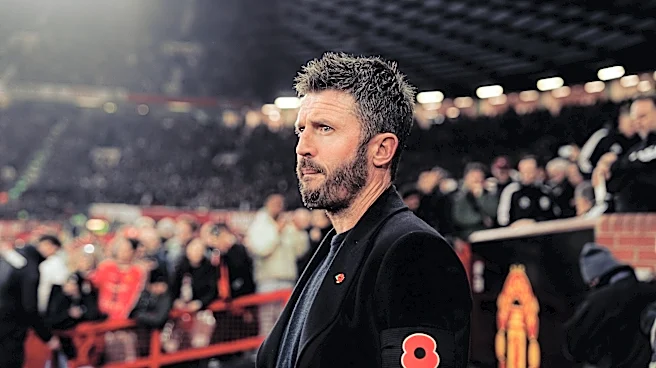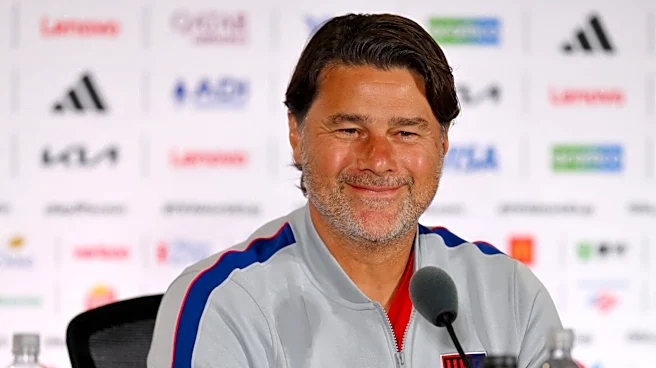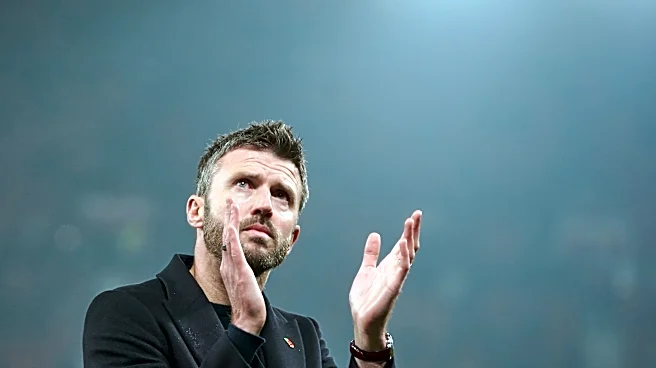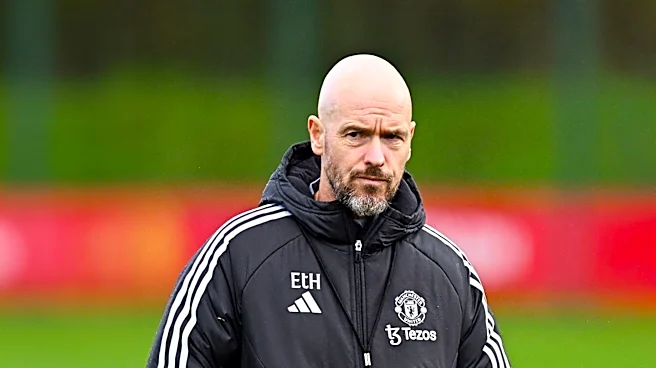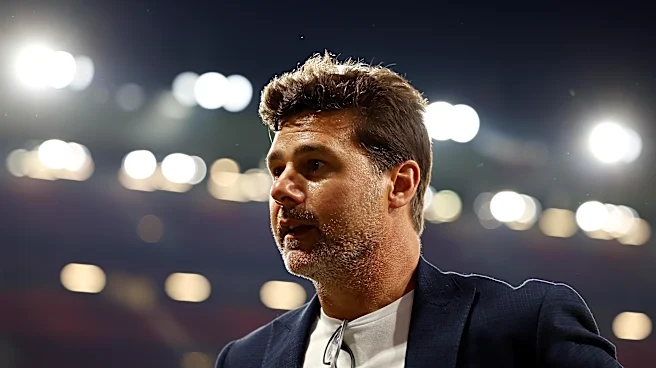


Manchester United look set to part ways with Michael Carrick and hand the keys to Mauricio Pochettino. Parting ways with Carrick was first reported Monday night, with the Pochettino news coming Wednesday morning. Of course, because the club can’t do anything right, or handle the situation with class, as of Wednesday afternoon Michael Carrick was stilltaking training at Carrington. To further argue their competency, the same club that did not want to appoint an international manager ahead of the World
Cup is now working to appoint an international manager smack dab in the middle of an international break, where he’s preparing to take charge of two matches.
But hey, that’s not what we’re here for. We’re here to talk about what Pochettino will bring to Manchester United.
Pochettino has had club stints at Espanyol, Southampton, Tottenham, PSG, and Chelsea before taking his current role with the USMNT. His career highlights include taking Spurs to the 2019 Champions League final and being credited for turning Spurs into a perennial Champions League side. This past summer he took the United States to the round of 16 at the World Cup – right at the level they should be. He does get to claim being the second US manager to win a World Cup knockout game (thanks to the new round of 32).
With Pochettino’s appointment being imminent, we’ve entered the phase of the new manager cycle where everyone rushes to utter the same superlatives about the new coach. You know them all – trusts youth, holds players accountable, plays front-foot attacking football, improves the players he has, provides leadership.
These superlatives are dumb. What do they even mean? The same superlatives get said about every new manager, are they even true?
“Pochettino will provide leadership.”
The same thing was said about Erik Ten Hag and Ruben Amorim. He’ll hold his players accountable, no more playing favorites, now it will be a meritocracy. This gets said about every new manager which means that one day you’re the manager who will hold players accountable and the next day someone else will come in to do that because you haven’t been.
Plays front-foot attacking football?
What does that even mean? The definition of attacking football will vary from person to person. Some will say it’s Pep Guardiola, who’s sides always controlled the ball. Others will say Guardiola’s control wasn’t about attacking but about defending. If you don’t have the ball you can’t score, thus Pep’s sides strove to have as much of the ball as possible simply so they’re opponent didn’t have it.
“For me, end-to-end counter-attacking football is the stuff of dreams.” That’s a direct quote from Sir Alex Ferguson’s new book Games of My Life. These days counter-attacking is seen as almost negative football, but it’s widely accepted that Sir Alex’s United teams played attacking football. Go figure.
Trusting Youth
Then there’s the trusts youth bit. This is important to United fans who have a proud history of promoting players from the academy. Every fan believes there’s a whole wave of useful players just waiting for their chance in the academy. They just need the manager to give them a chance.
Trusting youth is a reputation Pochettino has had for a long time and it’s always been a bit misguided. In six years at Tottenham only one player came through the academy and established himself in the first team – Harry Winks. That’s not a slight on Pochettino, Spurs academy wasn’t bustling with talent. It’s not like Pochettino left and immediately some kid broke through.
Pochettino is just like any other manager. He adheres to the philosophy of “if you’re good enough, you’re old enough.” The important part of that quote is the first part. When it comes to youth players every manager asks the same question, are you good enough to help me win today? If the answer is yes, they play. If the answer is no, they don’t.
Most of the time, the label comes from context. Pochettino managed at Southampton, where he had no choice but to play younger players, that’s all he had. This was also an era where Southampton were particularly good at developing talent. The previous decade had seen the academy produce the likes of Theo Walcott and Gareth Bale. Just before Pochettino arrived Alex Oxlade-Chamberlain left for Arsenal, while Adam Lallana and Luke Shaw broke into the first team. Even after he left the club continued to find young talent with players like Sadio Mane, Toby Alderweireld, and Virgil Van Dijk all joining in the subsequent years.
When he moved to Spurs, Pochettino inherited a 21-year-old Harry Kane, who would go on to be England’s all-time leading goal scorer. Kane had scored three goals in five Premier League starts at the end of the previous campaign but Pochettino did not throw him straight into the team. It took Kane scoring eight goals in seven Europa League & League Cup starts for him to usurp 30-year-old Emmanuel Adebayor in the pecking order. His first Premier League start didn’t come until November 9th!
Improving the Squad
The most important of these superlatives is improves the players he has. A recent article in The Athletic name drops Harry Kane, Dele Alli, Danny Rose, Kyle Walker, Luke Shaw, and Adam Lallana as players who flourished under Pochettino. That is all true, but how much of that was Pochettino?
Bruno Fernandes has performed under several different managers at Manchester United, as has Luke Shaw. Did Pochettino make Harry Kane or was he just the manager who finally gave him a shot? Kane has performed for every manager he’s played for. In fact it was right after Pochettino left that Kane re-invented himself as a player, transitioning from just a goal scorer to a creator and goal scorer who won the Ballon d’Or. Good players will be good players regardless of who the manager is.
That’s not to say other players like Dele Alli, Danny Rose, Jay Rodriguez, or Rickie Lambert didn’t massively improve when playing under Pochettino, but that seems much more a case of they were now being asked to do exactly what their skill sets were good at. For example, Jesse Lingard thrived under Jose Mourinho, when Mourinho asked him to do a lot of off-ball work and attack directly. He found success playing with the same type of responsibilities for Gareth Southgate’s England at the 2018 World Cup and in the early Ole Gunnar Solskjaer days. But as Solskjaer evolved the team and wanted more on-ball productivity from his no. 10, Lingard started to struggle. Eventually he went on loan to West Ham, where he thrived in David Moyes’ counter-attacking team. Lingard was a limited player, when he played in a team that matched his skill set he was good. If the style didn’t match, he couldn’t perform.
It’s really that simple. If a coach truly improved players in other ways then we’d have to shine the spotlight on players like DeAndre Yedlin, Federico Fazio, Vincent Janssen, Fernando Llorente, or Tanguy Ndombele – players who were signed by Tottenham during the Poch era who did not make it. Why not just improve them? Obviously it’s not that simple, but even Lionel Messi had his worst season in Europe under Poch, which just goes to show if the team style isn’t the right fit, even a player like Messi can struggle.
And so…
This is what United will be hoping for from Pochettino. That he can bring in a system that will get the best out of a rag-tag group of players. It would be naive to think he’s going to do this the way he did at Tottenham.
Pochettino’s Spurs teams lined up in a 4-2-3-1 and were built around high intensity running and fullbacks who could bomb up and down the pitch. Poch’s teams thrived because he could interchange Kyle Walker, Kieren Trippier, Danny Rose, and Ben Davies at the fullback position. Manchester United do not have anything resembling that. Hell, they don’t even have a second left back.
If Pochettino is going to succeed at Old Trafford he’s going to have to find another way. Just like everyone who came before him, if he wants to get results early on he’s going to have to do adapt to the players he currently has at his disposal. When it comes to longer term success that’s where things get tricky.
For Manchester United, winning games doesn’t seem to be enough anymore. It’s now about how you win those games (though no one can really agree on what the “how” is). So while fans can put up with Erik Ten Hag changing his style in his first year to get results – or Michael Carrick playing a certain way as an interim – because they don’t yet have the players to play how they truly want to play, once you enter your second season and have some transfer windows under your belt, there becomes much more pressure to start showing the style you were supposed to bring.
There’s just one problem.
Taking Over a Mess
One or two transfer windows is still not enough time to transition a team. In Ten Hag’s second season United only signed three first team players (plus Jonny Evans and a backup GK). As a whole the team still wasn’t able to play the way Ten Hag truly envisioned. Michael Carrick wanted to transform United into a more possession heavy side this year, but only three midfielders were brought in, leaving a team with attackers and defenders who still weren’t suited to that kind of style. Both pushed through with transitions and both ultimately failed.
Manchester United are bad this season, but they are not 18th place bad. Their underlying numbers have them closer to 13th, still bad, but there is time and space to improve on that. In all likelihood, Pochettino will get the ship stabilized and we’ll see improvement in the short term. What will really determine the future of the club is come next summer, when Pochettino will see just how real United’s financial issues are. United won’t have the money to fill all the holes in the squad. If Pochettino is going to succeed long term, he’s going to need to go into next season once again planning to figure out how to just get the best out of the current players he has. Otherwise this cycle is just going to continue.
There is one more thing that Mauricio Pochettino will bring to Old Trafford – a spotlight. What Pochettino will do is fully expose where the problems of this club truly lie. (Not that we don’t already know this). He’s not going to publicly call out the board in his press conferences, well at least not until things start falling apart, but if he fails there is nowhere left to hide.
Erik Ten Hag and Ruben Amorim had won league titles in smaller leagues. They were completely unproven in a league as big as the Premier League. Michael Carrick was someone who understood how Manchester United functions and how Manchester United players feel and need to be treated. With all three of them there was a very real possibility that they could be in over their head and thus, any failure could be blamed on that.
Pochettino is proven at the Premier League level. He’s not a “guaranteed winner,” he’s not even a superstar, but he is proven to be competent at this level. If United continue to fail, it’s not going to be because the coach is in over his head. It’s going to be crystal clear that the club cannot win while the current decision makers are in charge.
We probably already know enough to know this, but Pochettino will bring confirmation.