
With the Commanders disappointing 2025 season winding to a close, attention is now shifting to the next round of off-season team building.
The mismatch between expectations heading into the season and results on the field seems to be driving a level of hysteria that we have not seen since the 2024 offseason, when Adam Peters famously neglected to invest all of his resources into the OT position after selecting a QB second overall.
Following the Commanders’ Week 17 loss to the Cowboys, they are now
slated to pick no later than seventh overall, with realistic possibilities to move up one or two spots if they get help from other teams in the final week of games.
This article takes inspiration from two seemingly overstated arguments which have been making the rounds for the past few weeks:
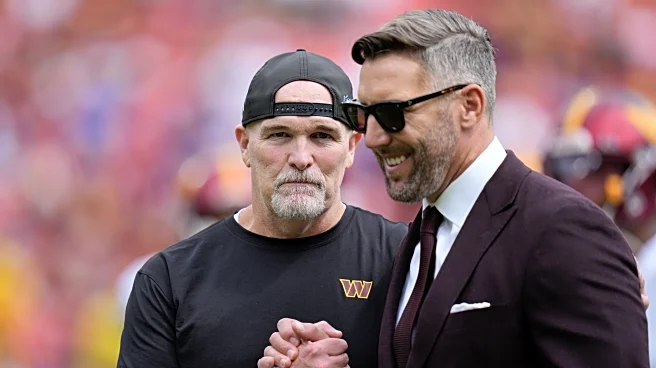
- If you are a regular Hogs Haven reader, you have probably heard that Dan Quinn blew the Commanders’ draft by playing to win and beating the Giants in Week 15. Had the Commanders lost that game, they would currently be sitting at second overall in the draft order, rather than seventh. By winning a meaningless game, we are led to believe that Quinn dropped the Commanders out of the range of sure-thing impact players in the draft and the blockbuster trade offers that come with them. While the win did drop the Commanders 5 places in the draft order, as it currently stands, is it also true that the change in draft position will have such a drastic impact on Adam Peters’ outlook in April?
- If that were not bad enough, you might have also heard that trading back from 7th overall to acquire additional picks could make things even worse. By trading back, Adam Peters would be passing up on an impact player, like OSU safety Caleb Downs or ASU WR Jordyn Tyson, just to pick some guys later in the draft who are not likely to move the needle. Does that sound a little overstated?
Both of these arguments are based on a commonly voiced misconception about draft prospect evaluation. Anyone who has followed the NFL draft, even casually, should know that projecting college players to the NFL is not a precise science. Practically every draft class sees highly rated players picked early in the first round who fail to ever catch on as starters. And every year impact players are picked as late as Day 3, or go undrafted. The truth is that prospect ratings are only partially predictive of player outcomes.
That doesn’t mean that player evaluation is a total crapshoot. As a group, players picked early in the first round tend to have better long-term outcomes than those picked in the 20’s. But the margin of error around player evaluations is so wide that it becomes meaningless to split hairs around a few places in the draft order.
Strong statements, like the ones I have paraphrased above, oversimplify the complexity of draft decision-making, and underestimate the extent to which uncertainty influences the outcomes.
To put the two arguments making the rounds to the test, I performed a simple experiment using results from the last 10 drafts. In each draft I asked whether the team picking 7th overall would have been better off by swapping the player they picked for the player picked 2nd overall. Then I asked whether they would be significantly disadvantaged in a trade back in which they swapped the player they selected with the team who picked 20th overall. The trade-back scenario was inspired by the Pittsburgh Steelers, who are currently sitting at 20th and might be interesting in trading up if a QB somehow fell to 7th, or if they really liked an LT, RB Jeremiyah Love, or one of the top defenders.
Draft Swap Scenarios – 2016 through 2025

2016
2nd – QB Carson Wentz, Philadelphia Eagles
AP-2, PB, MVP-3
The Eagles traded up from 8th to 2nd, sending 2016 third- and fourth-round picks, along with their 2017 first-round pick and 2018 second-rounder to Cleveland in order to draft the phenomenal talent out of NDSU. Initially, it appeared that they had hit the jackpot as Wentz guided them to a Super Bowl run the following year, earning an AP-2 nomination and finishing 3rd in MVP voting for his effort. However, injuries and the Eagles drafting Jalen Hurts to back him up in 2020 appear to have precipitated a mental collapse. Wentz was dealt to the Colts in 2021, and quickly transitioned from journeyman to backup. Three years of top-tier QB play is not the worst outcome from a 2nd overall pick in recent draft history, but it likely fell short of expectations when Howie Roseman pulled the trigger on trading up.
7th – DL DeForest Buckner, San Francisco 49ers
AP-1, AP-2, PB x3
Buckner was named to the PFWA All-Rookie team in 2016. He took three seasons to reach his peak. When he did, he had a four-year stretch of All-Pro and Pro Bowl nominations. After exercising his 5th year option, the 49ers traded him to the Colts for a first-round pick in 2024. He is still starting for them at DT.
20th – OLB Darron Lee, New York Jets
Lee earned the start at ILB as a rookie and kept it for three seasons. He was released following a PED suspension at the end of his third season, and had 1-year stints with limited playing time on the Chiefs and Bills to end his career.
Verdict: There is something to be said for a QB who gets you to a Super Bowl, but Buckner had the best long-term outcome for the team that drafted him. Seventh overall wins it.
2017
2nd – QB Mitch Trubisky, Chicago Bears
PB
Trubisky was considered to be a top prospect in his class, despite having been a one year starter in college. He earned a Pro Bowl nomination in his sophomore season. But inconsistent play led the Bears to let him walk after his rookie contract. He has bounced around the AFC as a journeyman backup ever since.
7th – WR Mike Williams, LA Chargers
The Chargers had high hopes of giving QB Philip Rivers a dangerous offensive weapon when they drafted the big receiver out of Clemson. He earned the start in his third year, and held it for four seasons. He posted two seasons over 1,000 receiving yards in an 8 year career with the Chargers (7 yrs), Jets and Steelers.
20th – OT Garett Bolles, Denver Broncos
AP-2, PB
Bolles was a day 1 starter at LT in his rookie season and claimed the role as a franchise left tackle. He has earned two 4-year extensions at $68M and $82M, and has consistently been one of the best LTs in football. He earned a 2nd team All-Pro nomination in 2020, and was named to the Pro Bowl this season.
Verdict: 20th overall is the clear winner.

2018
2nd – RB Saquon Barkley, New York Giants
AP1, AP OPoY, PB x3, MVP-3, AP ORoY
The fact that Saquon did not elevate the Giants to Super Bowl contention was clearly not his fault. Just ask the Eagles. The analytics crowd frowns on picking RBs in the first round unless they turn out like Saquon. He has topped 1,200 yards from scrimmage in 6 out of 8 seasons, and led the league with over 2,000 YScm twice.
7th – QB Josh Allen, Buffalo Bills
MVP (MVP-2, MVP-3, MVP-5), AP2 x2, PB x4
The Bills traded two second round picks to Tampa to move up from 12th to 7th to make this pick. Allen still has his doubters. But he has finished in the top-5 in MVP voting 4 times in 8 seasons, including winning it in 2024. It is hard to argue that he is not one of the NFL’s elite QBs.
20th – C Frank Ragnow, Detroit Lions
AP2 x3, PB x4
Ragnow was a day 1 starter at center for the Lions and has locked down the starting job throughout his 7 seasons with his drafting team. He is the pivot of one of the league’s best offensive lines. Is the first round too early to draft a center? Not if he turns out to be a three time All-Pro.
Verdict: You couldn’t really go wrong in 2018. All-Pro players were picked at each position. I’d have to give the nod to 7th overall due to position value at QB, but it really just depends on what a team needed. Certainly a team that fell from 2nd to 7th by winning an extra game wouldn’t feel disadvantaged. A team that traded back from 7th to 20th would feel like they hit the jackpot, if they already had a QB. And if they didn’t, they wouldn’t make the trade, unless they knew how good Lamar Jackson would be.
2019
2nd – DE Nick Bosa, San Francisco 49ers
AP1, DPoY, PB x5, DRoY
Bosa was a day 1 starter and registered 9 sacks, 16 TFL and 25 QB hits in his rookie season to earn the AP Defensive Rookie of the Year award. Aside from two seasons when he was injured, he has been an elite edge rusher throughout his 7 year career with the 49ers.
7th – OLB Josh Hines-Allen, Jacksonville Jaguars
PB x2
Hines-Allen is no Nick Bosa, but he’s a quality edge defender. He earned a PB nomination in his 10.5 sack rookie campaign, but only earned the full-time starting designation in his third season. He peaked at 17.5 sacks in 2023, earning his second PB nod. He was extended in 2024 on a 5 yr, $141M contract.
20th – TE Noah Fant, Denver Broncos
Fant was a solid receiving option in his first three seasons with the Broncos. He was included, along with a treasure trove of draft picks and other compensation in the trade with the Seahawks for Russell Wilson. Fant peaked at around 670 receiving yards in his second and third seasons with Denver.
Verdict: 2nd overall is the clear winner. But a team in need of an edge rusher would have done alright despite dropping to seventh overall because they won a meaningless late season game. A team trading back would have to be hoping to recoup their losses with the additional picks that they added.

2020
2nd – DE Chase Young, Washington Football Team
PB, DroY
Young was the consensus best player in the draft class. When asked about trading back from this pick, personnel guru Ron Rivera shared his thoughts:
“if you’re going to pass up on Player A, and you go back and you take Player B, Player B has to equal Player A.”
That was a definite NO.
Young had a fantastic rookie season, earning DRoY and PB honors. But that was his peak. Failure to maintain edge discipline and freelancing led the new ownership group to deal him to the 49ers for a 3rd round pick at the trade deadline in 2023. He has established a role as a starting DE with the Saints. But he is really just a pass rusher, and has never developed into the complete 4-3 DE that Rivera thought he was getting.
7th – DT Derrick Brown, Carolina Panthers
PB
Brown was selected almost exactly where the consensus board had him projected. He has established himself as a cornerstone of the Panthers’ DL and is one of the better defensive tackles in the NFL. Brown is an elite run defender and can be disruptive in the passing game. He is the type of big DT who does not put up flashy numbers but makes the players around him better. He was extended in 2024 on a 4 year $96M contract.
20th – DE K’Lavon Chaisson, Jacksonville Jaguars
Chaisson never really caught on with the Jaguars. He started 11 games in 4 seasons in Jacksonville, with 5 total sacks. He was allowed to walk after his rookie contract, and his production has increased in single seasons with the Raiders and Patriots. But he has yet to top 6.5 sacks in a season.
Verdict: Derrick Brown won’t win the beauty pageant, but 7th overall is the clear winner.
2021
2nd – QB Zach Wilson, New York Jets
Wilson was a consensus top-3 QB in what was considered to be one of the strongest QB classes in a decade. But until the Texans broke the curse in 2023, 2nd overall had been a void spot for QBs. Wilson was a total bust on the field and in the locker room. Unlike other QBs that the Jets have seemed to wreck, a change of scenery has not seemed to fix him, yet.
7th – OT Penei Sewell, Detroit Lions
AP1 x2, PB x4
Sewell was a day 1 starter at RT. He achieved elite status in his second season, and has not let up. He is a dominant run defender and an elite pass protector. He is the best player on one of the best offensive lines in football. He has my vote as the best RT in the NFL.
20th – WR Kadarius Toney, New York Giants
Older readers might not know that Toney’s failure as a football player has made him a star on the internet. Despite having supreme physical talents, he never managed to catch on with an NFL team. In four seasons, he played with three NFL teams and set the current record for longest punt return in a Super Bowl. Nevertheless, he was not signed by a team in 2025.
Verdict: Seventh overall is the clear winner and it’s not remotely close.
2022
2nd – DE Aidan Hutchinson, Detroit Lions
PB x2
Hutchinson was a day 1 starter and finished second in DRoY voting in 2022. He is a dominant pass rusher and a very good run defender.
7th – OT Evan Neal, New York Giants
Neal was ranked 2nd on the consensus big board, so the Giants must have thought they got a steal when he fell to them at 7th overall. He is a gargantuan 6’7”, 340 lb OT. Through his first three seasons he struggled with injuries and just not being good at football. The Giants declined his fifth year option and planned to switch him to guard in 2025. But he spent the season on IR.
20th – QB Kenny Pickett, Pittsburgh Steelers
Pickett started 24 games in his first two seasons in Pittsburgh, posting 13 TD and 13 INT. He requested a trade when the Steelers signed Russell Wilson and was dealt to the Eagles as part of a pick exchange. He spent 1 season backing up Jalen Hurts, then signed with the Raiders in 2025 to back up Geno Smith.
Verdict: Second overall is the clear winner. That makes two in a row for Brad Holmes in Detroit. The trade back from 7th to 20th is no worse than staying put.

2023
2nd – QB CJ Stroud, Houston Texans
PB, ORoY
At the time, Stroud’s rookie season was one of the best ever at quarterback. He threw for 4,108 yds, with 23 TD to 5 INT and had the lowest interception percentage in the league and the highest average yards per game. That earned him a Pro Bowl nod and Offensive Rookie of the Year. After a sophomore slump, he has bounced back and is looking like a franchise QB in 2025.
7th – OLB Tyree Wilson, Las Vegas Raiders
The Raiders drafted Wilson precisely at his consensus rank. The hope was that Wilson would provide a bookend to Maxx Crosby for the Raiders. So far, he has mainly played in a rotational capacity, with just 6 starts in 3 seasons, and 10 sacks to his credit.
20th – WR Jaxson Smith-Njigba, Seattle Seahawks
The Seahawks landed Smith-Njigba 9 places later than his consensus rank, so he looked like a major steal on draft day. He is looking even better now. JSN had a decent rookie season, earning 3 starts and posting 628 yds and 4 TDs. He earned a Pro Bowl nomination in his sophomore season with 1130 receiving yards and 6 TD, and is currently leading the league in receiving yards at 1,709 with 10 TD and on pace to win OPoY.
Verdict: 2nd overall is the winner because of position value. But the GM who traded back from 7th to 20th also looks like a superstar.
2024
2nd – QB Jayden Daniels, Washington Commanders
ORoY, PB
The first pick of Adam Peters’ tenure re-set the benchmarks for best rookie season by a QB. In his sophomore campaign, JD5 had a sophomore slump for the ages, developing bad run-first habits and exhibiting the durability concerns that had worried some evaluators. If the coaching staff can’t fix what went wrong, it might be the end of them. Until proven otherwise, I’m going to call this the best draft pick by a Washington GM since Bobby Beatherd selected Mark Rypien in the 6th round in 1986.
7th – OT JC Latham, Tennessee Titans
Latham was a day 1 starter at RT for the Titans, holding down the position for 17 games as a rookie. He missed 5 games with a hip injury this season, and has started every game since recovering. He allowed pressure on 7.1% of dropbacks as a rookie and got it down to 6.3% this year. His PFF run blocking grade improved from 57.0 last season to 70.7 this year. He is showing promise of developing into a quality starter, but will need to get the pressure rate down to 5% to guarantee an extension.
20th – OT Troy Fautanu, Pittsburgh Steelers
It was rumored that the Commanders tried to trade up into the first round to draft Fautanu. He suffered a knee injury in preseason of his rookie year, then re-aggravated it in Week 2 and spent the rest of the season on IR. This season he has started 16 games and played 100% of snaps at RT. In his first NFL season, he has only allowed on 3.8% of dropbacks, which puts him in the top tier of pass protectors at OT. His 57.5 run blocking grade is just a little above average. Between Latham and Fautanu, I would give the advantage to Fautanu at this point in their respective careers. A team that traded back should be happy with what they got.
Verdict: 2nd overall is the clear winner. No penalty for trading back from 7th to 20th overall. Everyone’s a winner.

2025
2nd – WR/CB Travis Hunter, Jacksonville Jaguars
Hunter was the consensus #2 prospect in this draft. He was considered a special talent, who was both the top WR prospect and the top CB in the class. He played in the first 7 games as a rookie, starting 4 and playing on both offense and defense, before suffering a season ending LCL injury in Week 7.
His early returns at WR were good, if not record-shattering. Hunter played 323 snaps, with about 65% in the slot. In 7 games, he had 43 targets and caught 28 (65.1%, ADOT 8.1 yds) for 298 yds and 1 TD. His 1.32 Y/RR productivity is about right for a WR3 to WR4.
On defense, his receivers were targeted 15 times in 120 coverage snaps (12.5% target rate; 60% receptions). He has 3 pass breakups and no interceptions. According to PFF, he allowed 9 receptions for 96 yards and 0 TDs. His rate of yardage allowed (0.80 Y/Cov Snap) places him in the good starter range. Pro Football Reference rates him similarly at 18 tgt/9 rec (15% target rate; 50% receptions) for 106 yds (0.88 Y/Cov Snap).
It is too early to judge Hunter after just 7 games. He was not a game-changing talent right out of the box, but he could certainly turn out that way. At the very least, he is looking like a safe pick.
7th – RT Armand Membou, New York Jets
Membou rose from Day 3 projections early in the draft process to 8th on the consensus board, just one spot away from where he was drafted. He has lived up to the final ranking so far. Membou has started every game of his rookie season at RT and played 100% of the offensive snaps. He has allowed pressure on 5.4% of dropbacks, which is already in the range of a quality starter. He is a dominant run blocker, and has become a key driver of the Jets’ running game. He made ESPN’s All-Rookie team, ahead of 2nd team selection Josh Conerly Jr. Membou is a quality starter out of the box with upside to become a perennial All-Pro.
20th – CB Jahdae Barron, Denver Broncos
The Broncos picked Barron just a little later than his #15 consensus rank, so the pick looked like good value. Jahdae has been designated the starter in 5 games, but has played in all 16, logging 29% of defensive snaps. Barron plays nickel safety, with 139 snaps in the slot to 88 in the box and 76 at wide corner. He has made 21 tackles and 10 assists, with 9 stops. In pass defense, he has made 1 INT and 4 PBU.
In 215 coverage snaps, he has been targeted 35 times (16.2% target rate), allowing 23 receptions (65.7% rec) for 246 yds (1.14 Y/Cov Snp) and 2 TDs per PFF. PFR rates him similarly at 33 tgt (15.3%), 21 rec (64%) for 230 yds (1.07 Y/Cov Snp) and 3 TDs.
In early returns, Barron is shaping up as a versatile second-level defender, who can contribute in both phases. He is not yet an impact player like Membou, and most teams would probably rather have Travis Hunter if they had a choice, despite the injury.
Verdict: While it is too early to really judge the rookie class, the winner after year 1 is 7th overall. A GM who traded back to 20th might be a little nervous about the decision, unless he was set at OT.
FINAL VERDICT
Before we tally up the results, just a reminder, if the oversimplified views of the draft are correct, we would expect to see an impact player picked 2nd overall every year. That player should be clearly superior to the player picked 7th overall, making the coach who won a meaningless late season game look like an idiot. A witless GM who made the mistake of trading back from 7th overall to 20th should find himself picking from a lower tier of talent and risk losing his job.
Let’s see how well the results of the last 10 drafts bear that out:
- In 5 of the last 10 drafts (2025, 2021, 2020, 2018, 2016), the best player picked out of the three positions was taken 7th overall, where the Commanders are currently slated to pick. The 2023 and 2018 drafts deserve asterisks because impact players were also picked at other draft positions: Jaxon Smith-Njigba 20th overall in 2023, Saquon Barkley 2nd and Frank Ragnow 20th in 2018.
- In only 4 of the last 10 drafts was the best player taken 2nd overall. That could be debatable in 2023, particularly for a team that’s set at QB. And some commenters might argue about how I have ranked the players in 2018 as well.
- The clearly best player was selected 20th overall in only 1 of 10 drafts (2017). But the team picking 20th overall would have been very happy with their first round pick in 4 of 10 drafts (2024, 2023, 2018, 2017), and possibly 5 depending how Jahdae Barron turns out. Compared to that, only 3 of the past 10 picks at 20th were clear busts.
- More to the point, a GM trading back from 7th to 20th would have done just as well or better with his first-round pick in 4 or the past 10 drafts (2024, 2023, 2022, 2017), before even counting the value of the other players added with additional picks acquired in the trades. Add to those numbers 2018, when the GM trading back would have landed on an All-Pro center. On top of that, the additional picks acquired could have tipped the balance in favor of the trade-back in 2025, 2020, 2019 and 2018. That brings us to just 2 drafts in the last 10 in which the trade-back would be clearly the wrong move (2021, 2016). Add 2018 if the team trading back needed a QB, which no GM in his right mind would ever do, unless he had the foresight to know that Lamar Jackson (consensus rank 21) would still be available.
- Only 7 of the 30 draft picks sampled across three positions in the first round were clearly busts, by which I mean players who did not catch on as long-term starters by the end of their rookie contracts. Since this is a Commanders’ board, I’ll throw in Carson Wentz to bring the total to 8 (27% bust rate). Notably, 4/8 of the first-round busts were QBs (Zach Wilson, Mitch Trubisky, Wentz, Kenny Pickett). Three of the 8 busts were QBs picked 2nd overall. Two were non-QBs picked 7th overall; and 3 were a mixture of players picked 20th. Second overall is not obviously safer than 20th, unless you are not targeting QBs. There is not a glaring difference between 7th and 20th either.
In conclusion, the results of the past 10 NFL drafts provide no factual basis to support arguments that Dan Quinn scuttled the Commanders’ draft by playing to win against the Giants, or that trading back from 7th overall to the second half of the first round would be squandering the Commanders’ draft position. A lot depends on guessing correctly and what other players they pick up in the trade.
Commanders’ fans can take comfort that their team is well positioned for April’s draft and that GM Adam Peters has good options available to bolster the team’s talent pipeline, if he uses them wisely and fortune smiles upon his efforts.