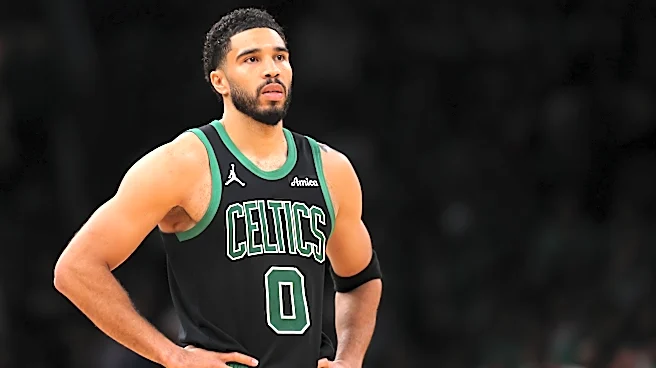




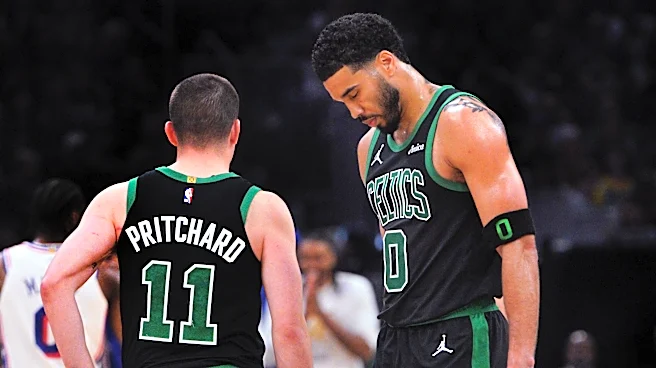
BOSTON — Late in the fourth quarter, as Derrick White’s fifth three-pointer of the night sailed through the net, Jayson Tatum turned his back to the TD Garden parquet and emphatically punched the Celtics bench with both fists.
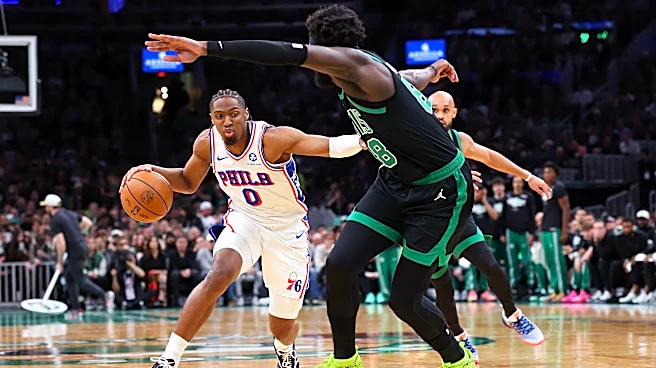
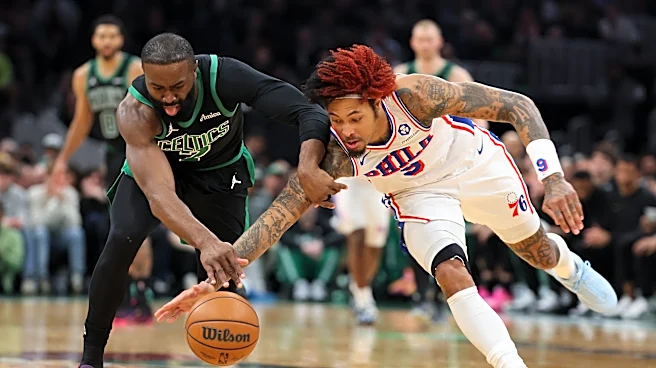
He badly wanted the Celtics to do the improbable, to pull out a come-from-behind victory in Game 7 against a Philadelphia 76ers team that was peaking at exactly the right moment.
He badly wanted the Celtics to advance to the next round, so that he could come back and continue
what was an incredible comeback story, so that he could return to the same Madison Square Garden where his season last ended in heartbreak.
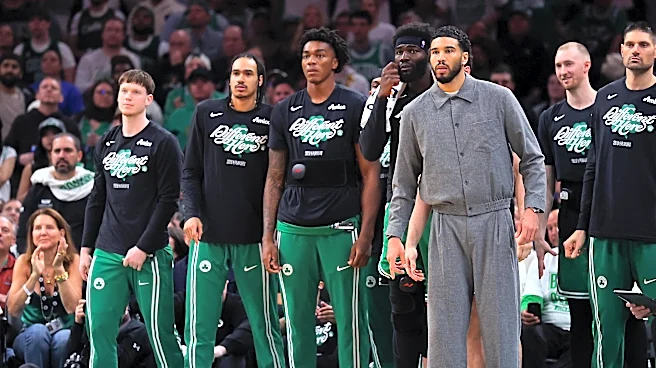
But, almost a full year after he suffered the worst injury in basketball, Tatum was once again sidelined, let down by his body, ruled out of game action by his medical staff.
This time, it wasn’t season-ending, and he wasn’t writhing on the floor in pain. On Saturday morning, Tatum simply woke up with some back-of-knee stiffness that appeared to begin in Game 6, a likely side-effect of returning to action in just 10 months, quickly ramping up minutes, and battling in physical, postseason action.
“It was just unfortunate timing,” Tatum said. “But, it’s a little bit to be expected, right? I was away for 10 and a half months, and I came back, and I’m playing every other day, and I was playing 36 to 40 minutes — so it’s not unusual that something would come up. It was just kind of tough because rehab was going so well the entire time. I guess it was inevitable at some point that I was gonna have to deal with was something — and it just kind of came at the worst possible time.”
Tatum said that he was day-to-day and expected to return at some point in the second round, had the Celtics advanced in Game 7.
But, as the team went ice-cold down the stretch of the fourth quarter, all he could do was watch, just as he did for the first 62 games of th season.
“It was tough,” Tatum said. “I was upset, I was sad, I was disappointed all day.”
Part of what made it so painful was how seamless his rehab had gone up until that point. He came back in 10 and a half months. He averaged 23.3 points, 10.7 rebounds, and 6.9 assists in the series’s first six games, shooting 47.5% from the field — the best mark of his playoff career.
Everything was going exactly to plan.
Then, just like that, he was back to the sidelines.
“It just kind of really never crossed my mind,” Tatum said of the possibility of not being there for the final game of the year. “Once I came back, everything was just going so well, so to have to sit yesterday in the biggest game of the season, and just not being able to be out there and be a part of that… it was just tough.”
In the end, the Celtics season ended as it started, with three straight losses, and with their best player in street clothes.
Still, for a myriad of reasons, Tatum said he had zero regrets about doing everything possible to make his return, that making the push to return this season was “100%” the correct decision.
In large part, that’s because going into next season, he knows that he is capable of being exactly who he was before the injury — if not an even more improved version.
“I’m very happy that I came back to be a part of this team, get back to doing what I love, to help give us a chance to compete for a championship, to prove to myself that I can get back to being the guy who I was, and hopefully better,” Tatum said.
“I was able to prove to myself that I can still play this game at a very, very high level, even not being 100% of myself. I know what I’m capable of. So , checking that box off mentally, because that was a question in my head. There was doubt. Will I be able to be the same player? Will I be able to play at a high level after this injury? Now I have proven it and shown that — even at 85% of myself. So you know, now getting an extended period of time to deload and take some time off and come back next seaso 100%, 110% ready, get my right calf bigger compared to my left one. So I’m excited about that.”
In addition to overcoming that mental hurdle, Tatum also feels a level of pride regarding what he was able to pull off — even if it did not result in the outcome he desired.
He knows that he blazed a trail for other NBA players with the same injury to follow, players like Tyrese Haliburton and Damian Lillard, who have yet to make their returns following Achilles ruptures last Spring, and more recent examples like Donte Divincenzo.
That, in and of itself, meant a lot.
“Not necessarily from a standpoint of, ‘I’m great look at what I was able to accomplish,‘ but to give other guys hope,” Tatum said. “Obviously, I don’t want anybody to have to go through tearing their Achilles, but in the unfortunate event that it does happen, that I can be sort of inspirational: if you attack rehab a certain way if you follow these guidelines, or do it a certain way, that it’s not, like, a career-ending injury, that you can come back, that you can be yourself, that you can be better, that it won’t take 18 months, that you can come back whenever is right for you.”
“So, I’m happy and proud of the fact that I was able to do that, and unfortunately, if somebody else has to deal with this, they can look at what I was able to do and and have some hope and inspiration that it’s not what people used to think it was,” Tatum said. “And, you can come back from this, and be who you were and hopefully be better.”
For now, it will be a long offseason in which Tatum will get some much-needed rest.
At the podium, it was evident that Tatum tried tirelessly to look at the positive view, burdened by the disappointment of a first-round exit and his unexpected Game 7 sidelining.
“I get a long offseason to really get back to 110%,” he said. “I guess that’s the silver lining of it all.”