




Alan Durban’s third – and, as it would turn out, final – season at Sunderland had picked up after a slow start that saw the club with just one win in the first six Division One games. A 1-0 victory over Bob Paisley’s Liverpool at Anfield in October, and a 2-1 win against Arsenal at Highbury, had certainly shown that the team was no pushover, and had higher aspirations than finishing just three points clear of the relegation zone, as they had done the previous campaign.
After the trip to Highbury,
Sunderland had faced a midweek Milk Cup trip to Norwich – a nil-nil scoreline drawing the ire of Canaries striker Mick Channon, who said: “We would never go away and play like they did. In fact, I’m glad we don’t play like that otherwise Mick Channon would have retired by now.”
I’m glad I don’t refer to myself in the third person, Mick.
That meant a Roker replay would soon follow – but in the meantime the lads were looking to build on the three points in North London with another three at home to Watford.
It would be no small ask.
Watford, under the headline-grabbing stewardship of Elton John, and the exceptionally promising managerial ability of Graham Taylor, had finished second in the First Division the season before. 1982/83 had been their first season ever in the top flight, with Taylor guiding them quickly up the leagues since taking over the Fourth Division club in 1977.
For Sunderland, progress had been rather more sedate. While Durban – who’d taken over the permanent reins from Ken Knighton in the summer of 1981 – had been stifled by a lack of funds to really take the team forward at pace, he’d built a smart, young squad that, while capable of producing some excellent displays was also, predictable, a little inconsistent.

Progress is rarely linear, yet the feeling was the team was heading steadily in the right direction. Watford’s achievements, however, showed that sometimes success could be achieved at a greater pace – albeit with a bit of spend. From taking over at Watford to achieving top flight promotion, Taylor had spent £1.38m – recouping around £500,000 in player sales. Sunderland, in the same timeframe, spent similarly. But, while Sunderland had spent serious money for the time on the likes of Claudio Marangoni and Ally McCoist, Watford’s investments in the likes of Gerry Armstrong, Wilf Rostron, Ross Jenkins and Pat Rice brought greater value for money. Star attractions Luther Blissett and John Barnes had both come through as youngsters – Blissett departing in a million pound move to AC Milan after a brilliant top flight debut season saw him score 33 goals in all competitions, including four against Durban’s Sunderland in that infamous 8-0 Watford win.
The money from Blisset had enabled Taylor to reinvest into the squad, and in the background on this day 43 years ago the future England manager was working on a deal that would see Partick Thistle’s young goalscorer Mo Johnston join the club for a fee of £200,000. 46 games and 27 goals later, Watford would double their money. In contrast, Sunderland had signed McCoist for £400,000 in 1981, and had sold him for less than half that price in the summer of 1983.
One player who Sunderland had paid decent money for was Paul Bracewell. The £250,000 signing from Stoke had settled well into Durban’s midfield, and was looking smart business – he was a doubt however for this game, as were Shaun Elliott and Ian Atkins.
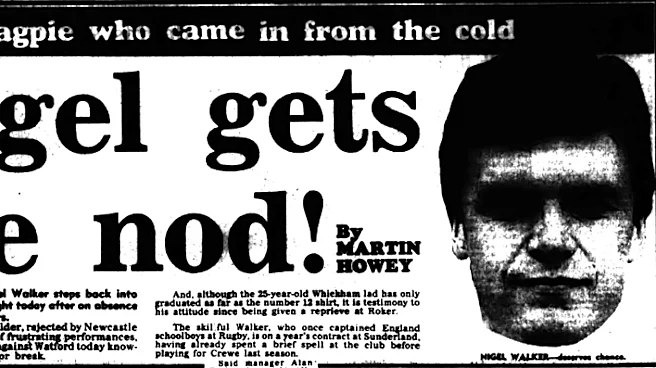
Come kick off, however, it was only Elliott who was absent – and his unavailablity opened up an opportunity for 25 year old midfielder Nigel Walker, who’d spent his early career at Newcastle, playing 81 times between 1977 and 1982, including lining up in midfield against Sunderland as Gary Rowell netted that hattrick in 1979.
After a spell in American ‘soccer’, Walker had earned a contract at Sunderland, and was named on the Roker bench for the first time – five years after his last top flight appearance.

As it was, Sunderland ran out convincing 3-0 winners – thanks to headers from Colin West on 25 minutes, Mark Proctor on 47 and Gordon Chisholm on 72. Half time and full time ovations were afforded to the team who were looking like they were on the up, with only one defeat now in the last ten games.
Sunderland showed an attacking flair that I’m sure even Mick Channon would say Mick Channon would have enjoyed – 21-year-old West’s diving header from Gary Rowell’s knock back completing a fine five-man move.
Maverick winger Leighton James had been heavily involved in that move, as he was in the second and third goals; Proctor heading in from the Welshman’s cross and Chisholm doing the same from his corner. In between, Proctor and Chisholm both hit the post with long rangers from 25 yards.
James left the field in the closing stages to generous applause – to be replaced by Walker, who got eight minutes of action.
Such was the quality of Sunderland’s display, greater retribution could have been dished out as Durban’s men looked to right some of the wrongs of their trip to Vicarage Road the previous year.
After the game, Graham Taylor said to Durban.
At least it wasn’t 8-0. It could have been!
However, for both Durban and certainly for Nigel Walker, it’s fair to say this game was one of the last highlights in their Sunderland careers. Walker never played another first team game – and for a while held the record for the shortest Sunderland career. After losing just one in ten, Sunderland’s form dipped – winning just three of their next 15 league games, drawing six and losing six – and that was enough for Tom Cowie to take decisive action, replacing Durban with Len Ashurst.
Some, with significant justification, still look at that decision as being the one that put Sunderland into a downward spiral for the next decade or so. Whether you stick or twist is always a gamble.
As for Walker, he joined Blackpool on loan later that season before signing permanently for Crewe and then spending a couple of years at Hartlepool before giving up the pro game at 28, retraining to be a maths teacher while still playing Northern League for Blyth Spartans and Dunston Fed. Walker sadly passed away aged just 54 in 2014 – however, for Sunderland supporters of the late 70s and early 80s, he’d played a part in two of the more memorable contests of that period, one wearing black and white, and the other in Sunderland’s red and white.