
There are many names to know for the 2026 NFL Draft, but the endless list of players can be narrowed down to those who have a fitting skillset for the Kansas City Chiefs.
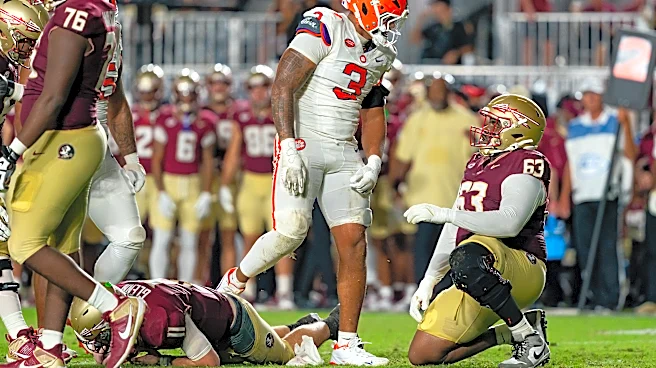
Clemson defensive end T.J. Parker could be on that short list. Let’s take a closer look at the stout and explosive edge defender:
Background
As a high school recruit, Parker was a top-50-ranked player and a sixth-ranked defensive lineman. He decided to play at Clemson, which has a rich history of producing NFL defensive ends.
Early in Parker’s
career, he looked like an immediate star player. Parker had 16.5 sacks in his first two seasons, including 11 as a sophomore. Parker’s youth and production had him getting top-5 buzz before the 2025 season.
Unfortunately, last year was a disaster scenario for the Tigers. The team didn’t live up to the hype and struggled all season, including Parker. He finished with only five sacks and a career-low mark in tackles for loss.
Parker’s draft stock has fallen, but he has still had an impressive pre-draft process. At the NFL Scouting Combine, Parker came in with good size: 6 feet 3 1/2 inches, 263 lbs and 33 1/8-inch arms. He ran an impressive 40-yard dash, clocking at 4.68 seconds with a 10-yard split of 1.62.
Parker’s Strengths

The base of Parker’s game starts with his get-off. He’s a quick-twitch athlete who gets on top of tackles in a hurry. Parker can immediately blow up plays with his burst past linemen to position himself behind the line of scrimmage.
That same burst translates to his pass-rush ability, accelerating to turn the corner without much flexibility to bend through. He relies on his explosiveness, then tops it off with good closing speed to finish at the quarterback. Parker presents a threat to win around the corner, which does force tackles to open their hips to chase him.
To counter, Parker translates the speed to power; that skill is his top attribute. He is a long, dense player who uses his quickly gathered momentum to thrust into a bullrush and penetrate the pocket. His hands are heavy, and he has enough flexibility to play beneath tackles and disrupt their balance and anchor.
With only those two moves, Parker’s floor is relatively high. If you have a move around the corner and a power move, that’s enough to be an effective pass rusher.
In run defense, Parker has flashes of good play. He’s not big enough to align as a 4i-technique, which would require an ability to take on double teams, but he’s strong when setting the edge. He can play with a low pad level and has enough strength and length to force runs inside.
Parker should function well in a slant or stunting scheme. He can slant into a gap with his burst and power to disrupt a play or clear space for someone to loop behind him. Parker is an ideal fit across defensive fronts because he can win traditionally or be useful to free up another player.
What Parker needs to improve
The main thing Parker needs to work on is improving his technique as a pass rusher. Parker’s two moves are a great foundation, but he needs to learn and execute more counter moves. The best offensive tackles in the NFL will beat Parker to the top of the arc while keeping their hips square to deal with his power.
Parker is going to have to mix in some changeups to keep tackles honest. He is not a bendy pass rusher, so it’ll be hard for him to dip underneath tackles to clear the edge. Where Parker can get better is his inside moves. I would love to see Parker add an inside-swipe move. His hands are heavy enough to displace a tackle’s punch. If Parker can win inside, with power, or with speed, he’ll be hard to block.
Why Parker fits with the Chiefs

Parker is well-built to play for defensive coordinator Steve Spagnuolo. His body type matches what Spagnuolo typically wants. His game is also a good fit for a 4-3 scheme, and he does the things the Chiefs want their defensive ends to do. He’ll set the edge and crush the pocket with his power.
The enticing part about Parker is that he’s more explosive than the players the Chiefs have had in their defensive end room. There’s more upside to tap into, but at the very least, his floor is high. The Chiefs would get a Day 1 starter with Parker.
The Bottom Line
Parker was projected to be a top-10 player coming into the season, and he didn’t live up to that. His 2025 tape showed some of the limitations of his ceiling. Parker isn’t bendy enough to have a high ceiling as a pass rusher, and he still needs to develop other pass-rush moves. He didn’t take the step people were hoping for.
That being said, Parker’s floor is higher than people realize. His combination of length, density, and explosiveness translates cleanly to the NFL. His speed-to-power game will work in any defense. Even if Parker is just a pocket crusher who sets the edge, he can be a quality starter that gets around 5-6 sacks a season.
Parker can also get better. His lack of bend might prevent him from progressing into putting up 10 or more sacks by the season, but if he can develop some inside moves, he could maximize the skillset he has and push for that range consistently. He’s still a young player with good tools that appear capable of further development than what Clemson was able to provide.
I still prefer drafting one of the top defensive ends at pick No. 9, but if that’s not possible, the Chiefs project to still have a chance to secure a good starter in Parker with the No. 29 pick; he ranks 34th on The Athletic’s consensus top-100 rankings.