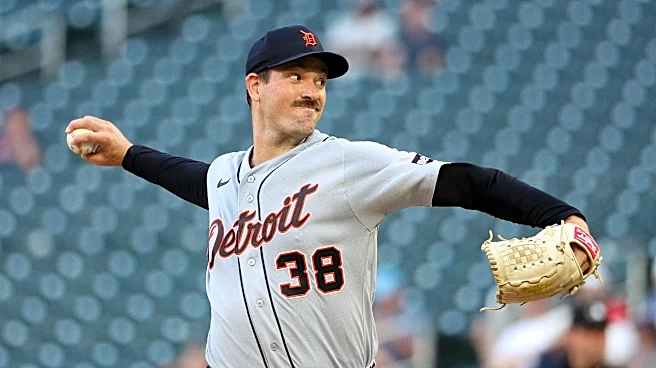




One of the easier decisions Scott Harris will have to make about his roster for 2027 will also be one of the first of the offseason. The Detroit Tigers hold a $10 million club option on right-handed pitcher Drew Anderson, and they seem certain to exercise it. With a long lockout looming, and minimal free agent movement expected until a new CBA in place, the Tigers can’t really afford to let major league caliber pitchers walk at such a reasonable price.
After four years almost exclusively as a starting
pitcher in Japan and South Korea, Anderson’s return to the major leagues went pretty well overall, despite him having to flex back and forth between the bullpen and a starting role. He made 11 starts for the Tigers, posting a 2.61 ERA with a 4.45 FIP as a starting pitcher. Out of the bullpen, he had a 4.63 ERA with a 4.11 FIP across 56.1 innings of work. That’s not far from a full season’s work out of the bullpen, and yet he managed 51.2 innings as a starter as well. That versatility is something the Tigers sorely need with a reasonably deep group of rotation options and a bullpen that is still weak on the right-handed side of the equation.
Anderson was a little too prone to free passes and home runs, but he also posted one of the team’s best strikeout rates in a relief role. His FIP numbers say he had things go his way in his time as a starter, but Anderson does keep the ball on the ground as well, posting a 48.4 percent ground ball rate on balls in play. Combined with a 12.4 percent swinging strike rate compared to the league average of 10 percent and a high chase rate, Anderson has plenty to operate with.
Over the course of the season, the Tigers helped him dial in his pitch mix, relying mainly on his fourseamer, nasty kick change, and his curveball. They experimented with his slider more in late April and May, but it did not go well and they rightly ditched that pitch more and more as the season progressed and turned to the curveball instead. He only threw the slider 4.8 percent of the time, yet it accounted for three of the 16 total home runs Anderson allowed on the year. More work is required before it’s more than a show-me pitch.
The issue with keeping Anderson is that while he was pretty useful as a starting pitcher, he’s going to have a hard time cracking the rotation next year without some injuries. Framber Valdez, Jackson Jobe, Troy Melton, River Ryan, Keider Montero, and, if finally healthy, Reese Olson, are probably all ahead of him on the starting depth chart. At least to start the year, Anderson is going to be in the bullpen, and he’s just not a great fit for high leverage relief either. He functions best as a fifth starter or as a bulk and middle relief arm, and he’ll have to be more consistent next year for that to change.
The Tigers have at least three lefties to hold down that side of the bullpen in Drew Sommers, who should be a high leverage option next year, Brant Hurter, and Tyler Holton. That leaves five spots for right-handers. Will Vest’s status is a big question mark, and the Tigers have Kyle Finnegan under contract already for 2027 after a tough 2026. The situation is really uncertain on that side of the bullpen. There’s clearly room for Anderson, and with free agency bound to be delayed this offseason, the Tigers will almost certainly keep him, but the only problem he helps solve for them is depth.
The issue with high leverage relief work is that Anderson’s curveball and kick change are his big swing and miss pitches. The changeup is clearly the nastiest pitch he’s got, but the big movement and the feel required to spot it down make him vulnerable to leaving too many hangers up in the zone under pressure. At least, that was how it looked this year. His fastball doesn’t get hit very hard, but it’s certainly not the type of whiff generating heater that most good high leverage relievers possess. The x-factor is his 80 mph curveball, which he used more and more as the year went on and he was moved into the rotation and really needed a strong third pitch. He racked up a 33.3 percent whiff rate on it, and while it has a similar tendency to get crushed when left up in the zone, it’s a lot simpler pitch to grip and rip under pressure.
One of the changes Anderson made in his years playing overseas was lowering his arm angle. He averaged 42 degrees this year, whereas in his major league seasons prior to going to Japan and South Korea, his arm angle was averaging 49 degrees. The lower arm slot, without other adjustments, can produce less induced vertical break, which usually leads to fewer whiffs. On the plus side, Anderson now averages over 95 mph with a few extra inches of extension than he did earlier in his career when he was averaging 92-93 mph. The tradeoff for more velo and extension is probably worth it, but with modest ride and not much run, it’s almost more like a cut fastball. It worked out, as hitters hit .215 with a meager .356 slugging percentage, and those numbers are backed up well by Statcast’s expected metrics, but it’s not that easy to see where more whiff inducing movement is going to come from.
Anderson gets 82 percent spin efficiency on the fourseamer, so they could possibly work on that to get more ride, but with his arm angle that may just add more run rather than ride, and sometimes that hurts a pitcher more than it helps them. Anderson’s fourseamer has pretty similar traits to Jack Flaherty’s fastball, and that bodes well for it as Flaherty’s fourseamer is rarely hit hard in the air either. They just aren’t going to miss a ton of bats with it either. Those slightly gyrospin fourseamers are more about getting a little late, seam-shifted movement to miss barrels rather than to generate big whiffs.
An argument in Anderson’s favor is that pitching late innings relief is not what he’s used to doing. He also had to deal with a different baseball than they use in South Korea. It’s possible that those factors just required more acclimation time than the Tigers could give him once the injuries started piling up left and right in April and May. Perhaps with his experience gained he’ll do a better job in setup situations with a lead next year and just feel more comfortable all around, no matter how the Tigers deploy him.
Anderson is worth the $10 million on the open market. There’s no buyout cost if the Tigers choose otherwise, but really it’s a pretty easy decision to pick up the club option. He may not fit perfectly into the Tigers needs in terms of specific relief roles, but he does in terms of their need for more right-handed depth, and he offers some bat missing ability and a solid ground ball profile. Figuring out exactly what to do with him in the bullpen is a little more complicated. Still, having him in house makes it a little easier to wait out the CBA negotiations and then try to target pitching in free agency once everyone knows where they stand with the new ruleset. And possibly Anderson’s improved second half says he was settling in and bound for a stronger second season back in the big leagues next year.