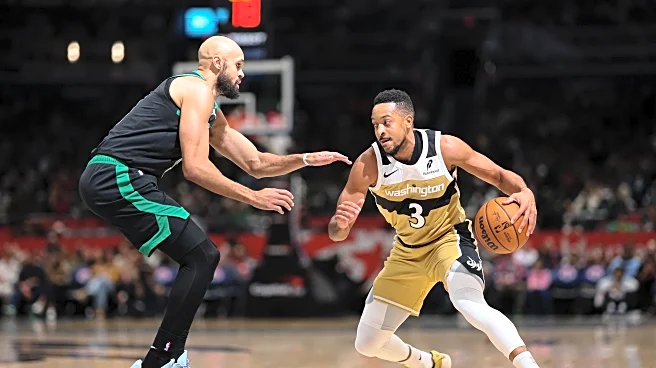

So, I’m on the road and failed to pack anything to read. The best options where I’m saying are a book about The Actors Studio by James Lipton, the first chapter of which was surprisingly dull, and a memoir(?)
by Chelsea Handler, which is not funny, interesting, or insightful. Spending the evening reading either would have been a better use of time than watching the Wizards get annihilated by the Boston Celtics.

The Wizards never led in this one, but the first half wasn’t awful in the sense that Washington’s offense was efficient and the score was close. They trailed by just six at halftime.
Let this one sink in: In the first half, the Wizards defensive rating (points allowed per possession x 100) was an abysmal 137.5. Not a typo. League average is 115.8. In the second half, their defensive rating was 163.3.
It would be tempting at this point to talk about Washington’s abundant injuries (Alex Sarr, Corey Kispert, Bilal Coulibaly, and Tre Johnson all missed the game). Except Boston was missing Jaylen Brown and Jayson Tatum. We’ll generously call that even.
It would als0 be tempting to talk about how this is a rebuilding team that doesn’t want to win games this year. Except “rebuilding” and “getting stomped by 45 points on your home floor by what amounts to the other team’s second unit” are not synonyms.
Part of rebuilding is establishing a foundation for future success. There are certain basics that should (at least in my opinion) be part of that foundation:
- Running back on defense
- Picking up the ball handler in transition
- Matching up with a nearby offensive player whether he’s your man or not
- Setting and using screens properly
These things are somewhat on the coach, but as was clear from the sideline reporting (and the sideline mics), Brian Keefe and the coaching staff were sharing some helpful tips on some of these very subjects throughout the game.
Which reminds me of something a good friend and former work colleague would say to me when someone would tell us we should have gotten the word out about an event they’d missed, which we’d promoted repeatedly over a period of months: “You can’t read for them, Kevin.”
Thoughts & Observations
- Jamir Watkins got his first NBA start. I wouldn’t say it went well — he had almost no offensive impact (1 field goal attempt and a 4.6% usage rate), and the defense was horrific when he was out there. I wouldn’t say the defensive failures were particularly on him.
- Early in the broadcast, Drew Gooden praised Marvin Bagley III’s board work and said it would be important because Boston was the eighth in offensive rebounding. There were two things wrong with this. First, by offensive rebounding percentage (more meaningful than per game stats), Boston is sixth in offensive rebounding. Second, Bagley is a superb offensive rebounder and a below average defensive rebounder for a big. In other words, the kind of rebounding Bagley does well would not help against what Boston does well.
- While it was nice to give that start to Watkins, the team should go back to Champagnie as a starter, at least until Sarr or Coulibaly returns.
- I think Kyshawn George has the potential to be very good, but he’s gotta cut down on the dumb turnovers and relentless hacking. Last night: 4 turnovers, 4 fouls.
- Let this sink in: league average turnover rate is 13.1% this season. George’s turnover rate last night: 38.6%.
- Someone send me a good book to read!
Four Factors
Below are the four factors that decide wins and losses in basketball — shooting (efg), rebounding (offensive rebounds), ball handling (turnovers), fouling (free throws made).
The four factors are measured by:
- eFG% (effective field goal percentage, which accounts for the three-point shot)
- OREB% (offensive rebound percentage)
- TOV% (turnover percentage — turnovers divided by possessions)
- FTM/FGA (free throws made divided by field goal attempts)
Stats & Metrics
PPA is my overall production metric, which credits players for things they do that help a team win (scoring, rebounding, playmaking, defending) and dings them for things that hurt (missed shots, turnovers, bad defense, fouls).
PPA is a per possession metric designed for larger data sets. In small sample sizes, the numbers can get weird. In PPA, 100 is average, higher is better and replacement level is 45. For a single game, replacement level isn’t much use, and I reiterate the caution about small samples sometimes producing weird results.
POSS is the number of possessions each player was on the floor in this game.
ORTG = offensive rating, which is points produced per individual possessions x 100. League average so far this season is 115.1. Points produced is not the same as points scored. It includes the value of assists and offensive rebounds, as well as sharing credit when receiving an assist.
USG = offensive usage rate. Average is 20%.
ORTG and USG are versions of stats created by former Wizards assistant coach Dean Oliver and modified by me. ORTG is an efficiency measure that accounts for the value of shooting, offensive rebounds, assists and turnovers. USG includes shooting from the floor and free throw line, offensive rebounds, assists and turnovers.
+PTS = “Plus Points” is a measure of the points gained or lost by each player based on their efficiency in this game compared to league average efficiency on the same number of possessions. A player with an offensive rating (points produced per possession x 100) of 100 who uses 20 possessions would produce 20 points. If the league average efficiency is 114, the league — on average — would produced 22.8 points in the same 20 possessions. So, the player in this hypothetical would have a +PTS score of -2.8.
Players are sorted by total production in the game.