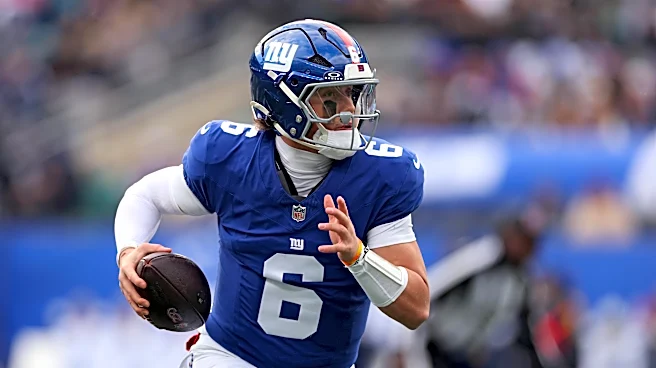


Jaxson Dart did enough in his rookie season to make the New York Giants believe they might have found the answer they have been seeking at quarterback since Eli Manning retired.
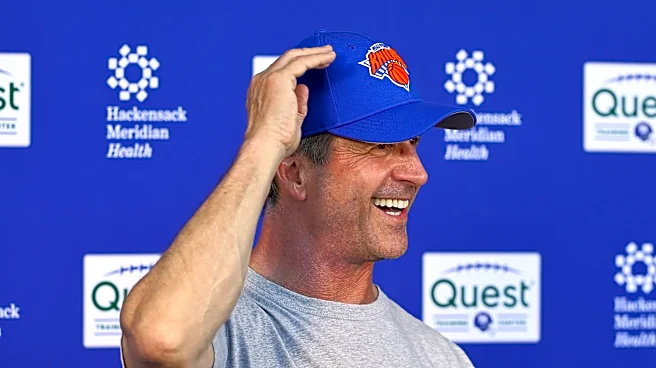
Dart played well enough, in fact, to be one of the reasons why John Harbaugh was interested in taking the Giants’ head-coaching job.
“The quarterback’s kind of important. You know, that’s kind of a big deal,” Harbaugh said at his introductory press conference. “I’m excited about Jaxson Dart.”
After working with the young quarterback
for a few months, Harbaugh’s excitement has grown.
“I don’t know about surprised, probably just impressed more than anything. I do think he’s obsessed. I believe he really really wants to be good,” Harbaugh said recently via Bleav in Giants with Bob Papa and Carl Banks.
“He’s kinda got the it factor from a leadership standpoint because he’s respected by the guys. They just know how hard he works, how much he prepares and they respect his talent. He’s got some charisma.”
Dart has all those things. What he doesn’t have are the pelts on the wall that prove he is a top 10-type quarterback the Giants can and will win with on a consistent basis.
Quarterback rankings should be taken with a grain of salt. This list of starting quarterback rankings, though, tells a consistent story:
- Pro Football Focus — Dart is No. 25
- SB Nation — Dart is No. 28
- Sports Illustrated — Dart is No. 23
- FOX Sports — Dart is No. 21
- NBC Sports (Chris Simms) — Dart is No. 22
The story those rankings tell? That Dart has a long way to go to become the quarterback the Giants drafted him to be, and think he can be.
Simms summarized Dart this way:
Dart is a master of backyard football who can make magic happen but questions remain about the quarterback’s ability to thrive in the pocket heading into his second season.
The Giants have been here before
Not so long ago a rookie quarterback named Daniel Jones excited the fan base by throwing 24 touchdown passes to 12 interceptions while passing for 3,207 yards in 13 games, 12 of them starts.
Jones was “Danny Dimes.” He could throw it. He could run it. His rookie season offered hope that GM Dave Gettleman, criticized for using the No. 6 overall pick in the 2019 NFL Draft on Jones, would be proven right.
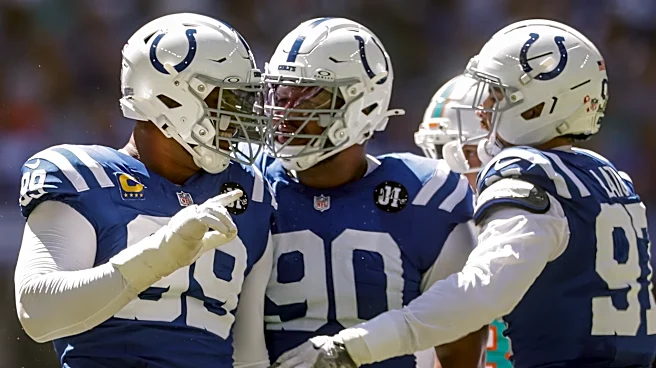
That, of course, did not happen. Jones has never again reached 20 touchdown passes in a season. The 2025 season with the Indianapolis Colts is the only time Jones has surpassed the 232.8 yards passing per game that he averaged as a rookie. He averaged 238.5 yards in 13 games.
So, as good as most feel about Dart’s future, there are no guarantees. The hoped-for leap into the upper tier of quarterbacks never truly happened for Jones. Will it happen for Dart?
The New York Post did some Year 2 quarterback research that bodes well for Dart:
The Post researched the 33 first-round quarterbacks drafted from 2016-24 to see how many actually took a Year 2 leap — or was it more like a baby step? — and how many went in the other direction.
Removing five instances where there is not enough data over the first two seasons to draw a conclusion, 19 of the other 28 experienced a spike in quarterback rating, including seven whose progress was dramatic. Of the nine who went in reverse, only one (the Commanders’ Jayden Daniels) was limited by injury.
But perhaps the most interesting finding related to expectations for Dart in 2026 is that quarterbacks who had a new head coach and new offensive coordinator made some of the biggest strides.
The Post pointed to Drake Maye of the New England Patriots and Caleb Williams of the Chicago Bears as examples of the quarterback/new coach jump.
Young quarterback issues
Young quarterbacks in the NFL always have a lot to learn. The variety of things Dart needs to improve upon appear to be things typical of quarterbacks early in their NFL careers. Let’s break these down into a handful of categories. In reality, as you will see, the various categories overlap in some ways.
Too much hero ball
This is really the “Dart takes too many hits when he runs” category.
The Giants can’t take running the ball out of Dart’s game, it is part of what makes him dynamic. Per Sumer Sports, Dart was third in the NFL in quarterback rush yards (487), second in rushing touchdowns (9), and second in Expected Points Added (EPA) when running (38.12).
Harbaugh has no intention of taking that away from his quarterback.
As has been discussed ad nauseum, what the Giants need Dart to do when he does run is to protect himself, to make smarter decisions about when to put the ball and his body at risk.
As a rookie, Dart seemed resistant to the idea that discretion was the better part of valor. The unnecessary hit that he took against the New England Patriots after missing two games with a concussion is evidence of that.
Offensive coordinator Matt Nagy and quarterbacks coach Brian Callahan have spent time showing Dart clips and going over when it is and is not worth taking risks. Callahan said there have been some “very direct conversations” with Dart about things he needs to improve upon.
One of those, of course, is not subjecting himself to unnecessary hits.
“There’s an awareness of when to put yourself at risk, when to get out of bounds, when to get down on the ground and not take a hit, and when to be smart with the football,” Callahan said. “Those are things you just point out … but I never want to take that ability to affect the game with his legs because it’s something that makes him a really dangerous player.”
Dart sounds like he has gotten the message.
“It’s important for the quarterback to make sure how he’s feeling one play that he’s going to feel that same way the next play,” Dart said this spring. “And at the same time, just having the experience last year of sitting out two games, I hadn’t done that in my career. So, I just hated that time of not being out there with my teammates.
So obviously I understand the most important thing is to be out there. So, you just grow and learn from things. And I think I’m going to do a good job at it this year for sure.
“My competitiveness isn’t going to change at all. I think, just like I said, it just goes into situationally. Just what times it’s worth it and what times it’s not. And just making those mature decisions.”
We will see if words lead to actions.
Not always making the right read
Greg Cosell, one of the premier quarterback analysts in the business, said recently of Dart that “there were times he didn’t see it the right way” during his rookie season. Cosell told Ross Tucker that Dart will “get better in that regard with more experience.”
One of Dart’s strengths is, of course, his ability to make plays with his legs. Cosell pointed out that this is a double-edged sword for young quarterbacks that often causes them to run before they need to.
“When quarterbacks can run, when they don’t see it the right way, they take off,” Cosell said. “And that disrupts your pass game and obviously as we saw last year, it caused problems for him in terms of injury.”
According to Pro Football Focus, Dart was the worst quarterback in the league last season in terms of allowed pressure — defined as pressures where the quarterback is fully or partly responsible for being pressured while attempting to pass.
Dart was at least partly responsible 39.1% of the time when pressured. Shedeur Sanders was second at 27.3%. Dart was at least partially at fault on 50 pressures. Only Maye (52) was responsible for more. Maye’s total, though, came on 234 dropbacks under pressure, while Dart’s came on 128 dropbacks under pressure.
One of the reasons for those self-allowed pressures? Leaving the pocket too soon, thus putting your blockers at a disadvantage because they don’t know where you are.
Like Cosell, Nick Baumgardner of The Athletic also saw Dart taking off from the pocket before he needed to.
“I actually think Shedeur Sanders is worse at this despite what the numbers maybe showed there in the percentages because I think when you watch Shedeur a lot of his problems are it’s not it’s before the first read. It’s before he’s finished his like first step,” Baumgardner said. “I don’t see that as much with Jaxson. I see I’ll see one to two and then he freaks out instead of one to two to three and then we got to keep going through the thing and if I get through four and I don’t know what I’m doing then I’ll go.”
Not throwing with anticipation
Baumgardner lauded Dart’s accuracy in terms of ball placement and ability to make all the throws. What he did express concern about was Dart’s tendency to throw the ball a tick too late, to not throw with anticipation that could help receivers turn modest gains into big plays. Or turn incompletions into completions.
“He’s one of these guys where it’s you’ve got to be wide open sometimes before he’s ready to rip it,” Baumgardner said. “He’s just a guy that needs to see that receiver break two full steps or two full strides into a really wide window before he rips the ball.”
Baumgardner calls that “a hangover from the [Lane] Kiffin offense” that Dart played in at Ole Miss, where anticipatory throws weren’t required.
This was always an issue for Jones. It still is. Some quarterbacks improve in this area, and some do not. Baumgardner thinks Dart can get better.
“I don’t think he’s a guy that it’s totally a lost cause. I think he can coax more out of it,” Baumgardner said. “But I do think it might be one of those things where it’s like, hey, we got to be careful with how we run the offense because it might not be something that he’s ever super, super strong at. Can he get better at it? Yeah, but I’m not sure he’ll ever be great at it.”
Learning to play under center
Dart admitted during the spring that the team’s new offensive scheme will feature “a lot more of the under-center action game.”
Yes, the more traditional reliance on plays with the quarterback under center is a Harbaugh thing. Offenses around the league are playing more under center, and with heavier personnel, to counter defensive trends. The chart below is from Sharp Football:

Playing from under center forces defenses to have more respect for the run, rather than simply adjusting to the run on their way to a quarterback who is in shotgun. Sharp Football puts it this way:
When you are in a static shotgun situation, you lose more offensive leverage.
That is not always the case in neutral game scripts, as offenses like the Colts, Eagles, and Ravens have had success in recent seasons when everything is in order.
Still, when you are in a static dropback game out of shotgun, you are fighting with a hand tied behind your back and allow the defense to know the assignment.
As Dart alluded to, it also brings real play-action passing into play. Another chart from Sharp Football, detailing passing success under center vs. shotgun in 2025:

These numbers show the value of passing from under center. Unfortunately, Dart was not good at this skill as a rookie. And, it is clear that Brian Daboll and Mike Kafka knew it.
Among 36 quarterbacks who dropped back to pass at least 325 times in 2025, Dart used play-action 106 times. Per Giants.com, only 24 of those were true under center dropback play-action passes Only Joe Flacco (79) and rookie Tyler Shough (62) used play action less often. Dart completed just 57.3% of his passes using play action. Only Shough (56.3%) and Trevor Lawrence (56.1%) were worse.
Without play action, Dart completed 65.1% of his passes.
Here are more damning stats from the Giants on Dart’s play-action struggles:
Dart’s EPA per dropback on play-action plays under center last season was .05, which was 27th among 45 quarterbacks with at least 100 pass attempts. His sack rate of 20 percent was 33rd of 33 quarterbacks and his average time to throw on those plays was 4.01 seconds, longer than only Tyrod Taylor and Cam Ward of quarterbacks that had at least 100 pass attempts.
Clearly, a concept designed to give the offense an advantage did not with Dart playing last season.
Dart spent considerable time this spring working on drop backs and play-action fakes from under center. That will continue through training camp.
Deep ball accuracy
Even though Baumgardner praised Dart’s accuracy, there is one area where Dart did not fare well. Among 36 qualifying quarterbacks, Dart was 32nd in the NFL in deep ball accuracy, completing just 16 of 50 passes of 20 or more yards downfield, just 32%.
Dart wasn’t afraid to take those deep shots, as Jones had sometimes been while with the Giants. Dart threw deep 14.7% of the time, fourth-most often among those 36 qualifiers. He just did not do it well.
Was that about Dart? Was it about the Giants, without Malik Nabers, not having receivers who could get open or make plays down the field? Four of those deep throws were dropped. If those were caught, a 40% completion rate would vault him to 13th among those 36 quarterbacks.
Whatever it is, it needs to get better. After all, we know Dart can throw the deep ball.
Dart understands the assignment
Most of the “young quarterback issues” described above are about learning the nuances of the position at the NFL level, and learning to play the game from within the pocket.
Dart gets it.
“There’s steps in my game that I want to grow within the pocket,” Dart said. “So, I just think that each and every rep you’re just trying to identify pre-snap, post-snap reads and then just be really solid with progressions. And those are just steps I’m trying to take at this time for sure.”
Who will help Dart get there?
Harbaugh is a former special teams coach, and admittedly involves himself more in the nitty gritty of the defense than the offense. Still, he has been there and done that when it comes to successfully developing young quarterbacks.
Joe Flacco was the first player drafted after Harbaugh became Baltimore Ravens coach in 2008. Harbaugh and the Ravens won a Super Bowl with Flacco at quarterback. Many weren’t sure Lamar Jackson could play quarterback in the NFL. He won two MVP awards playing the position for Harbaugh.
Nagy as offensive coordinator seems uninspiring to some. Nagy, though, has worked with Patrick Mahomes, Alex Smith, and gotten better play from Mitchell Trubisky than any other coach. He has also been mentored by Andy Reid.
“It’s going to start off by building off the confidence he [Dart] has from last year,” Nagy said in the spring. “He was able to really put together a good year as a rookie. You want to grow from that. So it’s our job as coaches to make sure we see what he did well, but then we’re also going to make sure we’re staying locked in on him improving on certain areas.
“He wants to be the best. He wants to be coached hard, have that discipline, and work on his footwork, his timing, and his connection with teammates. We’re going to do that.”
Callahan has been both a head coach and offensive coordinator. He has worked with quarterbacks like Joe Burrow, Matthew Stafford, Derek Carr, and Peyton Manning. Senior offensive assistant Greg Roman is a four-time coordinator who has worked with Jackson, Justin Herbert, Alex Smith, and Colin Kaepernick.
Callahan will be the coach working most closely with Dart.
Callahan said during minicamp that being successful from the pocket is “always, always, always, always” going to start with footwork.
“There’s a timing and footwork element to everyting in the passing game,” Callahan said. “If your feet are in rhythm with what the play design is, whether it’s a five-step or a seven-step or play-action, whatever that timing is for the routes, and the route depth with the footwork is really, really important.
“Along with that is where your eyes are. That eye discipline, and where you’re supposed to look, and what you’re looking at, and why you’re looking at it also helps that decision-making process and that timing.”
Callahan said being able to do those things correctly time and again is critical.
“To me the biggest mark in this league for quarterbacks is how consistent are you with those things on a snap-to-snap basis,” Callahan said. “That’s what you work on, that it never changes, so your rhythm and timing for whatever the concept requires of you is consistent over the course of plays and games and series and weeks and months. That’s what you hope for. That’s what we’re drilling pretty hard on right now.”
Final thoughts
Development, as SB Nation’s Mark Schofield told me years ago, is never linear for quarterbacks. Dart has all the arm talent, charisma, play-making ability, and intelligence, to be successful as the Giants’ quarterback for the next decade.
How quickly he gets there, or whether he does at all, depends upon the things we have discussed. The giants have surrounded him with more talent, though the roster remains a work in progress, and an established, veteran coaching staff.
Let’s see what kind of jump he makes in Year 2. Training camp in West Virginia is the next step.