

St. Louis pitchers have the second-worst strikeout percentage in all of baseball over the last six seasons. The only team with a worse rate is the Rockies, who play in a home ballpark where pitches don’t break, so really the Cardinals have been the worst team in baseball this decade. This dynamic is not new, as the team has prioritized strong defense and pitchers that can control contact since the Dave Duncan era.
The highest the Cardinals have ranked this millennium in strikeout percentage was the year
2000, when their 17.7% team rate was seventh-best in baseball. Since that time, their high-water mark has been ranking 10th on three separate occasions: 2013, 2015, and 2017. Here is the league strikeout rate trended against the Cardinals’ rate over the last quarter century.

The homegrown talent that emerged in the mid-2010s gave the Cardinals a roughly average strikeout staff with Trevor Rosenthal, Jack Flaherty, Carlos Martinez, and Lance Lynn (first addition) leading the way.
This pitch-to-contact approach was obviously intentional to some degree. The Cardinals would load up on sinkerball pitchers and put one of the best defenses in the league behind them. This by itself is going to drastically limit the ability of a staff to generate strikeouts. Across MLB in 2026, four-seam fastballs generate a whiff 21.5% of the time and sinkers only 13.5% of the time.
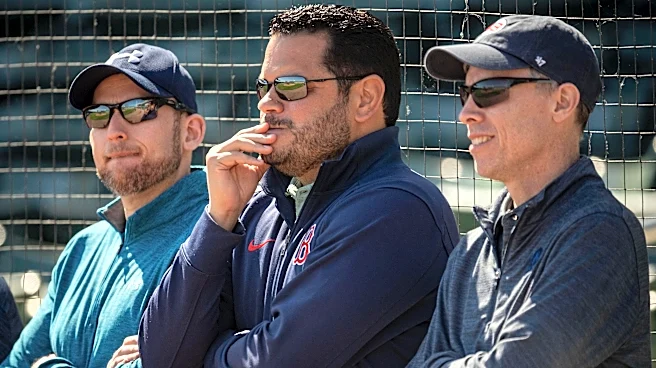
The lack of strikeouts was addressed by Chaim Bloom at last offseason’s GM Meetings in an interviewwith FanGraphs’ David Laurila.
“It’s definitely a concern,” replied Bloom, who succeeded John Mozeliak as St. Louis’ president of baseball operations at the conclusion of the regular season. “It’s not the only thing that matters, but it does matter. Having stuff that can beat people in the strike zone, that can miss bats — both in and out of the strike zone — is really important. It’s hard to have an elite staff without being able to do that. It’s not something you want to chase at the expense of throwing strikes — you’re not trying to put people in positions where they can’t succeed, or stay healthy — but it’s super important.”
Bloom was not given much in terms of resources to find strikeout arms for the big birds, but two of his free-agent adds, Dustin May and Ryne Stanek, were targeted because of their bat-missing potential. Turning over a pitching staff takes more than one year, especially when you aren’t allowed to go shopping in the expensive aisle of the free-agent store. Still, the team has made marginal improvements. Four-seam utilization has gone from 22.6% (last in baseball) to 26.4% (27th in baseball) this season. The team’s overall strikeout percentage has increased from 19.8% to 20.7%.
I was curious how the players Bloom acquired or promoted from within performed in the strikeout department relative to the major-league team he inherited. All pitchers that had pitched for the Cardinals prior to this season have a combined 20.1% K% in 2026. All of the newcomers, including callups, have struck out 21.8% of batters. The difference is not huge, but the new player rate would rank 16th in baseball. Obviously, Bloom does not get full credit for players like Cooper Hjerpe, Cade Winquest, and Luis Gastelum who were brought in by his predecessor, but I included them because I wanted to illustrate the full shift in the shape of the pitching staff that is already underway.
The marginal improvement at the major-league level is encouraging, but the makeover of the pitching pipeline is truly remarkable. Each of the Cardinals’ four full-season clubs posted strikeout percentages in the top eight in baseball for their respective levels. All four clubs had a higher strikeout percentage relative to the league than at any point since 2015. And this isn’t in the aggregate. Each individual team put together a more prolific strikeout staff than at any point in the last decade. That is bonkers.
Memphis

The average Triple-A strikeout rate trended down slightly this year from 22.6% to 22.3%. The Redbirds staff ranked fourth in Triple-A with a 24.2% team rate. 2026 was the first time since 2019 that the staff ranked above the league average. You have to go all the way back to 2009 to find a Memphis staff that ranked this highly.
Looking at all Triple-A pitchers to start at least five games at age 25 and under (creative filters, I know), the Cardinals have four of the top 22 strikeout artists in Cooper Hjerpe (34.2%, 5th), Quinn Mathews (29.2%, 12th), Mason Molina (28.2%, 14th), and Jurrangelo Cijntje (27.1%, 22nd).
When looking at the pitching pipeline, I tend to focus on starting pitchers because of how rarely relief-only prospects end up being impact relievers in the bigs. Jason Motte and Fernando Salas are probably the two most notable who have taken this trek for the Cardinals in the last 25 years. Still, this Memphis squad could very well buck the trend. Luis Gastelum (28%) and Sandro Santana (35.5% in 7.2 IP) are true relief-only pitchers who I would bet on having long MLB careers. Cade Winquest (34.8%) and Hancel Rincon (31.1%) are converted starters that could figure into the bullpen plans next season as well.
It is also worth noting that the Memphis staff increased four-seam utilization from 30% in 2025 to 35% in 2026. All eight of the high-K-rate pitchers mentioned use their four-seam as their primary fastball.
Springfield

The Springfield Cardinals made Memphis look like a bunch of finesse pitchers by comparison. The team’s 27.7% strikeout rate was the highest in franchise history and led all Double-A teams, edging out Baltimore, Boston, and the New York Yankees.
Springfield had a downright embarrassing number of strikeout specialists start at least five games this season. Tanner Franklin (30.9%), Daniel Eagen (30.7%, STL and Arizona), Liam Doyle (30.0%), Brandt Thompson (28.8%), Mason Molina (28.8%), Braden Davis (28.3%), Cijntje (28.2%), and Chen-Wei Lin (26.0%) all had strikeout rates above the Double-A average. To put this into perspective, here is the number of pitchers each year since 2015, age 24 and younger, to make at least five starts in Springfield while carrying an above-average strikeout rate.

These criteria filter out Yhoiker Fajardo (K rate slightly below Double-A average) and Brandon Clarke (one start) who are both potential top-100 prospects this offseason.
Peoria

Peoria did not have as much prospect firepower as the top two farm clubs, but still put together the eighth-highest strikeout rate across High-A clubs and the best team rate since 2011.
Much of the Peoria star pitching power matriculated to Springfield by the year’s end, but Clarke (36.5%), Fajardo (32.1%), Franklin (29.4%), and Blake Aita (26.6%) all carried strikeout rates above the High-A average of 24.2%. As this group was slowly promoted, Jacob Odle (33.0%) and Cade Crossland (29.3%) filled in to keep the strikeouts rolling.
Palm Beach

The Palm Beach pitching staff struck out 25.6% of batters faced, good for seventh among all A-ball teams. This was the best performance by the Cardinals’ lowest full-season affiliate since 2013.
The thing that is interesting about Palm Beach is that they put together a high-strikeout staff without the same level of big-name prospects that spent time at the other three levels of the system. Odle was the only consensus top-30 prospect in the system to spend significant time in Palm Beach. Since we have Statcast data available for Florida State League games, I pulled the last two seasons for the Cardinals to see how the pitch mix was evolving. The change in fastball type is quite pronounced as the team rate of four-seamers increased by 6% while sinker utilization dropped by 4%.

Not only did the club increase four-seam utilization, but the average velocity increased from 92.3 mph to 92.9 mph. The staff could have even more velocity next season as the 2026 draftees make their debuts. Tegan Kuhns had one of the top fastballs in the draft, Dawson Montesa topped out in the upper-90s, and Cal Randall hit triple digits in college.
Looking ahead
Regardless of what else happens with the Cardinals rebuild, the team is going to have one of the highest-strikeout staffs in baseball in the coming years. The focus from the front office is clear, and the quality of the minor-league depth is unprecedented. With fewer balls in play, the Cardinals might put less of an emphasis on defense. Masyn Winn would lose a bit of his value to the team if the ground balls are replaced by strikeouts. Perhaps Rainiel Rodriguez looks more attractive as a third baseman on a staff that can take care of business without as much help from the defense. The Cardinals might start systematically shuffling out their contact-oriented pitchers (sorry McGreevey and Pallante) as the next wave of talent arrives. Not much is certain in baseball, but I am certain that a pitching staff of assassins is on the way, and I cannot wait.
Join the conversation!
Sign up for a user account and get:
- Fewer ads
- Create community posts
- Comment on articles, community posts
- Rec comments, community posts
- New, improved notifications system!
Download the SB Nation app on iOS or Android.