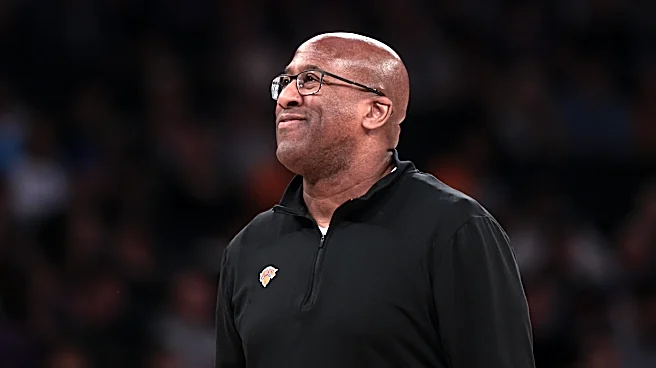




Mike Brown’s performance in the first round of the playoffs has gone similarly to his regular season. It’s been a mixed bag of some brilliance, some head-scratchers, and some gutsy moves. We saw him start off the series with the decision to put cross-match on defense, putting Karl-Anthony Towns on Dyson Daniels, which was expected but effective nonetheless. And starting from the very first second of the playoffs, Brown has gotten the most out of Josh Hart and Towns defensively, although the players
themselves deserve plenty of credit for that as well.
But in Game Two, Brown made some much-maligned decisions that very well may have cost this team the game. He insisted on relying on lineups that were without both Jalen Brunson and Towns for non-insignificant stretches. What that did was put both Deuce McBride and Landry Shamet—two players who are great amplifiers, but not initiators or creators—in incredibly difficult positions to succeed. The inexplicable decision to willingly opt into sitting his two best players without staggering them, despite such lineups performing suboptimally in the past, wasn’t the only reason they lost the game, but it did play a large role in it.
Brown then compounded his questionable-at-best decision by watching idly as his offense reverted to the stagnant Brunson-led heliocentric offense that he was supposed to come in and get rid of. Instead of calling for more sets, getting Brunson off the ball, or involving Towns more, he persisted. Now, it’s true that if Brunson makes better decisions, Anunoby makes his free throws, or if Bridges hits his game-winner attempt, the Knicks still win. But missed shots and bad decisions are part of the game and can be categorized as uncontrollable. What is controllable, though, are rotations and coaching decisions. And in a game where the Knicks were clearly more talented and had the Hawks looking desperate and on the ropes early on, Brown did just about everything he could to keep the Hawks alive.
Game Three wasn’t much better. He struggled to adjust to the Hawks’ defensive game plan on Brunson, and despite Hart being the only defender to consistently bother CJ McCollum, he chose to put the shorter McBride on him on their last defensive possession. And while Brunson’s last-second turnover wasn’t strictly a coaching decision, his late-game offense once again lacked creativity.
Yet here we are on Thursday, heading into a pivotal Game Six with the Knicks up 3–2 in the series. And the Knicks’ coach undoubtedly deserves credit for that. Brown has looked like a totally different coach during New York’s back-to-back wins. He started off by running the offense through Towns in Game Four while using Brunson as a decoy and screener off the ball more. And in Game Five, anticipating the Hawks’ adjustments, he was a step ahead, installing counters and balancing the usage of Brunson and Towns to near perfection.
He has, to the dismay of some fans, stuck with the same starting lineup, but he has also made the gutsy decision to play Mikal Bridges much less, especially down the stretch, opting to lean on Jordan Clarkson and McBride. He’s also played Mitchell Robinson more, despite questioning his effectiveness earlier in the season, signaling his openness to being proven wrong.
Sports is so often about “what have you done for me lately?” Brown, since righting the ship, is on a positive trajectory. But I still cannot get around to praising him as much as I criticized him. While, on the whole, he’s either been neutral or a slight positive, I do think that the weight of those back-to-back losses weighs more. It’s the playoffs, and every game counts. And unfortunately for him, the fact that those games were close may actually do him a disservice. He may have cost his team crucial minutes, possessions, and ultimately the game. Brown ran out suboptimal to downright bad lineups, took too long to adjust his offense to run through Towns, and put McBride on McCollum. He changes any one of those things, and there’s a very good chance that the Knicks win one, if not both, of those games and have tonight off after already winning the series.
And who knows? Sometimes the extra game(s) can have a ripple effect and lead to more minutes and/or (knock on wood) injuries. Ultimately, if the Knicks win the series, it won’t matter in the grand scheme of things. Brown will be judged on how far the team goes, and his decisions in the latter rounds will be magnified even more. But for now, Brown, despite trending in the right direction, should pray for an easy win tonight to escape any further questioning about his blunders from Games Two and Three.