
Right before the deeply embarrassing season finale in 2023, where the Falcons were blown out by the New Orleans Saints to seal up a third consecutive 7-10 season, I wrote that Arthur Blank should have already known Arthur Smith’s fate. To me, that meant that if Blank was going to keep Smith based on a body of work that spanned 50 games at that point, a pummeling at the hands of the Saints shouldn’t change that; ditto in the opposite direction if the Falcons had dragged themselves to 8-9 by beating
New Orleans. We know now that Smith was fired as the Falcons pursued Bill Belichick and then pivoted to hiring Raheem Morris; what we may never know is to what degree that final loss impacted the decision.
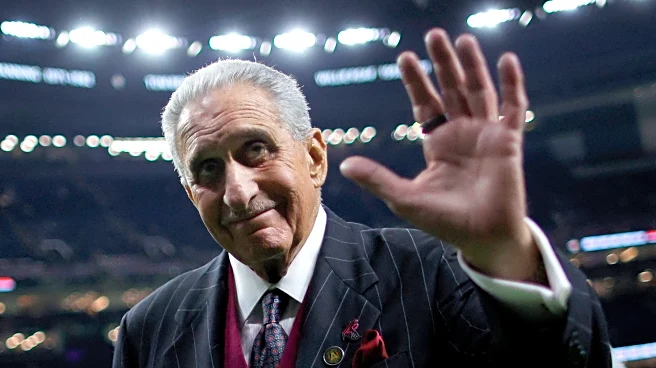
I bring this up now because the Falcons are at another pivot point, with Blank reportedly still deciding the fates of head coach Raheem Morris and general manager Terry Fontenot. He’s going to make a decision at season’s end, with at least some kind of unspecified changes to football operations on the table and the outside consulting firm Sportology doing a “health check” on the franchise’s operations, but we don’t have a real great sense of which way he’s leaning outside of Morris repeatedly talking about next year as though he’ll be here and a recent report from insider James Palmer that sources around the league expect the Falcons to move on.
Regardless of what that decision is, I’m going to once again urge Blank not to let it hinge on the final few games of this season. Here’s why.
We already did this in 2020
Remember the 2019 season? The Falcons started the year 1-7 before going 6-2 in the second half to finish the season at 7-9, the team’s second straight losing season. At the time, I was urging Blank to fire Dan Quinn because of how unbelievably sloppy and listless the team was, but for some strange reason the owner was not inclined to listen to me. The Falcons then surprised a good Saints team, beat a (at the time) 5-4 Panthers team and then beat them again at 5-7, impressively knocked off a great 49ers squad, stomped a crummy Jaguars team, and triumphed over a mediocre Bucs squad in overtime in the season finale to finish 7-9.
Despite the couple of quality wins, it seemed dangerous to believe that a team riddled with holes and prone to long stretches of infuriating football would be able to replicate that stretch the following year, and predictably the decision to keep Dan Quinn and Thomas Dimitroff led to a 0-5 start to 2020 before Blank mercifully pulled the plug. The mistake Blank had made, out of fondness for Quinn, a desire to believe in things like momentum, and some good old-fashioned recency bias, was imagining that the final eight games were more relevant than the eight games that came before them. That’s a larger sample size then I’ll be discussing for 2025 in this article, but the principle is very much the same.
There’s a real danger of that with these final few games, if Blank gives in to that temptation again. Say the Falcons beat the Rams in a stunner and knock off the Saints, finishing the season on a 4-0 run. You could look at that, in the face of Atlanta’s injuries and some renewed competence, and imagine that this was a reflection of who the team should have been all along. You could convince yourself, in other words, that the Falcons had Figured It Out.
The reason that would be a bad idea is fairly obvious. Blank has had Morris as a full-time head coach for 32 games now, and Morris is 14-18 in those games, with very few of the team’s persistent problems getting better over that span. The team has been slow to adjust to reality, from Cousins’ poor play imperiling the 2024 season to adjusting the offense to mitigate Darnell Mooney’s lost year and lack of receiver depth to Younghoe Koo’s implosion, and
To a lesser extent, the reverse would be true. If the Falcons lose these next two games, decimated as they are and facing a really tough primetime matchup and an always weird divisional battle, Blank should not go from leaning strongly toward keeping Morris to firing him based on a couple of games. Whether you’re looking at two games or four games, it’s a handful of data points that need to be considered, but should not be deciding factors. Teams that make decisions based on small sample sizes, like the Falcons over the past decade, tend to be teams that make major mistakes.
The team needs to take a big picture view
Consider the last decade. The Falcons have, as I wrote earlier this season, failed to understand their place in the NFL’s landscape and overall quality of their football operations and roster repeatedly over eight losing seasons. A large part of that failure has come because the Falcons appear to hyper-fixate on certain shortcomings, like the pass rush and special teams in 2025, quarterback in 2024 and (with a miss) in 2022, skill position players on offense (repeatedly, to the detriment of other needs, but certainly notably in 2020), and the offensive line in 2019. The net effect of that, and disastrous moves like clearing out the coordinators in 2019, is that the team repeatedly overlooks other needs and potential trouble spots that end up sinking them.
This isn’t to suggest that the Falcons can and should fix every possible problem every offseason—it’s not gonna happen, folks—but that their blind spots and half-measures have mixed in disastrous ways. It has also led them to push significant resources into singular fixes, which has borne real fruit in some instances (2019’s Chris Lindstrom and Kaleb McGary double dip, 2025’s Jalon Walker and James Pearce Jr. selections) and led to cratering fortunes in others (thus far Kirk Cousins and Michael Penix Jr. together in 2024, Hayden Hurst and Todd Gurley in 2020).
What’s necessary is a clear-eyed, deeply sober look at the top-to-bottom way this team functions, a look that insiders like Ian Rapoport have repeatedly said Blank is expected to take. That should include considering whether Rich McKay, who has been involved with this team basically since the day Arthur Blank bought it, should be involved at all in football operations given the team’s long playoff drought and back-to-back underwhelming hires. It should include a look at the front office, which has acquired some foundational pieces of the next great Falcons team while also repeatedly carving out depth and making risky, resource-intensive moves. It definitely will include considering whether this coaching staff is one the Falcons can win with, and if it’s determined the head coach is still someone the organization believes in, whether he can carry the same trio of coordinators into 2026. It should zoom out to consider the way the Falcons make football decisions, why so many of them have been failures over the past eight seasons, and whether the team needs to look at emulating more successful franchises or simply adjust slightly by, say, not always trading up in the NFL Draft.
Whether it’s personnel, process, or both, change is needed for the Atlanta Falcons. They’ve been one of the least successful franchises over the past decade, and like the Raiders, Browns, Cardinals, and Dolphins they find themselves keeping company with, they have no slam dunk path back to relevance. The talent level is a bit higher than many of the teams down in the basement with them—and certainly better than, say, the Saints—but they don’t have a for-certain franchise quarterback, have aging and fragmented position groups to address, and lack resources with limited cap space and no first or fifth round pick a year from now. There are hard decisions that have to be made, and unfortunately few guarantees any decisions will deliver immediate success.
What the Falcons can’t do is let these final two games influence them. If Morris and Fontenot’s roster pull off a couple of brilliant wins, you’ll need to weigh that against 32 other games, the same as you’d need to if they get smoked. Fans are going to be skeptical of this team until they start winning and justifiably so, but this franchise still owes it to those fans to be thoughtful and make a decision based on two years for Morris, five years for Fontenot, and over 20 years for McKay that considers what has been built and whether they’re the right men to build what’s coming next.